×
![woodturning]()

Trees Gallery - Breezy Knees
Warthill, near York.
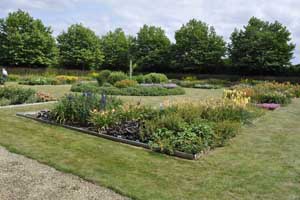
Breezy Knees
Breezy Knees started in 1999 when a framework of trees hedges and shrubs were planted in what was arable farmland. By 2006 these provided some shelter and borders began to be planted. Maintained by the equivalent of 2 full time gardeners. Lots of bark for mulching retains moisture in the sandy soil and reduces weeding. Marylen, Colin and Holly Parker.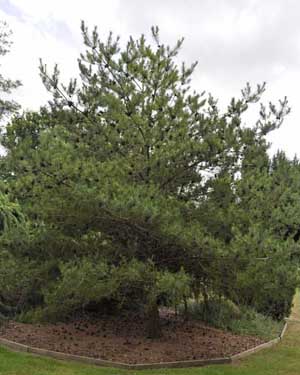
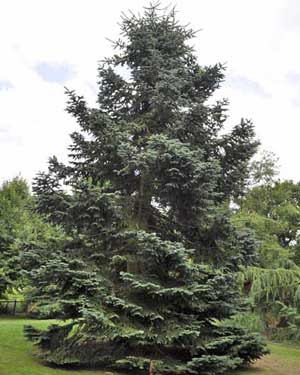
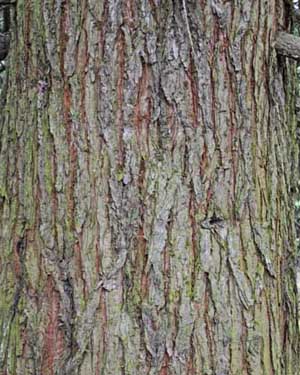
Pinus densiflora
Japanese Red Pine
The garden at Breezy Knees is divided into different areas, one of which is the conifer garden. Many of the specimen trees have labels on them, which identify the genus and species, though not the year of planting.
The Japanese Red Pine is native to Japan, Korea, NE China and southern Russia. This pine should eventually grow to 25 - 30 m tall. Closely related to the Scots pine.
Sequoiadendrum giganteum
Giant redwood
Not yet a giant, but growing steadily. This is the classic Wellingtonia or Californian redwood, growing to enormous heights in its native range - 100 m is possible, 50 m in Britain - and enormous girth. There was something of a craze for planting these in Victorian times, following their discovery in America in 1852.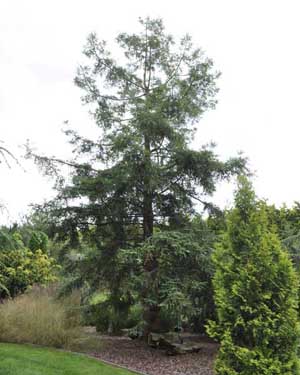
Sequoia sempervirens
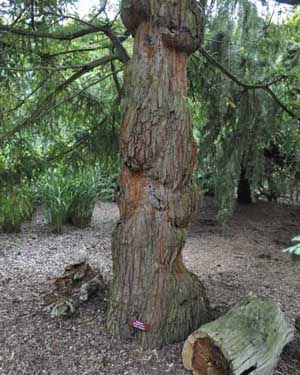
Coast Redwood
A variation from the standard giant redwood, this one can grow even taller, up to 115 m, but in Britain no more than 40 m. Less popular for planting in Britain than the giant redwood, but introduced earlier, in 1843. Native to California

Liriodendron tulipifera
Tulip Tree
Native to North America, introduced to Britain in the 17th century. We were too late to see the flowers (which appear in May - this is a member of the magnolia family) but the distinctive leaves give the identity away.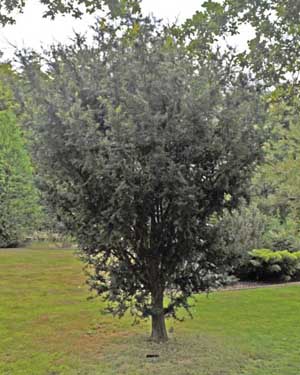
Taxus x media Hicksii
Anglo Japanese Yew
Hybrid of Taxus baccata and Taxus cuspidata. A smaller version of tree than either of its parents, often used for hedging, though this specimen is being allowed to grow and form a natural shape, which is a self-limiting 4 foot diameter and 20 feet in height. Probably hybridised in America in the 1900s. Named after American botanist Gilbert Henry Hicks (1861 - 99)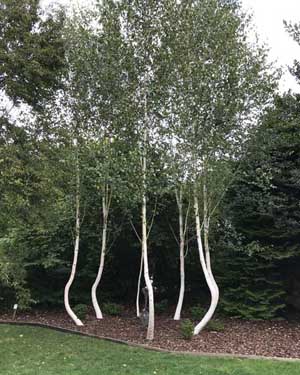
Betula utilis 'Jacquemontii' (?)
Himalayan birch
A fascinating circle of six birch trees, shaped to resemble a bulbous barrel. I am guessing these are Himalayan birch, Betulus utilis, probably 'Jacquemontii'. These are situated towards one end of the conifer garden.
Juniperus x pfitzeriana 'Sulphur Spray'
Juniper Sulphur Spray
In the conifer garden, a young juniper cross is spreading out. A bushy, evergreen conifer making a medium-sized shrub to 2m, with strongly ascending main branches. Foliage mostly scale-like, pale yellow.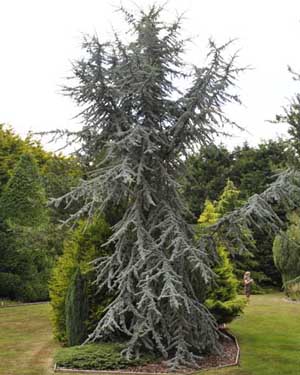
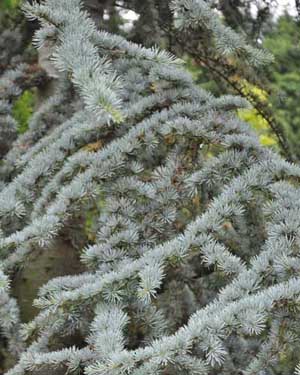
Cedrus atlantica glauca
Blue Atlas Cedar
A native of the Atlas mountains in Morocco. This "glauca" variety is a large blue-green spreading tree, with egg shaped cones. Typical growth in cultivation is 40 - 60 feet, growing around a foot per year.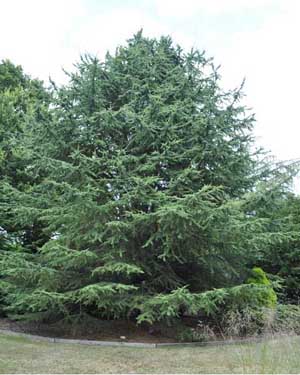
Cedrus atlantica
Atlas Cedar
A native of the Atlas mountians in Morocco. A large, evergreen tree, conical when young but broadening with age with horizontally-spreading branches and downy young shoots. Narrow, needle-like leaves to 3.5cm long are a dull green to grey-green colour. Barrel-shaped, erect cones ripen to brown and mature over two years, breaking up whilst still on the tree. There are also thin, papery male cones that grow on the same tree (it is monoecious male and female reproductive parts are on the same plant ).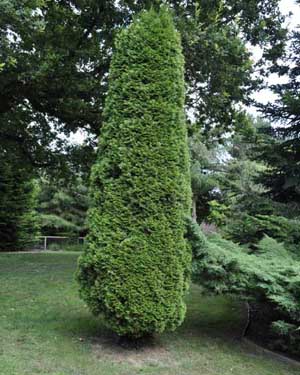
Thuja occidentalis Smaragd
White Cedar (Emerald)
Native to Eastern Canada and North East America, a small tree growing to 15 m. Slow growing evergreen conifer with glossy emerald green foliage. Conical habit. Popular for hedging and for ornamental planting in gardens. Tiny aromatic scale like leaves and small knobbly cones. Long lived - old specimens have been found which despite being relatively small and stunted were 1600 years old.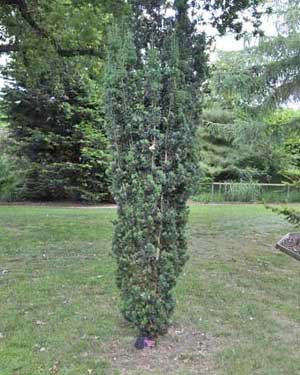
Taxus baccata fastigiata
Irish Yew
A mutant version of the common yew, found in County Fermanagh in the 1700s. It has a narrow, upright habit, and can grow to 7 m. Unlike common yew, the needles grow all around the twig, rather than in rows. Very commonly seen planted in churchyards.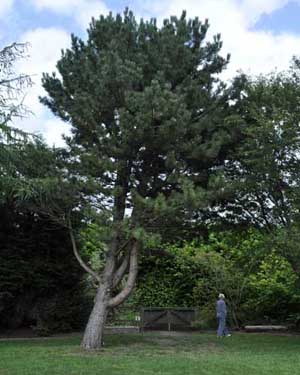
Pinus nigra
Austrian Pine
Also called the black pine. A native of the coastal areas of south eastern Europe, but planted in Britain in graveyards and for forestry. Fast growing and long lived - 500 years is not uncommon. Can grow to 50 m tall and 14 m wide.
Abies nordmanniana
Caucasian Fir
Also know as the Nordmann fir (after the Finnish zoologist Alexander von Nordmann (1803 - 66). Very popularly grown as a Christmas tree, as it retains its needles even when cut. A native of the mountains of Turkey, Georgia and the Russian Caucasus. Can grow to 60 m or more, with a trunk diameter of 2 m.