
Trees Gallery - Woodland plants
Winter aconite
February 2023Wykeham
Winter Aconite, eranthis hyemalis, flowers a little earlier than the more familiar snowdrop. Very low growing, it produces a single yellow flower. It grows best on moist soils rich in leaf mould and prefers deep shade or semi-shade.
Snowdrop
February 2023Thornton le Dale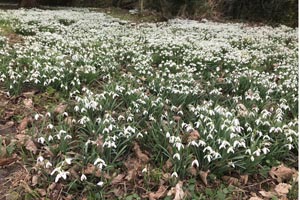
Snowdrops, galanthus nivalis, favour damp soil and are often found in broadleaved woodland and along riverbanks, but can also be seen in parks, gardens, meadows and scrub. They are not native to the UK, first recorded in the wild in the late 18th century. Their native range is mainland Europe.
Daffodils
March 2022Farndale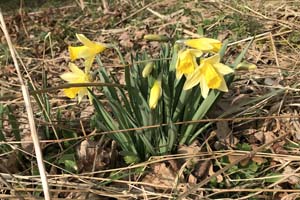
The wild daffodils at Farndale are very famous, and the walk along the river from Low Mill to the "Daffy Cafe" at Church Houses attracts large numbers of visitors every spring.
Sweet violet
March 2023Thornton le Dale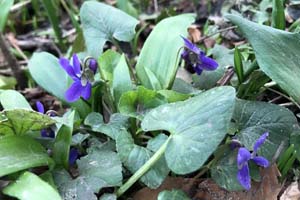
This is a sweet violet, violet odorata, with a strong scent, rounded sepals and a spur which is the same colour as the petals, and no groove along it. These all distinguish it from the unscented dog violet (pointed sepals) and wood violet.
Dog's mercury
April 2022Acorn Bank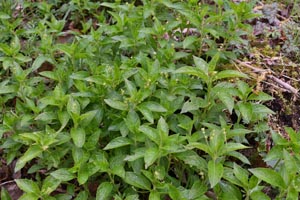
Dog's mercury, mercurialis perennis, green flowers and green leaves, creeping plant that indicates long established woodland. Dog in this case means bad as the plant is poisonous.
Wood anemone
April 2023Acorn Bank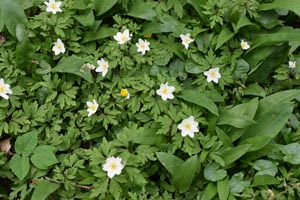
Wood anemone, anemone nemorosa, is one of the first spring blooms, arriving to take in the light through the leafless canopy in broadleaf woodland. Old and ancient woodland suits their slow growth. Basal leaves, white petals with a pinkish tinge. Many distinct yellow anthers.
Comfrey
April 2023Hutton in the Forest
Comfrey, symphytum officinale, is a hairy plant of damp ground and is found beside rivers, in fens and ditches, and on roadside verges and waste ground. It often grows in clumps and displays clusters of bell-shaped, pinky-purple flowers.
Few-flowered garlic
April 2023Thornton le Dale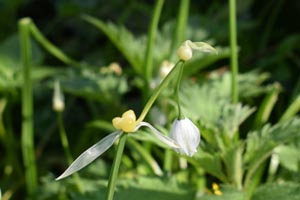
Few flowered garlic, allium paradoxum, is a non-native invader that can colonise woodlands, particularly on their margins. It produces a clutch of small yellow bulbils at the end of its stem, usually with just one white bell-shaped flower suspended on a drooping stalk. The leaves have the characteristic onion smell if pinched.
English bluebells
May 2021Low Force, Teesdale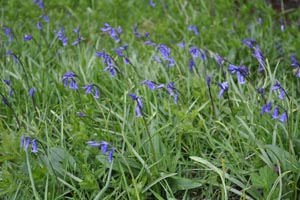
English bluebells, hyacinthoides non-scripta, has differences to the Spanish invader, which has spread in recent years. On the Spanish flower, the bells are all around the stem, not just on one side, which gives the English bluebell its drooping stature.
English bluebells
May 2016Newmillerdam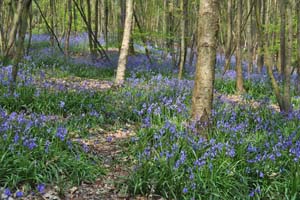
English bluebells growing in the woods by Newmillerdam, Wakefield. The English bluebell is a deeper blue than the Spanish one, which is a delicate shade of pale blue. Spanish can tolerate sunshine and happily grows in open spaces, whereas the English bluebell prefers at least partial shade and is never found growing in open spaces. Spanish flowers lift their heads towards the sun. English never do.
Cowslips
May 2021Low Force, Teesdale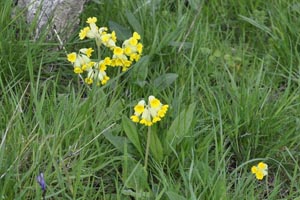
Cowslips, primula veris, by the river bank at Low Force, Teesdale. Simple yet lovely, cowslips are synonymous with spring and Easter. Found in woods and meadows during springtime.
Greater stitchwort
May 2021Stanwick Iron Age Fort
Greater stitchwort, Stellaria holostea, has white flowers and can reach up to 50cm in height. It has five white petals, each of which is split half-way, giving the appearance of 10 petals. The flowers are usually 2–3cm in diameter, with an explosive seed-dispersal mechanism.
Red Campion
May 2021Stanwick Iron Age fort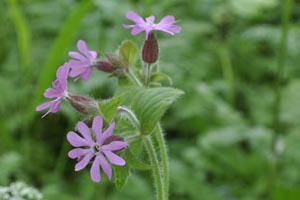
Red campion, silene dioica, is a medium tall perennial or biennial plant with a downy stem. It grows in lightly shaded areas in woodland, along hedgerows, in fields, ditches and roadsides. Ann ancient woodland indicator, it may give a clue to the age of a wood.
Wild garlic
May 2022 Thornton le Dale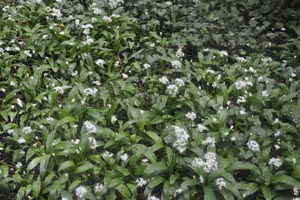
Wild garlic, allium ursinum, a medium-sized bulbous perennial with a distinctive and pungent garlicky smell that pervades woodland in spring. Found in shady woods where they coat the woodland floor.
Leopard's bane
May 2021 Ushaw Gardens, Durham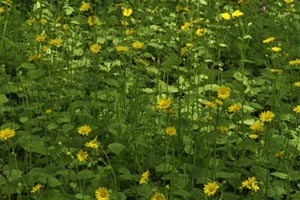
Leopard's bane, doronicum orientale, with daisy like yellow flowers 2.5-5cm across on slender stems in mid and late spring. A slow-spreading, rhizomatous perennial, probably an escape from cultivated gardens, as doronicum is not a UK native.
Hogweed
June 2021Thornton le Dale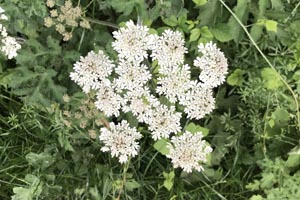
Hogweed, heracleum sphondylium, is a native plant (unlike its alien relative, giant hogweed) which is abundant in hedgerows, roadside verges, waste grounds and rough grasslands. It has large, umbrella-like clusters of creamy-white flowers between May and August (although it can flower all year-round).
Cranesbill
June 2021 Thornton le Dale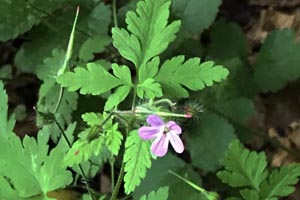
Cranesbill, or Wild Geranium, Geranium maculatum, is a woodland rhizomous perennial that readily spreads, forming flowering patches that bees and butterflies can’t resist. The elongated seedpod resembles a beak, giving the cranesbill name.
Woodruff
June 2021 Ellerburn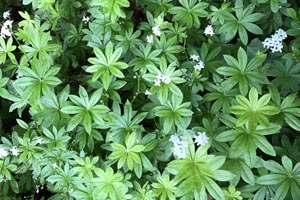
Sweet woodruff, galium odoratum, or sweetscented bedstraw, is a flowering perennial plant in the family Rubiaceae, growing to 12–20 in long, often lying flat on the ground or supported by other plants. It owes its sweet smell to the odoriferous agent coumarin.
Oak seedling
June 2022Ellerburn Bank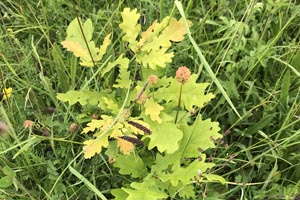
Mighty oaks from little acorns grow. This 8 inch high seedling was poking through the grass in the nature reserve meadow at Ellerburn Bank, Dalby Forest.
Foxglove
June 2022 Pexton Moor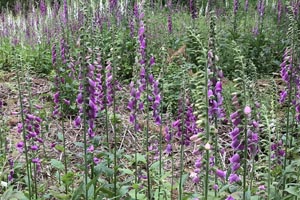
Foxglove, digitalis purpurea, is a perennial or biennial, and produces a spike of purple-pink flowers between June and September. It can grow up to 2m tall and is found in heathland, woodland edges and gardens. A valuable source of nectar for bees.
Bee orchid
June 2022Ellerburn Bank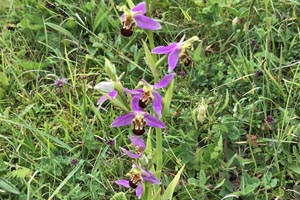
The bee orchid, ophrys apifera is a sneaky mimic - the flower’s velvety lip looks like a female bee. Males fly in to try to mate with it and end up pollinating the flower. Sadly, the right bee species doesn’t live here, so this orchid is self-pollinated in the UK.
Common spotted orchid
June 2022Ellerburn Bank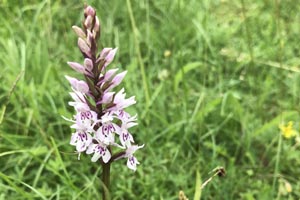
The common spotted-orchid, dactylorhiza fuchsii, is the easiest of all our orchids to find: sometimes they create a pale pink carpet in our woodlands, old quarries, dunes and marshes. "Spotted" because of spots on the leaves. Flowers range from white to purple.
Ladies bedstraw
June 2022Pexton Moor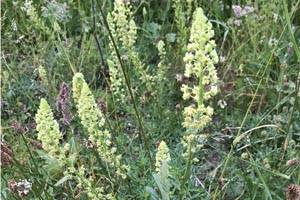
In summer, the 'frothy' flowers of lady's bedstraw, galium verum, can carpet the grasses of meadows, heaths and coasts with yellow and fill the air with a sweet, honey-like scent.
Trailing bellflower
July 2023Thornton le Dale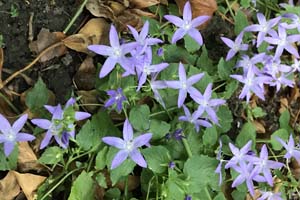
A small bright blue patch of flowers growing in the woods by Dog Kennel Lane in Thornton le Dale. A garden escape, this is campanula poscharskyana, trailing bellflower. A neophyte, first cultivated in 1931, first recorded in the wild in 1957. Populations arise from seed and stem fragments, which root readily, and more occasionally from garden throw-outs.
Autumn crocus
September 2022Beningbrough Hall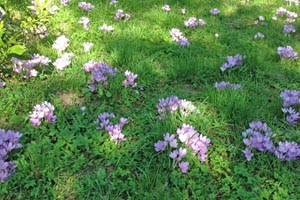
Autumn crocus, colchicum autumnale, is a cormous perennial herb often found in clearings and rides within woodland, as it is toxic to livestock and often destroyed when found in grazed situations. Not a true crocus. Also called "Naked ladies" because the flowers appear before the leaves. Native to UK.
Mistletoe
October 2014Baddesley Clinton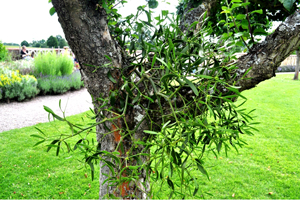
Mistletoe, viscum album, is a small semi-parasitic shrub with sticky white berries. It is found in apple, lime and poplar but has also been recorded on blackthorn, hawthorn, rowan and willow. Mistletoe can produce some of its own food via photosynthesis but takes minerals and water from the host tree.
Purple toothwort
April 2024Yorkshire Arboretum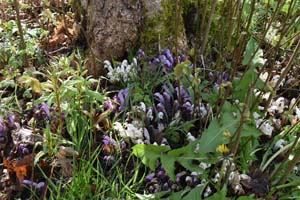
Purple toothwort, lathraea clandestina, is a holoparasite plants that are not capable of photosynthesis and obtain all nutrients and water from a host plant The subterranean part, which can weigh several kilograms, consists of white stems covered with fleshy scales. Seeds can be projected some distance into the surrounding area.