
Trees gallery - Hidcote
Gloucestershire
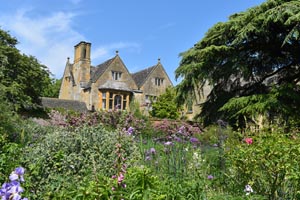
Hidcote Manor is an arts and crafts house, and the garden was created by Major Lawrence Johnston, an American who took British nationality in 1900. His mother, Mrs Winthrop, bought Hidcote in 1907, and Johnston spent the next 40 years developing the gardens. He donated it to the National Trust in 1948.
There were not many trees labelled, so only a couple of pages of photos from this visit. I have identified some from the garden guide and internet research, and others with some help from Hidcote gardener Richard Marshall. A garden map may help with some of the references to positions of the trees. An alternative map is also available.

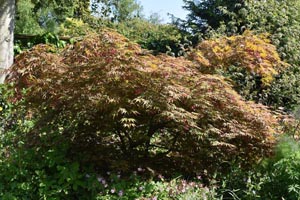
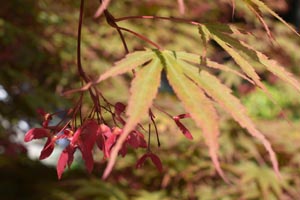
Acer palmatum dissectum
Acer group
A group of acers near the house in the 'maple garden'. Not sure of the specific varieties, but the deep purple one at the back could be 'Bloodgood', and the beautiful salmon-pink could be 'Katsura'.
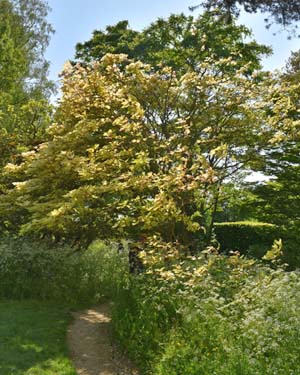
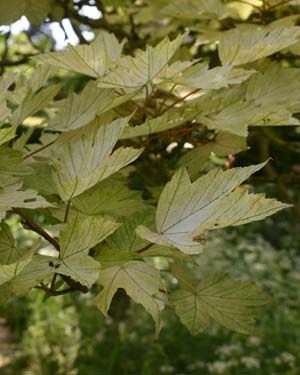
Acer pseudoplatanus brilliantissimum
Japanese maple 'Brilliantissimum'
This is a popular acer cultivar, a relatively small, slow-growing tree well suited to gardens. This one is quite tall for its type. It has bright salmon-pink leaves in spring, which gradually turn through bright yellow-green to a darker green. Bright red samaras a type of fruit in which a flattened wing of fibrous, papery tissue develops from the ovary wall in autumn .
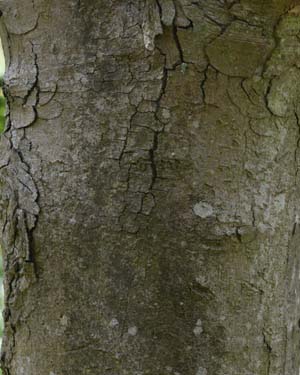
Acer griseum
Paper bark maple
Native to China, a popular introduction to gardens on account of its attractive exfoliating loss of skin (bark) papery bark, and for the typical multi-coloured show of turning leaves in autumn. A deciduous, androdioecious bearing only male flowers on some plants and either bisexual or both male and female flowers on other plants medium sized tree - this specimen is much taller than usually seen, at least 10m.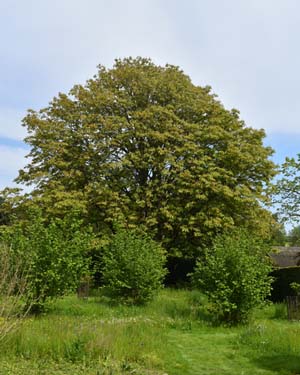
Aesculus indica
Indian horse chestnut
Also known as the Himalayan horse chestnut, a broad-leaved deciduous tree growing to 15m. Flowers are hermaphroditic containing both the male and female floral organs: pistils and stamens and with plentiful white blossoms during May and June pollinated by bees.Elsewhere in the garden (lower stream), is another specimen, which is the girth county champion for Gloucester. The one pictured here is noted by The Tree Register as a 'remarkable tree'.
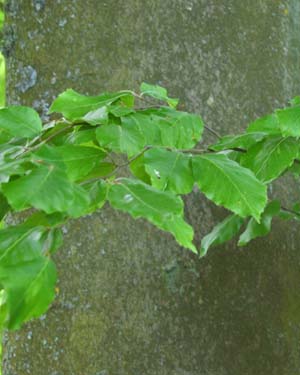
Fagus sylvatica
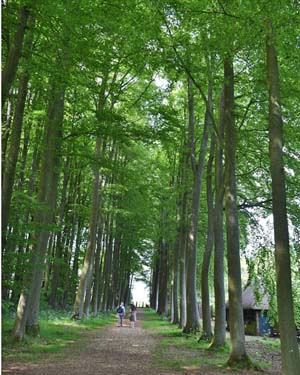
Beech Allée
A line of tall beech trees behind the tennis court, known as an allée (a path or alley lined with tall trees). The common beech is native to Europe, and a late colonizer of Britain where it is considered native certainly in the South East. It can grow to 50m, though 30m is more likely.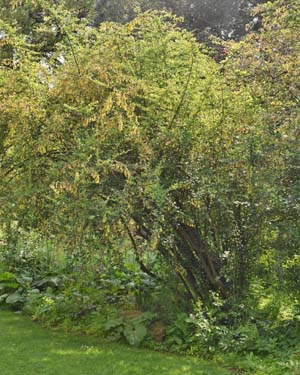

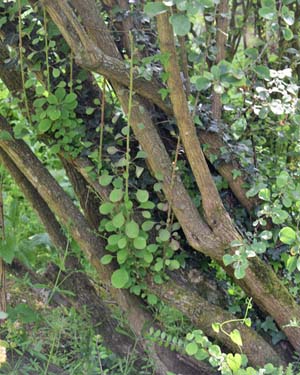
Berberis asiatica
Asian barberry
The berberis genus includes deciduous and evergreen shrubs from 1–5 m tall, found throughout temperate and subtropical regions of the world (apart from Australia). This species (asiatica) is native to the Himalayas (Nepal), is evergreen, hermaphrodite, containing both the male and female floral organs: pistils and stamens flowers in May and is pollinated by insects. It has a medium growth speed, reaching 4m over time. It has many medicinal uses, particularly from its roots.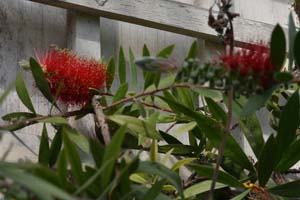
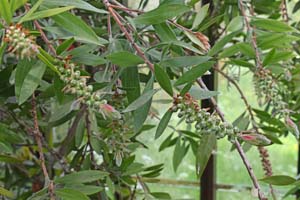
Callistemon
Bottlebrush
Just breaking into flower, revealing the reason for its common name of bottlebrush, with bright red cylindrical spiked flowers. A native of Australia.

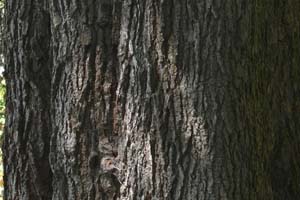

Cedrus libani
Cedar of Lebanon
An iconic feature of Hidcote, the great domed tree near the house is a distinctive feature of so many photos of the gardens. There are others on the estate, perhaps less beautifuly framed, such as the one on the left here. Flat branch ends and spreading habit help to distinguish it from the Atlas cedar (upward pointing branches) and the deodar (drooping branches). However this is only a guide - the famous cedar above does have drooping branches, no doubt due to the weight being carried. I wonder if the shape is completely natural, or whether any pruning has taken place?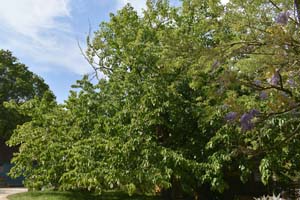
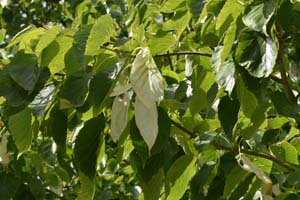
Davidia involucrata
Handkerchief tree
Also called dove tree, laundry tree and ghost tree, this is native to woodlands in SW China. Deciduous. Tiny flowers are out-performed by large oval-rounded white involucre bracts a ring of modified leaves around the small flower . Flowers are followed by round, greenish-brown, golf ball-sized fruits on 2-3” stems.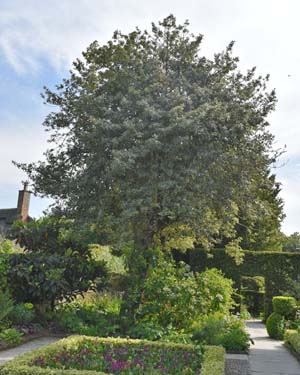
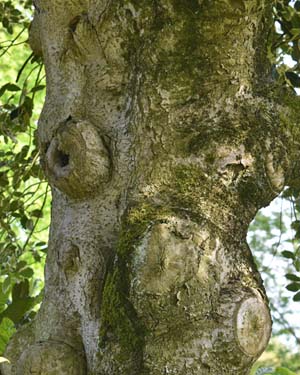
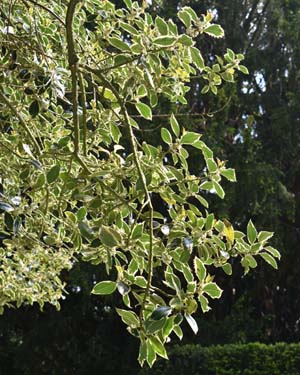
Ilex aquifolium argentea marginata
Variegated holly
A large holly growing in the east courtyard by the manor house. This is the girth county champion for Gloucestershire (Tree Register 2017)