×
![woodturning]()

Trees Gallery - Dawyck Botanial Gardens. Page 1
Near Peebles, Scottish Borders
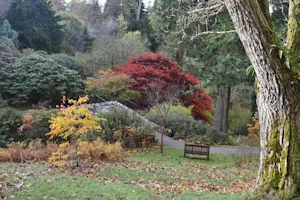
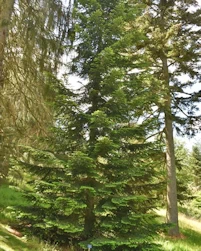 August 2024
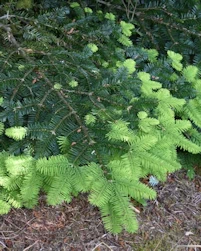 August 2024
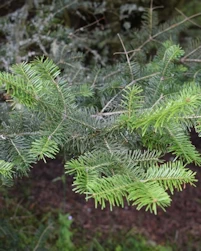
Abies amabilis abies - from L. abeo - to rise, to go up; amabilis - lovely or attractive
Pacific silver fir
A.k.a. Cascades fir, Red Fir, White fir, native to Alaska and N California, growing to 80 m. The cones are 8–17 cm long,dark purple before maturity. The brownish winged seeds are released when the cones disintegrate at maturity about 6–7 months after pollination. The tree can live to over 400 years oldThis tree is sometimes used as a Christmas tree or for Christmas decorations.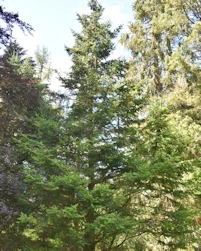 August 2024
 August 2024
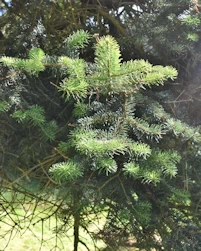
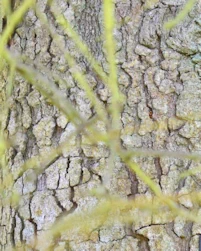
Abies balsamea abies - from L. abeo - to rise, to go up; balsamum, referring to the resinous sap
Balsam fir
A small to medium-size evergreen tree, native to most of E and C Canada and NE United States, growing to 20 m. The bark on young trees is smooth, grey, and with resin blisters, becoming rough and fissured or scaly on old trees. The seed cones are erect, dark purple, ripening brown and disintegrating to release the winged seeds in September. The bark on young trees is smooth, grey, and with resin blisters, becoming rough and fissured or scaly on old trees. August 2024
 August 2024
 August 2024
Abies cephalonica abies - from L. abeo - to rise, to go up; cephalonica - derives from the Greek island of Kefallonia, where the tree was first identified
Greek fir
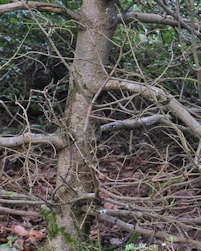
A medium-size evergreen coniferous tree growing to 35 m, native to the mountains of Greece, closely related to Nordmann fir. Large cones are 10–20 cm long with 150–200 scales, each scale with an exserted bract and two winged seeds; they disintegrate when mature to release the seeds. In the past the wood was used for general construction, but it is too rare to be of significant value now.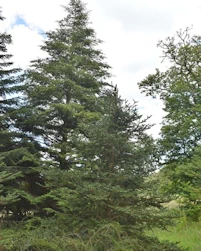 August 2024
 August 2024
Abies forrestii abies - from L. abeo - to rise, to go up; forrestii -after Scottish plant hunter George Forrest
Forrest's fir
A.k.a. Chuandian Lengshan. A species of conifer native to China, growing to 20 m. This species is variable in morphology, and there are several varieties. Some of these are treated as separate species. The needles are 1.5 to 4 cm long, and as the needles rise up to form a 'V' above the shoots their white undersides are exposed, creating a silvery hue from a distance. Purplish, brown, or black cones are 7 to 12cm long. The timber is used for construction and pulp.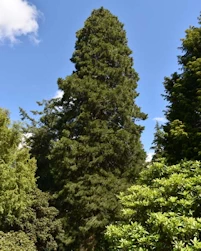 August 2024
 August 2024
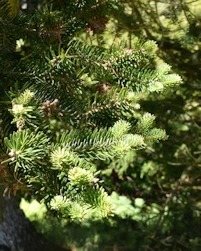
Abies grandisabies - from L. abeo - to rise, to go up, grandis - large
Grand fir
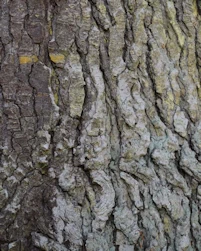
The David Douglas Tree Trail label says: The grand and the great. Grand firs often grow alongside Douglas firs in wild British Columbia. Here, this replica of a natural relationship clearly suits this agnificent tree. Since being planted in 1870, it has rapidly grown to become the tallest in the entire garden. Standing over 50 m high, the trunk has a diameter of over 1.8m. It took David Douglas eight months to ravel from Scotland to a wind-swept beach at the mouth of the great Columbia River. Duriing his epedition upstream he saw vast groups of the giant conifers for the very first time.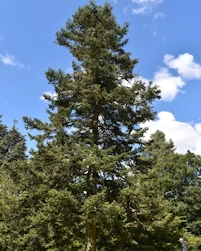 August 2024
 August 2024
 August 2024
Abies holophylla abies - from L. abeo - to rise, to go up, holos - whole, entire; phyllon -leaf (Greek).”
Needle Fir
A.k.a. Manchurian fir, an evergreen coniferous tree growing to 30 m, native to mountainous regions of N Korea, S Ussuriland, and China. The cones are 12–14cm long, yellow-brown, and slightly tapering with a bluntly rounded apex. The scale bracts are hidden under the cone scales. The seeds have a wedge-shaped wing; they are released after the cones disintegrate at maturity in October.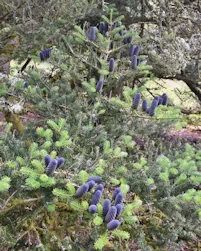 August 2024
 August 2024
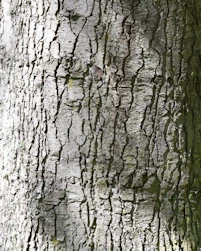
Abies Koreana abies - from L. abeo - to rise, to go up, koreana - from Korea
Korean fir
Compact evergreen conical tree to 18 m, native to the higher mountains of S Korea, with thick dark green needles, slightly notched at the tip, with white bands of stomata beneath. The cones are cylindrical blue or purple cones, some with protruding green or yellow bracts, often borne on young trees. The leaf arrangement is spiral on the shoot, but with each leaf variably twisted at the base so they lie mostly either side of and above the shoot, with fewer below the shoot. August 2024
 August 2024
 August 2024
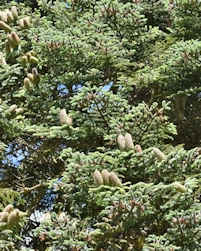
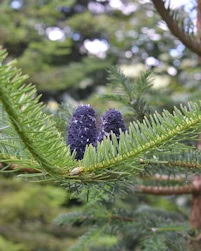
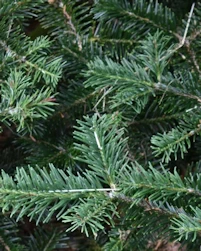
Abies procera abies - from L. abeo - to rise, to go up; procera - tall or long
Noble fir
The Majestic Tree Trail label says: Noble fir is restricted to the Cascade Mountains of Oregon and Washington. This large conifer was discovered in 1825 by the Scottish plant hunter David Douglas. In Scotland the noble fir thrives in wet conditions and poor acidic soils. As a result it has come to be an important component of plantation forestry in western Scotland. A form with blue needles is a popular garden ornamental.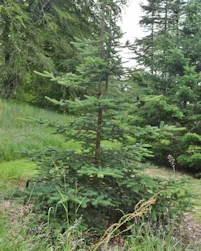 August 2024
 August 2024
 August 2024
 August 2024
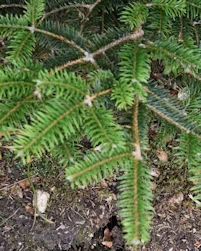
Abies recurvata ernestii abies - from L. abeo - to rise, to go up; recurvata - curved back, ernestii - after botanist Ernest Henry Wilson
Min fir
A.k.a. Minjiang fir, a small to medium-sized tree mostly with conical crown, occasionally reaching a height of 40 m, found only in China, where its wild population is classed as vulnerable. It was heavily exploited until recently when the Chinese government finally decided to preserve its remaining old growth forests in the western provinces. Its timber was used mainly for construction and carpentry work. Its bark is smooth grey or rusty brown, at first shedding in thin plates, becoming greyish-brown and detaching in thick plates with age. The variety a. ernestii was introduced to cultivation when Ernest Wilson sent material from Sichuan in 1903.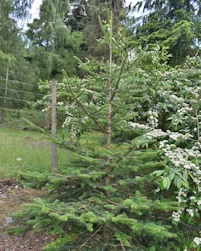 August 2024
 August 2024
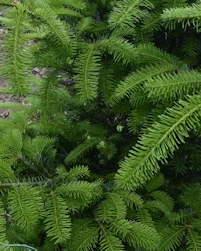
Abies squamata abies - from L. abeo - to rise, to go up; squamatus - scaly, referring to the flaky, distinctive bark of the tree.
Flaky fir
The Majestic Tree Trail label says: Flaky fir is a high mountain conifer from western China. With populations extending as high as 4,500 m, this tree forms some of the highest altitude forests known. Although the inaccessibility of this species makes logging difficult, slow recovery from such activity means that this species is regarded as 'Vulnerable' according to the IUCN Red List of Threatened Plants International Union for Conservation of Nature. . The Chinese Government has now placed a ban on further logging.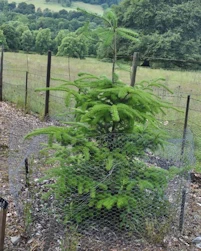 August 2024
 August 2024
Abies veitchiiabies - from L. abeo - to rise, to go up; veitchii - after British horticulturalist John Gould Veitch
Veitch's fir
A.k.a. Veitch's silver-fir, a coniferous evergreen tree growing at a fast rate to 25–30 m, native to Japan from the islands of Honshū and Shikoku. The cone is purple-brown, cylindrical, 4–7 cm long and tapers slightly. The cones are upright and have slightly exserted and reflexed yellow-green bracts. The bark is smooth and light grey, and has resin blisters characteristic of many firs. There are two varieties - this one, which is A. veitchii var. veitchii, and a. veitchii var. sikokiana (Nakai) Kusaka. The wood is sturdy and elastic, and is used in construction, boxes, utensils, and spindles.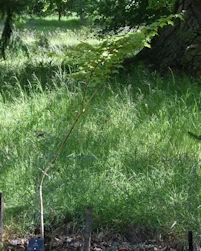 August 2024
 August 2024