×
![woodturning]()

Trees Gallery - Himalayan Garden
Grewelthorpe, near Ripon

The Himalayan Garden
Grewelthorpe, near Ripon
45 acres of woodland gardens, lakes and a young arboretum, dotted with a huge variety of contemporary sculptures by both local and international artists. Inspired by the Himalayas, the park is home to one of the North’s largest collections of rhododendrons, azaleas and magnolias. We visited in late June 2024.
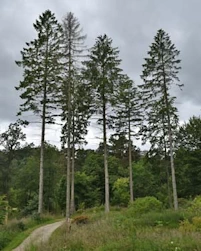
Abies alba
Silver fir
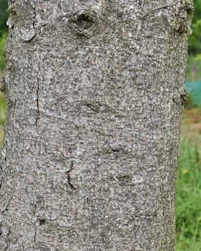
A.k.a. European silver fir, native to the mountains of Europe. A large evergreen coniferous tree growing to 40–50 m and girth to 1.5 m. Needles are flattened, thick, glossy dark green above, and with two greenish-white bands of stomata below. Needles are is usually slightly notched at the tip. The cones are 9–17cm long with about 150-200 scales, each scale with an exserted bract and two winged seeds; they disintegrate when mature to release the seeds. The wood is white, leading to the species name alba.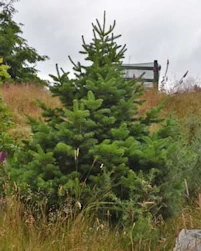
Abies Lasiocarpa Day Creek
Rocky Mountain fir
A.k.a. subalpine fir, Western Balsam Fir, Sapin Subalpina, a W North American, medium-sized evergreen conifer with a very narrow conic crown, growing to 20m, exceptionally 40–50m. with a trunk up to 1m thick, exceptionally 2.1m. The bark on young trees is smooth, grey, and with resin blisters, becoming rough and fissured or scaly on old trees.] The leaves are flat and needle-like, glaucous green above with a broad stripe, and two blue-white stomatal bands below; fresh leaf scars are reddish, arranged spirally on the shoot. The cones are erect, dark purple with fine yellow-brown pubescence, ripening brown and disintegrating to release winged seeds in early autumn.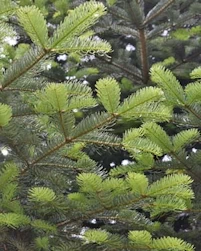
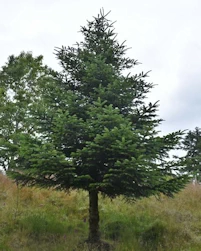
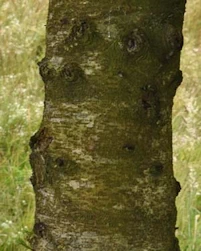
Abies Nordmannii
Nordmann Fir
A.k.a. Caucasian fir, native to an arc of mountains around the eastern Black Sea. A large evergreen conifer capable of reaching 60m. Very popular as a Christmas tree due to its habit of holding it needles for many weeks after cutting.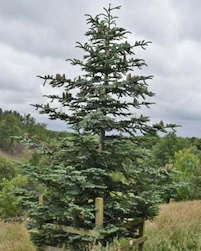
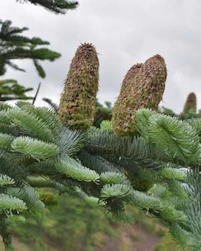
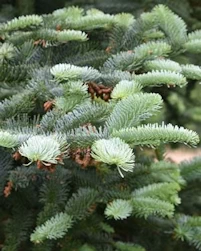
Abies procera
Noble fir
A native of NW USA. A large evergreen conifer with a narrow conic crown, growing up to 70m tall with 2m trunk diameter. The bark on young trees is smooth and grey with resin blisters, becoming red-brown, rough and fissured on old trees. The species can grow for up to 200 year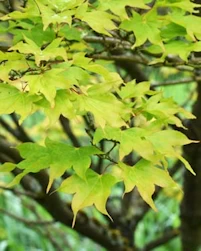
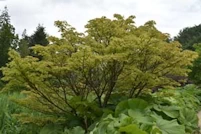
Acer
Maple
There are so many maples that without a definitive label it is difficult to name them. Even gardens with a rigorous labelling policy sometimes just use acer spp. or acer palmatum. This one could be acer cappadodicum 'aureum' given the pointed ends of the leaf and yellowish colouring.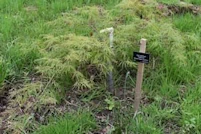
Acer palmatum dissectum
Japanese maple
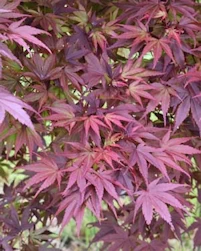
A slow growing, mound forming shrub or small tree, prized for its deeply dissected leaves which can almost look as if they have been shredded. Varieties can have deep purple foliage (purpureum) or deep red (garnet) or many colours in between.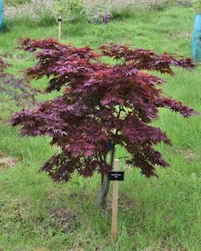
Acer palmatum Pixie
Japanese maple
A small, upright, slow-growing tree ultimately to about 2.5m tall and 2m across. Small green flowers in spring are followed by winged, red fruit in autumn. [RHS]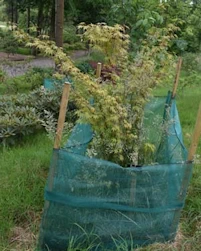
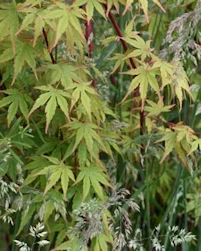
Acer palmatum sango kaku
Coral bark maple
A Japanese maple cultivar, capable of growing to 6m. The bark on all its younger shoots and branches is a conspicuous coral red. Acer palmatum 'Sango-kaku' is the most well known Coral Bark Maple tree, renowned for its striking coral pink-red stems. Producing pink young growth and yellow/orange, deeply lobed new foliage in the spring, the leaves turn a lush green in summer and then a pretty soft yellow in autumn.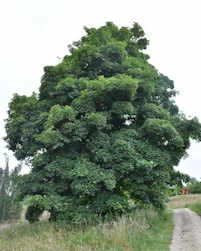
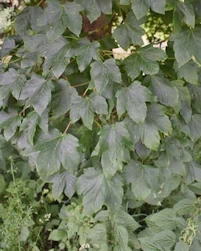
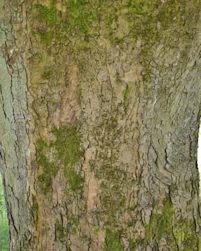
Acer pseudoplatanus
Sycamore
These broadleaf trees can grow to 35m and live for 400 years. Twigs are pink-brown and hairless. Small, green-yellow flowers hang in spikes, or 'racemes'. After pollination by wind and insects, female flowers develop into distinctive winged fruits known as samaras.

Acer rubrum 'October Glory'
Red maple
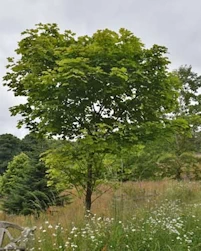
A large deciduous tree with erect main branches. Leaves are 3-lobed, dark green above, whitish beneath, turning shades of scarlet red, orange and yellow in the autumn; holding on to its leaves quite late. Small crimson flowers appear during the spring followed by winged green fruits.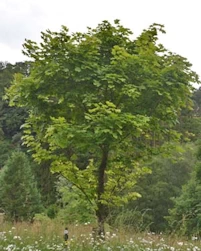
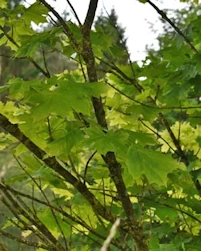
Acer saccharinum
Sugar maple
A.k.a. rock maple, sweet maple, or hard maple, a deciduous tree reaching 25–35m, native to E Canada and E USA. Best known for being the primary source of maple syrup, and for its brightly colored autumn foliage. Timber from it includes birds-eye maple and curly maple. Flowers grow in early spring in panicles of five to ten together, yellow-green and without petals. The fruit is a pair of samaras a winged achene, a type of fruit in which a flattened wing of fibrous, papery tissue develops from the ovary wall .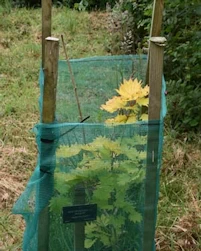
Acer shirasawanum aureum
Golden full moon maple
A.k.a. Shirasawa maple, a deciduous large shrub or small tree growing 8–15m, native to Japan. The bark is smooth on both young and old trees. The shoots are slender, and hairless. The flowers have five dark purplish-red sepals, five small whitish petals (soon lost), and red stamens; they are andromonoecious male (staminate) and hermaphrodite (bisexual) flowers are on the same plant , produced 10–20 together in erect terminal corymbs in early spring soon after the leaves appear. The fruit is a paired samara a winged achene, a type of fruit in which a flattened wing of fibrous, papery tissue develops from the ovary wall , erect above the leaves, bright red maturing brown. [Wikipedia]
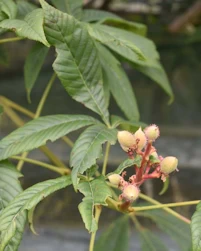
Aesculus bushii
Bush's chestnut
A naturally occuring hybrid between A. glabra and A. pavia, originating in S USA. They form small, low-spreading trees to 8–10m. Such hybrids typically have yellow, pink or red flowers (different coloured flowers can occur within the same inflorescence) with exserted sticking out, protruding (the opposite of inserted) stamens, petals of unequal size with glandular margins, and capsules with an irregularly spiny surface.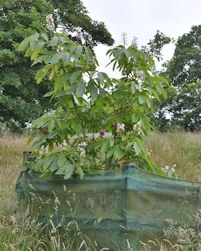
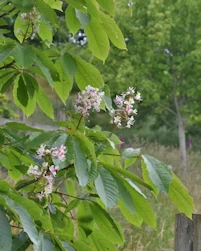
Aesculus indica 'Sydney Pearce'
Indian Horse Chestnut
The species is native to the N.W. Himalayas, reaching 30m. It often has a short, enormously thick trunk, the bark in old specimens peeling off in long strips. ; winter buds resinous. Flowers are in erect panicles erect, 30 - 40cm long, with four white petals, with a blotch of yellow and red at the base. The Fruit is rough, but not spiny. 'Sydney Pearce' is a selected form, very free-flowering, with flowers more richly coloured than in the common run of seedlings and arranged in a denser spike. The parent tree grows at Kew, planted around 1935. It flowers in June and July, at least one month later than the common one.
Aesculus neglecta erythroblastos
Horse Chestnut
A cloned hybrid with parents A. flava and A. sylvatica, rather slow-growing to 6m, a broadly columnar tree. Pointed, finely toothed leaves start to unfold in April, a vivif shrimp-pink, later yellow then dark green, turning into striking shades of orange and red in autumn. Small creamy white flowers are flushed pink which appear in upright panicles in May. Fruits are seldom formed.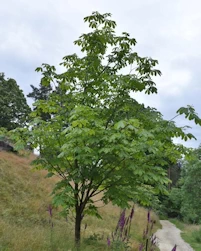
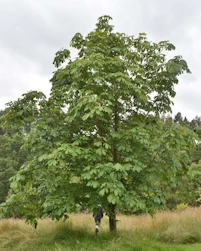
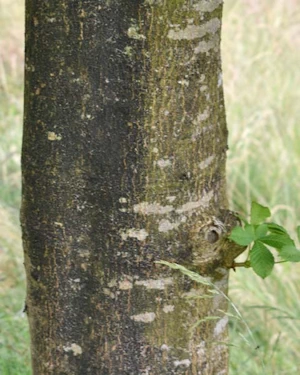
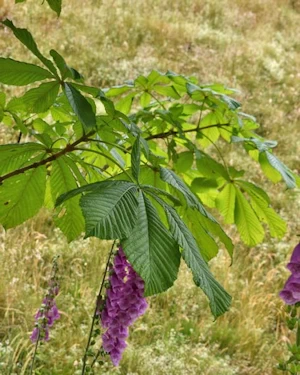
Aesculus turbinata
Horse Chestnut
A large tree native to Japan growing to 30m. The seeds were traditionally eaten, today they are used in Japanese cuisine to prepare tochimochi a horse chestnut rice cake that is made by boiling seeds and sticky rice together. Flowers are in erect panicles, white to pale yellow with red spots. They appear two or three weeks later than those of common horse-chestnut. Fruits are without spines, but rough, and broadly pear-shaped, one of the features that distinguish it from the common horse chestnut and its conkers.