×
![woodturning]()

Trees Gallery - Himalayan Garden
Grewelthorpe, near Ripon
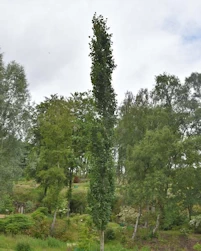
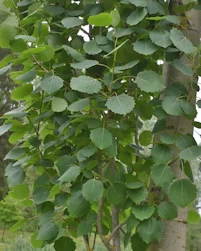
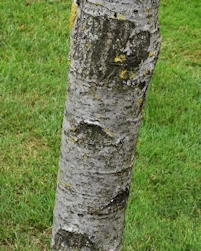
Populus tremula
Aspen
A.k.a. quaking aspen, this is a beautiful tree with shimmering foliage. Mature trees grow to 25m. The uppermost branches are sometimes bent over horizontally. Twigs are dark brown, slender and shiny. Aspens are dioecious male and female flowers (catkins) – which appear in March and April – grow on different trees . Male catkins are brown and around 12cm long, turning yellow with pollen when ripe. Female catkins start out green before developing into fluffy fruits. [Woodland Trust]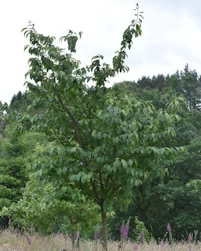
Prunus sargentii Charles Sargent
Flowering cherry
A round-headed deciduous tree growing to 15m. The elliptic, tapered dark green foliage is red-flushed as it emerges, then green in summer, and turns bright red before falling in autumn. A profusion of pale pink flowers are produced in spring; these are followed by small cherry-like, dark red fruits.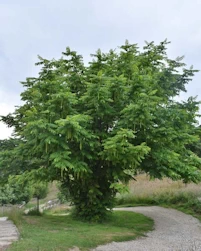
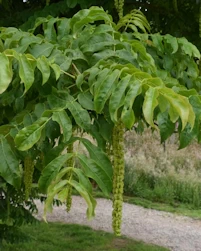
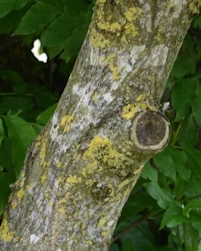
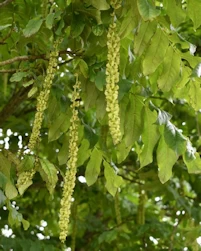
Pterocarya fraxinifolia
Caucasian Wingnut
A fast growing monoecious male and female flowers grow on different trees. tree growing to 30m, the short, thick bole supporting widely spreading branches to form a rounded structure, not unlike the wych elm. The . The flowers appear in April, the male catkins thick and green, 7.5–12.5cm long, the females longer with less dense flowers, bearing red styles forming fruiting catkins 30–50cm long. The green, winged, nuts are approximately 1.8 cm wide.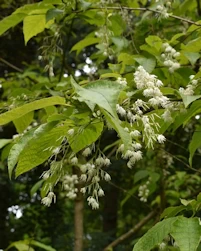
Pterostyrax hispidus
The epaulette tree
A spreading deciduous large shrub or tree native to China and Japan, growing to 12m. Leaves are ovate, growing to 20cm in length. Drooping clusters of small, fragrant white flowers are followed by small spindle-shaped fruits with narrow wings, which are absent in the related styrax genus - hence ptero-styrax, winged styrax.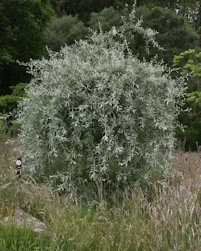
Pyrus salicifolia pendula
Willow-leaved weeping pear
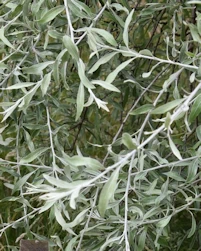
A spreading, pendulous, deciduous cultivar, growing to 10-12m, native to the Middle East. Large creamy-white spring blossom, highlighted with black-tipped stamens, is followed by small, pear-shaped, green fruit which is inedible, being hard and astringent.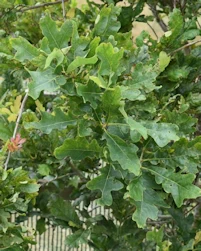
Quercus x bimondorum Crimson Spire
Two worlds oak
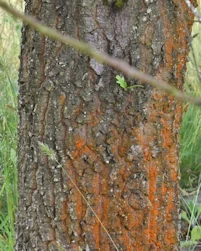
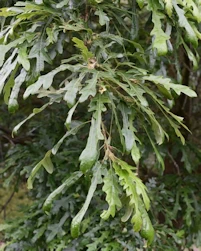
A.k.a. Crimschmidt, a columnar oak that becomes broader when older, especially at the base of the tree, and gets a narrow, oval crown, growing to about 15 m tall and about 5m wide. Q x bimondorum is a naturally occurring hybrid of white oak, Q. alba and pedunculate oak, Q. robur. The light brown bark is grooved. The leaves are shallow lobed and dark green, turning red and purple in autumn.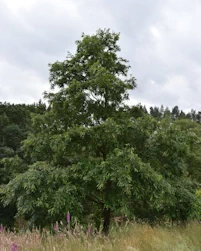
Quercus castaneifolia
Chestnut-leaved oak
A deciduous tree growing to 35m native to the mountains of Iran, it resembles the closely related Turkey Oak in appearance. The flowers are wind-pollinated catkins; the fruit is an acorn, maturing about 18 months after pollination, 2–3cm long and 1.5–2cm broad, bicoloured with an orange basal half grading to a green-brown tip; the acorn cup is 2 cm deep, densely covered in soft 4–8 millimetres (1⁄8–3⁄8 inch) long 'mossy' bristles. The acorns are very bitter, but are eaten by jays and pigeons; squirrels usually only eat them when other food sources have been exhausted.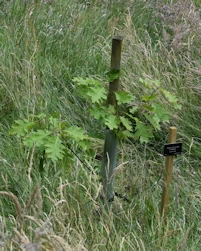
Quercus coccinea Bordeaux
Scarlet oak
A substantial deciduous tree, ultimately to 24m in height, with large leaves, 7.5-15cm long, deeply 7- sometimes 9-lobed, and coarsely toothed at the apex. Leaves are dark green above, paler beneath, both sides shining, becoming scarlet in autumn, the colour long-lasting. Flowers are yellow-green catkins, in spring. Acorns, if produced, grow to 2.5cm long and nearly as wide, partly enclosed in a deep, thin-edged cup. [RHS]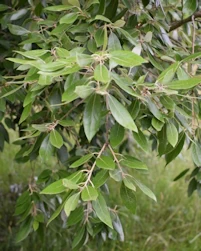
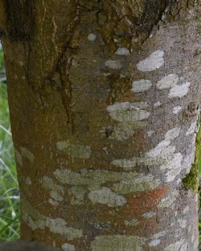
Quercus ilex
Holm oak
A large evergreen tree, growing to 21–28 metres, native to the Mediterranean. The trunk is sometimes over 6m in girth. The young shoots are clothed with a close grey felt. Acorns are produced 1-3 together on a short downy stalk, ripening in the first season. [Wikipedia]
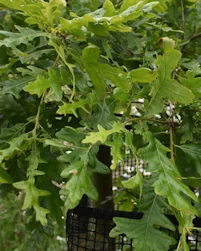
Quercus ithaburensis macrolepsis Hemelrijk Silver
Valonian oak
A medium-size semi-evergreen with a broad oval crown growing to around 8 m tall. The young twigs are grey-green, the old bark is dark grey brown and grooved. The oval leaves emerge inconspicuous silver-grey, turning grey-green later in the summer. The leaves are shallow serrated-lobed. They are semi-evergreen and will fall if it is too cold. The tree was named after Robert and Jelena de Belder’s Hemelrijk estate (Arboretum Kalmthout) where the tree was selected. Sometimes this tree is called ‘Hemelrijk’, which leads to confusion because Q. ellispsoidalis also has a cultivar called ‘Hemelrijk’. Its correct name is ‘Hemelrijk Silver’ on account of the striking leaf colour. [Van der Berk]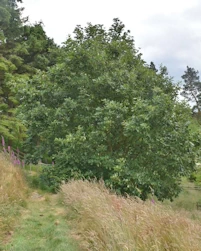
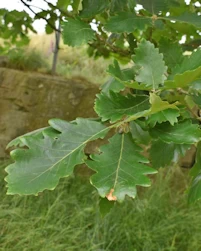
Quercus macranthera
Caucasian oak
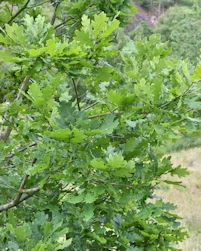
A.k.a. Persian oak, is a deciduous tree native to W Asia (northern Iran, Turkey) and in the Caucasia, growing to 30m. Fruits scarcely stalked; acorns about 1 in. long, the lower half enclosed by a cup which is covered outside with erect, lanceolate, downy scales.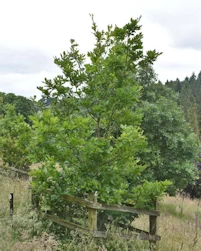
Quercus Montana laciniata
Chestnut oak
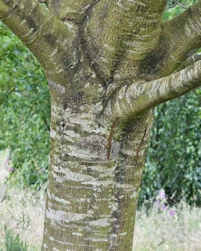
A.k.a. rock oak, it belongs to the white oak group, native to the E USA. Not usually a large tree, typically growing to 18–22m in mountain conditions, up to 40m in more favourable surroundings. Its massively-ridged dark gray-brown bark is the thickest of any E North American oak. Pale yellow catkins appear in May, when leaves are one-third grown. Pistillate flowers appear in short spikes on green peduncles, stout and hairy. Acorns are bright chestnut brown, shining, 3cm long, in a turbinate shaped like a spinning top cup.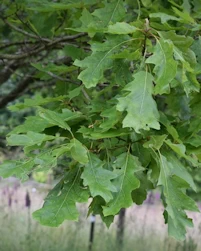
Quercus palustris
Pin oak
A.k.a. swamp oak or Spanish oak, a tree in the red oak section. A medium sized deciduous tree growing to 18–22m with a dense, slightly pendulous crown. Deeply lobed leaves to 15cm, with whisker-tipped teeth, turn reddish-brown or bright crimson in autumn. the upper branches point upwards, the middle branches are at right angles to the trunk, and the lower branches droop downwards. The leaves are 5–16cm long with 5 or 7 lobes, each lobe with 5-7 bristle-tipped teeth. The acorns, borne in a shallow, thin cap, are hemispherical, 10–16mm long,green maturing to pale brown about 18 months after pollination. Young trees exhibit marcescence the retention of dead leaves through the winter on juvenile trees . Flowering and leaf-out occur in late spring when all frost danger has passed. The flowers are monoecious catkins which, being self-incompatible, require the presence of another oak for pollination. Any species in the red oak group can serve as a pollinator, but in pin oak's natural range, this will usually be northern red oak or scarlet oak. Interspecies hybridization occurs freely. The acorns require two growing seasons to develop. [Wikipedia]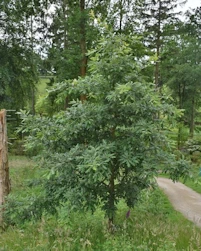
Quercus pyrenaica
Pyrenian oak
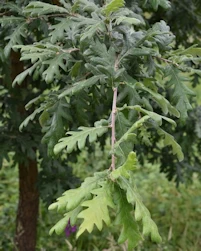
A.k.a. Spanish oak. A large, spreading, deciduous tree (though often marcescent it retains dead leaves through the winter in immature individuals), growing to 25m, native to SW Europe and NW Africa. Despite its common name, it is rarely found in the Pyrenees Mountains and is more abundant in N Portugal and N and NW Spain. Long, drooping male catkins turn from grey to gold in late spring; acorns are produced in clusters of 2-4 on a downy, erect stalk.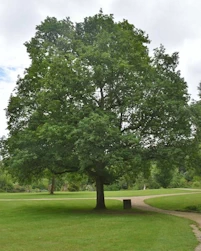
Quercus robur
English oak
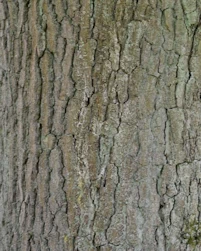
A.k.a. pedunculate oak, common oak. A large, deciduous tree growing up to 20–40m. Leaf-burst occurs mid-May; leaves have almost no stem and grow in bunches. Long, yellow hanging catkins distribute pollen into the air. Acorns are 2–2.5cm long, on long stalks and in cupules the cup-shaped base of the acorn . As it ripens, the green acorn turns brown, loosens from the cupule and falls to the canopy below, sprouting the following spring.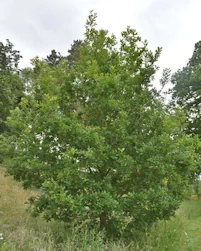
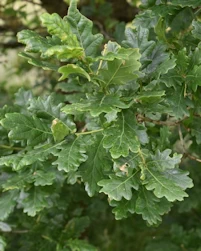
Quercus robur Goscote oak
Goscote oak
This tree was grown from an acorn collected from the 350 year-old oak growing at Goscote Nurseries, near Leicester, in 2014.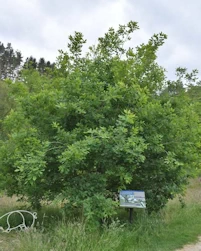
Quercus robur
King Alfred's oak
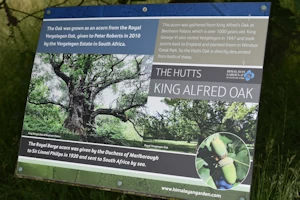
A (slightly confusing) noticeboard says: [1] The oak was grown as an acorn from the Royal Vergelegen Oak, given to Peter Roberts Peter and Caroline Roberts created the Himalayan Garden at The Hutts estate from 1996 onwards. in 2010 by the Vergelegen Estate in South Africa. [2] The Royal Berge acorn was given by the Duchess of Marlborough Gladys Deacon, 2nd wife of Charles Spencer-Churchill, cousin-in-law to Winston Churchill to Sir Lionel Philips South African financier, mining magnate and politician (1855-1936) in 1920 and sent to South Africa by sea. This tree was grown from an acorn gathered from King Alfred's Oak at Blenheim Palace, which is over 1000 years old. KIng George VI also visited Vergelegen in 1947 and took acorns back to England and planted them in Windsor Great Park. So the Hutts oak is directly descended from both of these.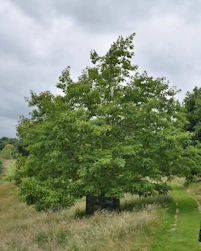
Quercus rubra
Red oak
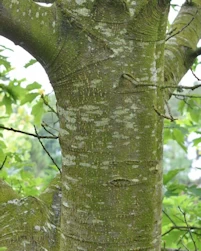
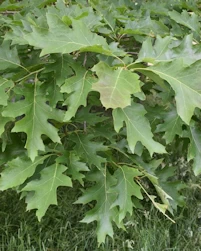
A deciduous broadleaf tree native to North America, which can grow to 25m and develops a rounded crown. In winter the buds are long and taper to a point, each with more than three scales. Slender male catkins hang in clusters and the tiny female flowers are found singly or in clusters. After pollination by wind, female flowers develop into acorns enclosed by a rounded cup, which take two years to ripen.