×
![woodturning]()

Trees Gallery - Himalayan Garden
Grewelthorpe, near Ripon
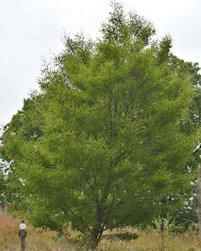

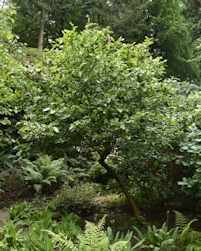
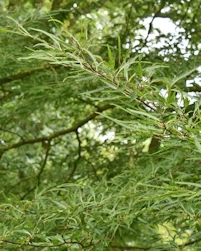
Fagus sylvatica ansorgei
Willow-leaf beech
A rare, slow-growing, shrubby, hybrid of the European beech with narrow, willow-like, deep purple(?) leaves. It hangs on elegant arching branches. The leaves are lanceolate, often with lobed but otherwise entire margins, 1–2 cm wide, dark brown-red to purple in colour. It was raised by Ansorge at the Flottbeck nurseries in Hamburg in 1891. [Trees and Shrubs Online]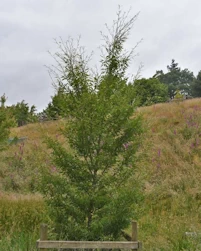
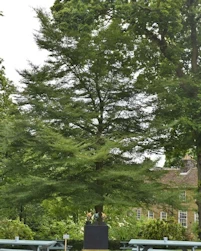

Fagus sylvatica heterophylla asplenifolia
Fern-leaf beech
A.k.a. cut-leaf beech. A large deciduous tree with a broad, open crown. Fern-like dark green leaves are variable, mostly long and narrow, feathery, fine textured, cut deeply into several pairs of pointed lobes and turning orange-brown or golden yellow in autumn. The smooth silky grey bark adds winter interest.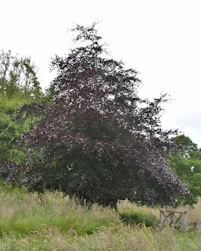

Fagus sylvatica purpurea
Copper beech
A.k.a. purple beech, a cultivated form of beech, though natural occurences do occur. It grows to more than 40m. The bark is smooth, thin and grey, often with slight horizontal etchings. It is monoecious both male and female flowers grow on the same tree . In spring tassel-like male catkins hang from long stalks at the end of twigs; female flowers grow in pairs, surrounded by a cup.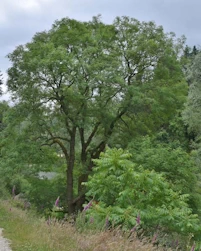
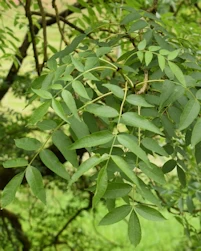
Fraxinus excelsior
Ash
Native to Europe, Asia Minor and Africa, reaching 35m. Tall and graceful, they often grow together, forming a domed canopy. The bark is pale brown to grey and fissures as the tree ages. The tree is easily identified in winter by its smooth twigs that have distinctive black, velvety leaf buds arranged opposite each other. Ash is dioecious male and female flowers typically grow on different trees although a single tree can also have male and female flowers on different branches. Both male and female flowers are purple and appear before the leaves in spring, growing in spiked clusters at the tips of twigs. Once the female flowers have been pollinated by wind, they develop into conspicuous winged fruits, or 'keys', in late summer and autumn. [Woodland Trust]
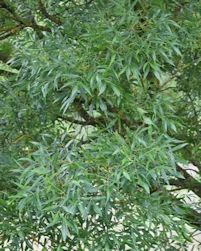
Fraxinus excelsior
Claret Ash
A.k.a. Raywood Ash, F. angustifolia ‘Raywood’, a medium sized (to 20m), fast growing, deciduous cultivar of ash, a seedling variant of Caucasian ash, F. angustifolia. It is distinctive in its leaves turning to a dark red colour in autumn. The bark of the tree is notably smoother than other Caucasian ash trees. In Australia and the USA a decline or dieback in some older trees has been observed, which has been attributed to a combination of environmental stress and fungal attack.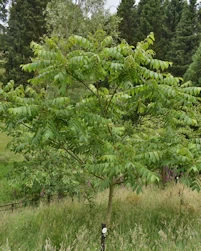
Juglans ailantifolia
Japanese walnut
A deciduous tree growing to 20-30 m (98 ft), with light grey bark. The leaves are pinnate, 50–90 cm long, with 11–17 leaflets, each leaflet 7–16cm long. The whole leaf is downy-pubescent, and a somewhat brighter, yellower green than many other tree leaves. Male flowers are inconspicuous yellow-green catkins produced in spring at the same time as the new leaves appear. The female flowers have pink/red pistils. Spherical nuts are produced in bunches of 4–10 together, surrounded by a green husk before maturity in mid-autumn.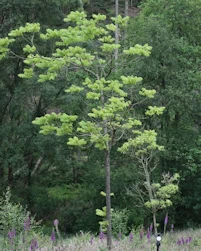
Juglans nigra
American black walnut
A deciduous tree native to central and eastern North America, growing to 30-40m. The dark green leaves are pinnately compound and alternately arranged on the stem. They are 30–60cm long. The stems have 15–23 leaflets, when terminal leaf is included. Flowers are monoecious male and female reproductive parts are on the same plant - male flowers are in drooping catkins, female (pistillate) flowers are terminal, in clusters of 2 to 5, followed by spherical nuts with a brownish-green, semi- fleshy husk and a brown, corrugated nut. Flowering is dichogamous the ripening of the stamens and pistils of a flower at different times, so that self-fertilization is prevented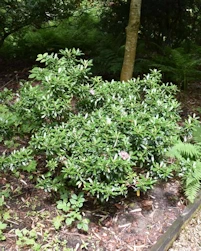
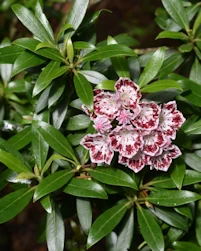
Kalmia latifolia(?)
Mountain laurel
A dense, bushy, evergreen shrub about 3m in height, with glossy dark green simple lanceolate leaves to 12cm long. Native to E. North America and Cuba. The flowers are white, pink or purple, in corymbs a type of inflorescence in which the lower flowers have longer pedicels than the upper ones, creating a flat-topped appearance. of 10–50, reminiscent of Rhododendron flowers but flatter, with a star-like calyx of five conjoined petals; each flower is 1–3 cm diameter. The fruit is a five-lobed capsule, which splits to release the numerous small seeds. The foliage is toxic if eaten, with sheep being particularly prone to poisoning.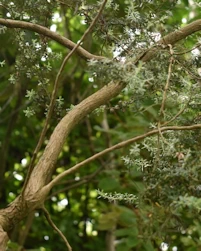
Leptospermum scoparium 'Dove Lake'
Manuka
A.k.a. mānuka myrtle, or tea tree, a native to New Zealand (including the Chatham Islands) and south-east Australia. Bees produce mānuka honey from its nectar. A prolific evergreen shrub-type tree and is often one of the first species to regenerate on cleared land, growing typically to 2–5 m, but potentially a moderately sized tree, up to 15 m. The small flowers are white, occasionally pink, 8–15mm in diameter, with five petals. The wood is tough and hard.
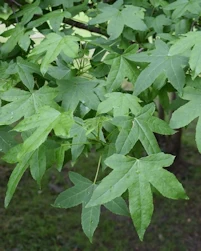
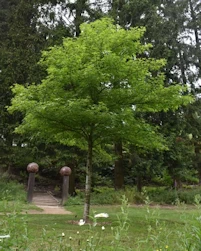
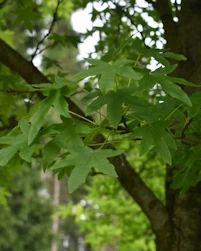
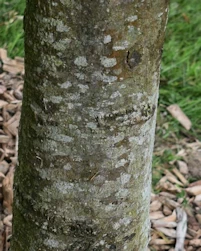
Liquidambar styraciflua
Sweet gum
Two cultivars, 'Thea' and 'Worplesden' are shown here. Liquidambar is a deciduous tree to 20m tall, with glossy green leaves , which turn deep shades of red and purple over a long period in autumn. It exudes a scented resin from its inner bark if the trunk is damaged, and this was tapped by native American tribes, the gum used medicinally and for chewing. The timber is used in cabinet making. It can form a large tree, with a bole well over 2m thick, and height 60m.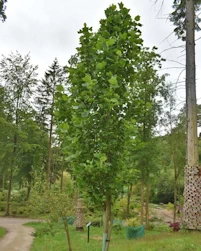
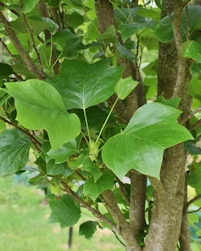


Liriodendron tulipifera
Tulip tree
A.k.a. tulip poplar or yellow poplar, a large deciduous tree native to E North America, growing to 30-50m, characterized by its distinctive tulip-shaped flowers and leaves, and a tall, straight trunk. It produces showy, cup-shaped, tulip-like flowers that bloom in late spring or early summer. The flowers are greenish-yellow with an orange band at the base. These are followed by dry, scaly, cone-shaped brown fruits, each bearing numerous winged seeds. They are long-lived trees, with some specimens living for 200-250 years or more.

Liriodendron tulipifera fastigiata
Fastigiate tulip tree
'Fastigiata' is a sport a part of a plant that shows morphological differences from the rest of the plant. Sports may differ by foliage shape or color, flowers, fruit, or branch structure. The cause is generally thought to be a chance genetic mutation with erect, twisting branches, maintaining a tight, narrow, upright growth habit. Prone to weak forks at a low height, which probably means that, like most fastigiate trees, it will never prove long lived.

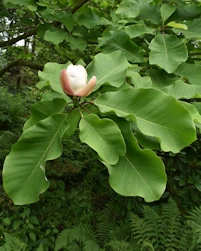

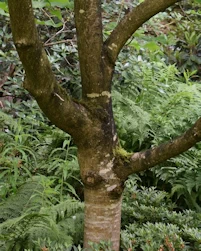
Magnolia
Magnolia
Some magnolias at the Himalayan Garden are clearly labelled. Here are a few without labels. Magnolias are ornamental trees and shrubs, characterized by large, fragrant, bowl shaped or star shaped flowers in shades of white, pink, purple, green, or yellow, with some species being evergreen and others deciduous. Some species bloom in late winter or early spring, even before the leaves emerge, while others bloom in spring or early summer, and some evergreen varieties have large, fragrant blooms in late summer.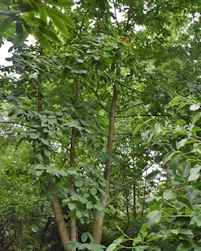
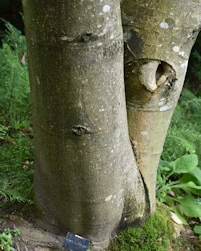
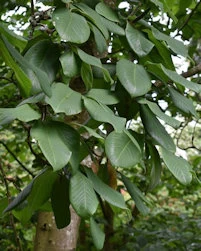
Magnolia campbellii Kew's surprise
Magnolia
A medium size (6m) cultivar known for its large, goblet-shaped translucent pink flowers that are paler inside, blooming before the leaves emerge in spring. It flowers MArch to May.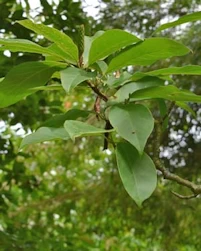
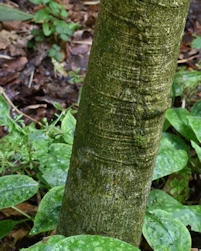
Magnolia peppermint stick
Magnolia
A mid-sized hybrid tree (M. veitchii × M. liliiflora) growing to 10m. It has an upright then spreading habit, and broadly oval, glossy green leaves. In spring, tall upright buds open to white flowers, flushed pink at the base and on the midribs, with upright inner petals and spreading outer petals [RHS]