Trees Gallery - RHS Bridgewater
Worsley, Salford
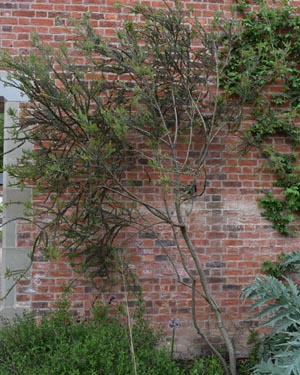

Acacia pravissima
Ovens Wattle
An evergreen shrub native to Ovens Valley in Victoria, Australia to 5m or more, with crowded, triangular leaf-like phyllodes modified petioles or leaf stems, leaf-like in appearance and function. These become flattened and widened, while the leaf itself becomes reduced or vanishes altogether. and racemes a flower cluster with the separate flowers attached by short equal stalks at equal distances along a central stem. The flowers at the base of the central stem develop first. of small rich yellow flower-heads in late winter and early spring
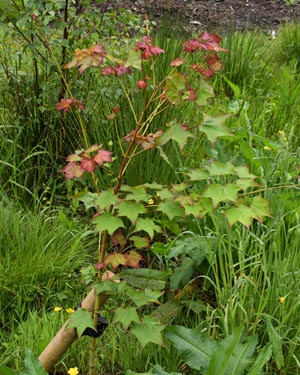
Acer cappadocicum 'rubrum'
Caucasian maple
A native of the Cappadocian mountains in Turkey, growing to 10m. The variety 'Rubrum' has fiery blood-red young leaves turn green in the summer and later assume golden yellow autumn tints. Here, in May, the green is just pushing the red to the margins of the leaf. The species is a neophyte a plant not native to a region, introduced and escaped into the wild in recent history (after 1500) in Britain, having been recored in the wild since 1977, spreading across most of the country. It will reproduce by suckering creating thickets, as well as by seed. The paired samaras a winged achene, a type of fruit in which a flattened wing of fibrous, papery tissue develops from the ovary wall. are at almost 180 degrees to each other
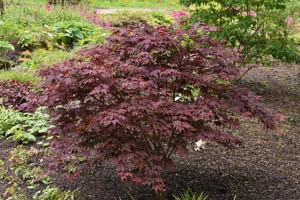
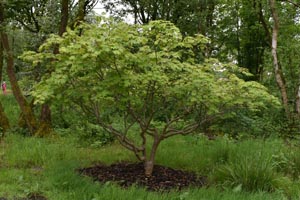
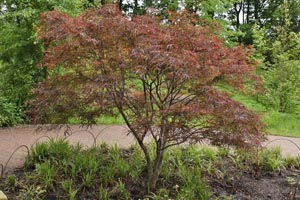
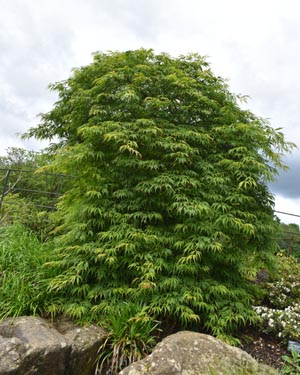

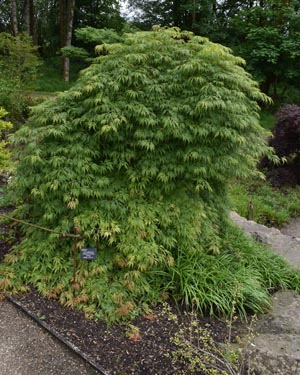

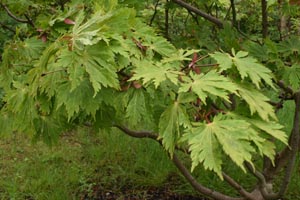
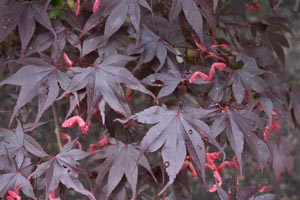
Acer palmatum
Japanese maple
There are many varieties of Japanese maple at Bridgewater. Sizes range from a large specimen in the Weston Walled Garden, to small mounds in the Chinese streamside garden; colours when we visited (May) ranged from bright green to deepest purple; leaf shape from thick palms to thinly dissected fingers. Where labels were seen, most only described the trees as a. palmatum, without a named variety. No doubt the autumn colour will be even more delightful.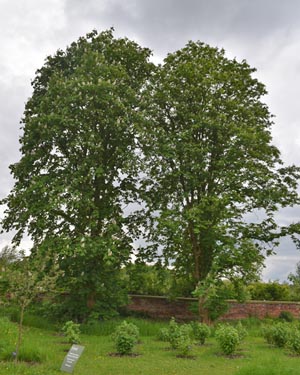
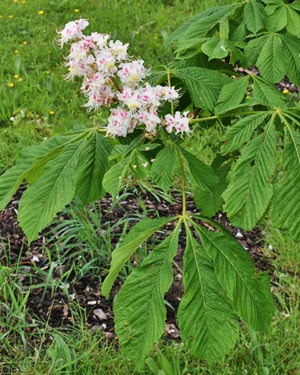
Aesculus Hippocastanum
Horse chestnut
A common tree in Britain, but native to the Pindus mountains in the Balkans. Popular for its spectacular flowers in spring, and subsequent fruits in autumn - conkers. Mature horse chestnut trees grow to a height of around 40m and can live for up to 300 years. The bark is smooth and pinky-grey when young, darkening and developing scaly plates with age. Twigs are hairless and stout; buds are oval, dark red, shiny and sticky.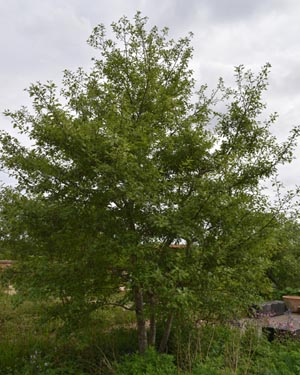
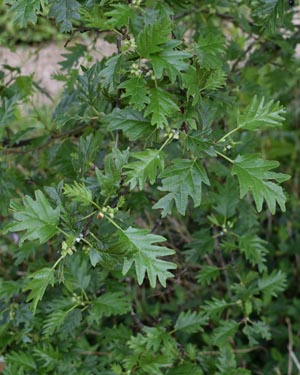
Alnus glutinosa laciniata
Cut-leaved alder
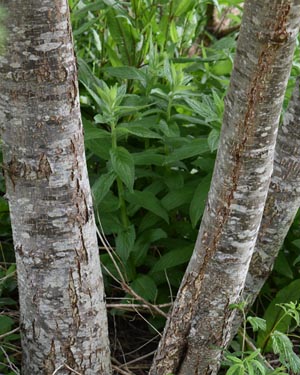
A cultivar of the common alder. It has deeply cut, dark green leaves that remain on the tree late into autumn. This graceful tree produces catkins and cones and can withstand flooding. Originally found growing in a garden near St Germain, Paris, in 1819. It is often likened to ‘Imperialis’ but they are actually quite different: ‘Laciniata’ is a sturdier tree of stronger growth with the leaves neither so deeply cut nor narrowly lobed; it differs from ‘Incisa’ in the leaves oblong in outline with the lobes pointed and untoothed, cf. rounded in outline with the lobes toothed in ‘Incisa’ [Trees and Shrubs Online]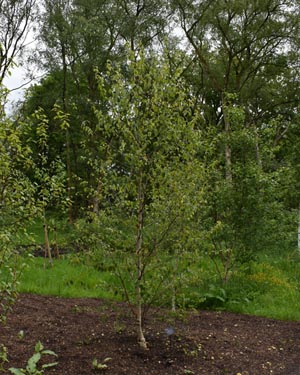


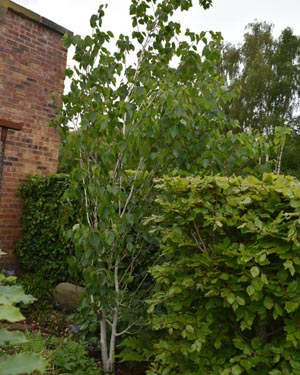
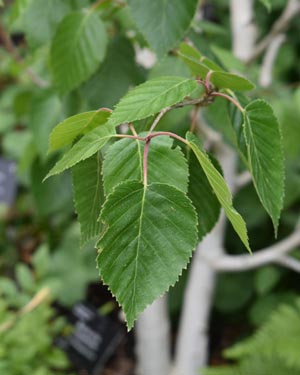
Betula utilis albosinensis 'China Rose'
Chinese red birch
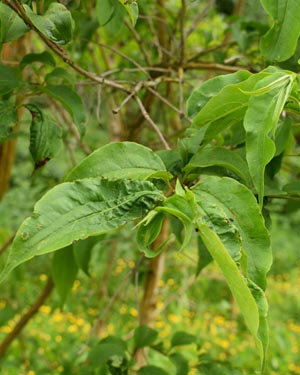
A native of Western China, growing to 25m, notable for its distinctive peeling bark (not yet fully developed on this young planting). Brown catkins are produced in spring, opening with the leaves, with male catkins slightly longer than female. The fourth photo is of a different cultivar of the same variety, named after Kenneth Ashburner (1927-2010), a specialist in birches.