×
![woodturning]()

Trees Gallery - Himalayan Garden
Grewelthorpe, near Ripon


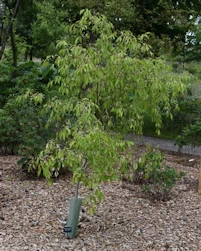
Alnus glutinosa imperialis
Imperial Alder
A.k.a cut leaved alder, a slow-growing medium-sized tree of conical outline growing to 12-15m. In late winter or early spring, long, pendulous, purple male catkins emerge. The fruits are small and cone-like.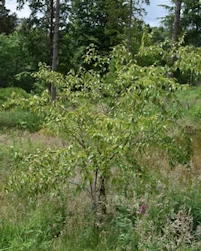
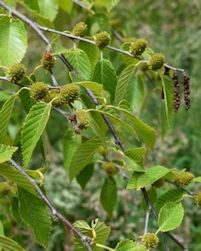
Betula grossa
Japanese cherry birch
A native of Japan, growing to 23m. It is conical in outline, but its most distinctive feature is its cherry-like bark, with horizontal stripes of reddish-grey becoming dark grey with age, exfoliating in thin papery curls. The shoots are aromatic, and carry long, yellow-brown, male catkins in early spring. Fruiting catkins are egg-shaped. The species is considered closely related to the American birch Betula lenta.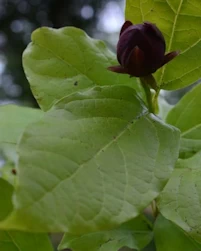

Calycanthus 'aphrodite'
Sweetshrub
A compact, dense, multi-stemmed, deciduous shrub that is a hybrid between the native E USA species and the Asian species, x Sinocalycanthus. It typically grows to 1.5 - 4m tall and wide. It has large, fragrant, deep red flowers, 10 cm across, resembling magnolia blossoms, produced in abundance at the ends of short branchlets in late spring – early summer. The scent of the flowers varies based on the age of the bloom, the time of day, and the flower itself.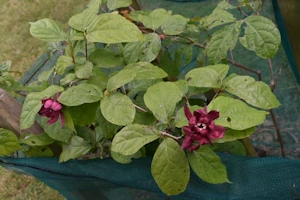
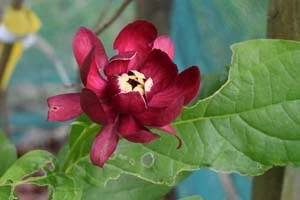
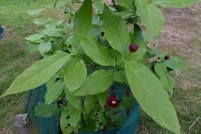
Calycanthus raulstonii 'Hartlage Wine'
Sweetshrub
A.k.a. Carolina Allspice due to its origins at the J C Raulston Arboretum in N Carolina, and its production of an edible and delicious spice. A multi-stemmed hybrid shrub with upright to arching branches, bearing lustrous green, oval leaves. Flowering from late spring to early autumn producing a light scent over a long period.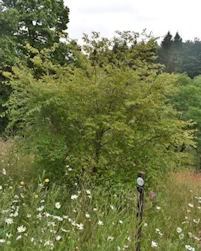
Carpinus monbeigiana
Asiatic hornbeam
Native to subtropical forests of China and Tibet, a medium sized tree growing to 16m . It has grey bark, with the slender brances and elegantly hanging shoots of many hornbeam species and, lanceolate to elliptic leaves which turn yellow in the wild, but tend to drop when still green in cultivation. Fruiting catkins are 5–8 cm long, producing a nutlet sparsely hairy but with dense brown to orange resinous glands, and prominently ribbed. [Trees and Shrubs Online]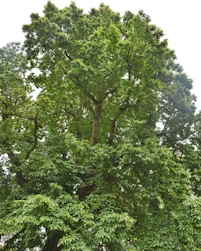
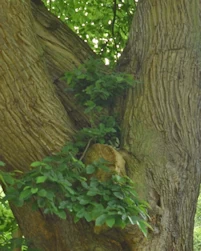
Castanea sativa
Sweet chestnut
A.k.a. Spanish chestnut. A large tree growing to 20–35m with a trunk often 2m or in diameter, capable of living 500 to 1000 years. The flowers of both sexes are borne in 10–20cm long, upright catkins, the male flowers in the upper part and female flowers in the lower part, appearing in late June to July, and by autumn, the female flowers develop into spiny cupules containing 3–7 brownish nuts that are shed during October. The female flowers eventually form a spiky sheath that deters predators from the seed. The tree is naturally self incompatible, meaning that the plant cannot pollinate itself, making cross-pollination necessary. The nut itself is composed of two skins: an external, shiny brown part, and an internal skin adhering to the fruit. Inside, there is an edible, creamy-white part developed from the .cotyledons an embryonic leaf in seed-bearing plants, one or more of which are the first leaves to appear from a germinating seed [Wikipedia]
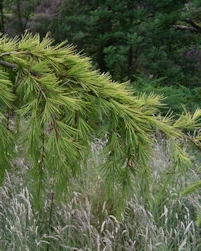
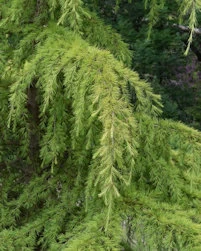
Cedrus deodara aurea pendula
Deodar cedar
A.k.a. Himalayan cedar, or just deodar. The species is native to the Himalayas, where it can grow to 40-50m, with a trunk up to 3m in diameter. It has a conic crown with level branches and drooping branchlets. This golden weeping cultivar grows somewhat more slowly than the species and has one main trunk that grows straight with lateral branches and twigs that hang off at the end. Barrel-shaped, upright cones grow singly or in pairs and have a round top. They disintegrate when mature (in 12 months) to release the winged seeds.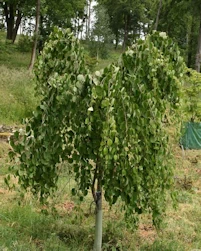
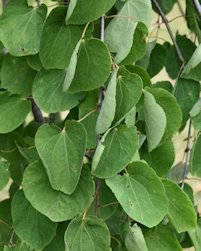
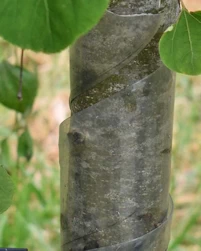
Cercidiphyllum japonicum pendulum
Weeping katsura tree
A.k.a. caramel tree, and candyfloss tree (due to scents). A flowering tree native to China and Japan, growing to 10 - 45m. The flowers are inconspicuous and produced in early spring among the opening leaves, with male and female flowers on separate plants (dioecious). The fruit is a cluster of two to four follicles 1.5cm long with each follicle containing several winged seeds. The species is listed as endangered in China, but overall when Japanese populations are included it is classified as being lower risk. [Wikipedia]

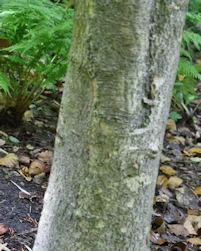
Cornus kousa 'Porlock'
Japanese dogwood
This cornus was labelled. A hybrid, spotted by Norman Hadden in West Porlock, Somerset (1958). Considered to be a cross of C. kousa (deciduous) × C. capitata (evergreen). A broadleaf evergreen or semi-evergreen small tree, growing to 7m. Leaves are opposite, simple, with a smooth margin. Globose red fruit ripens in autumn.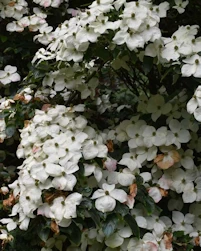

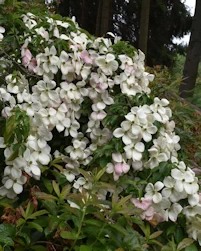
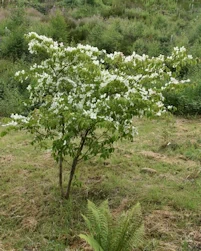


Cornus spp.
Dogwood varieties
A selection of cornus, sadly without any labels. They are probably c. kousa, one may possibly be c. florida. C. kousa is a small deciduous tree growing to 8–12m. What appear to be four, white petals are actually four spreading bracts below the cluster of inconspicuous yellow-green flowers. The blossoms appear in late spring, weeks after the leaves. The fruit is a globose pink to red compound berry 2–3cm in diameter, edible, with a sweet and creamy flavour. Autumn foliage is red.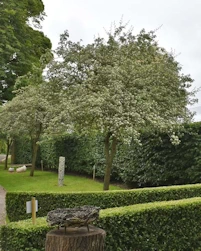
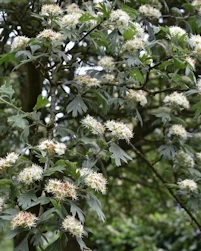
Crataegus Orientalis?
Oriental hawthorn
This is definitely crataegus, probably orientalis, a native of the Mediterranean region, Turkey, Caucasia, Crimea, and W Iran. Fruits are orange or various shades of red. A small tree growing to 6m. In Caucasia the fruits are either eaten raw or used to make a type of sweet bread.

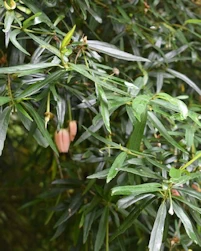
Crinodendron hookerianum
Chilean lantern tree
A dense, medium-sized evergreen shrub or small tree growing to 8m, native to Chile, where it grows near streams and in very humid and shady places. The fruit is a white, pubescent, leathery capsule with 3 to 5 valves. Seeds are ovoid, glossy.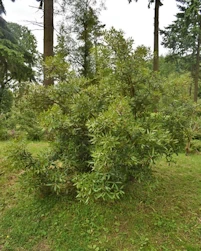
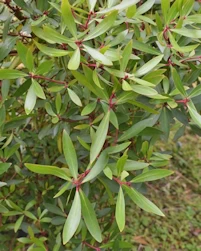
Drimys andina winteri
Dwarf winter's bark
A dwarf evergreen shrub, which only grows 0.5-1m tall, a native of Chile and Argentina. It flowers freely in summer, with white, star-shaped scented flowers growing in terminal clusters. These are followed by purple to black fruits in abundance.
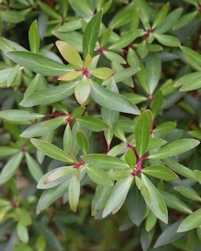
Drimys lanceolata
Mountain pepper
A dense, evergreen flowering tree or shrub growing to 30m tall, native to temperate rainforests of Chile and Argentina. The dioecious having male and female reproductive parts on separate plants flowers, greenish-yellow with narrow twisting petals are fragrant, borne in in side and terminal clusters in spring. The fruit is a glossy, round black berry, containing numerous black seeds. Bark and leaves are strongly cinnamon-scented.