×
![woodturning]()

Trees Gallery - Himalayan Garden
Grewelthorpe, near Ripon
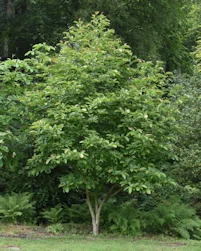


Magnolia shirazz
Magnolia
A magnolia cultivar from New Zealand, a cross between m. denudata and m. Vulcan. The result is a profusion of vibrant claret red goblet shaped flowers with paler interior. It is a deciduous small tree or large bush with mid green oval leaves.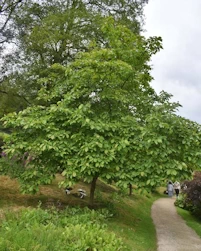
Magnolia Soulangeana Lennei Alba
Saucer magnolia
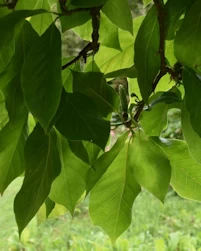
A large "saucer" magnolia hybrid, growing to 4-6m. Prized for its abundance of creamy white, goblet-shaped blooms in early spring, resembling those of M. denudata. Perhaps a seedling of ‘Lennei’, in which the outside of the cup is purple. Foliage emerges just as the bloom season is ending.
Magnolia Todd Gresham
Magnolia Todd Gresham
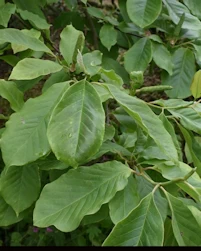
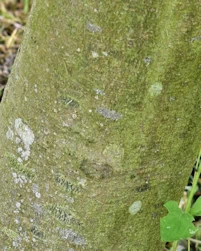
A fast-growing, vigorous small tree or large shrub, bearing masses of large (up to 25cm diameter) purple flowers with white interiors through late winter and early spring, borne on naked stems just as the foliage emerges. Todd Gresham raised over 15,000 hybrid Magnolia seedlings at his home in Santa Cruz, California, between 1955 and 1969. This one is a hybrid between M. x veitchii and M. x soulangeana ‘Rustica Rubra’
Malus Directeur Moerlands
Crab apple
A.k.a. Crab Apple Director Moerland, a vigorous, spreading, round-headed variety notable for its distinctive, large, bronze Maple-like leaves. It was bred as a disease-resistant form of M. Profusion. Slightly fragrant, wine-red flowers bloom profusely in spring, beautifully complementing the emerging red leaves. Flowers are followed by cherry-like, reddish-purple edible fruit. Named after Carolus Philippus Moerlands, who was Director of the School of Horticulture at Boskoop in the Netherlands in the early 20th century.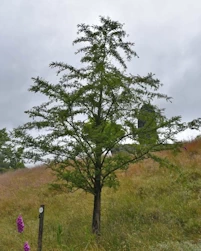
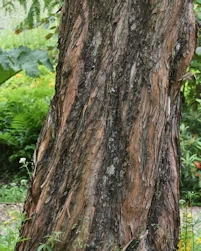
Metasequoia glyptostroboides
Dawn redwood
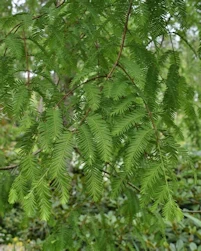
A fast-growing, endangered deciduous conifer, growing to 50m, the sole living species of the genus Metasequoia, now only surviving in the wild in S Central-China. Older trees may form wide buttresses on the lower trunk, and forms a distinctive "armpit" under each branch.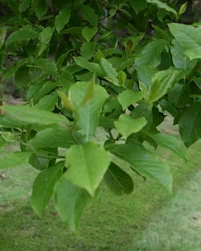
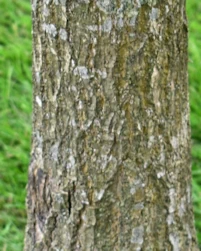
Nyssa sylvatica
Tupelo
A.k.a. black tupelo, black gum or sour gum, a medium-sized deciduous tree growing to 25m, native to E North America and Mexico. Tupelo is a native American term for the tree. Deer are extremely fond of the leaves on seedlings and saplings, to the point where large populations of them can make establishment of the tree almost impossible. The flowers are very small, in greenish-white in clusters at the top of a long stalk and a rich source of nectar for bees. The fruit is a black-blue, ovoid stone fruit, about 10mm long with a thin, oily, bitter-to-sour tasting flesh and very popular with small bird species. There are from one to three fruits together on a long slender stalk. The wood is pale yellow, sapwood white; heavy, strong, very tough, hard to split, used for turnery.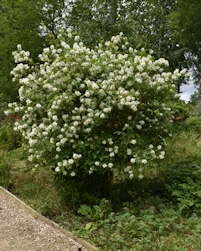
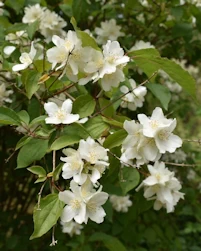
Philadelphus
Mock orange
Philadelphus are mainly tall, sometimes arching, shrubs with richly-scented flowers in early summer. Although usually pure white and cup-shaped, some flowers have a maroon central blotch or are double-flowered. The name "mock orange" comes from the similarity of its flowers to those of the true orange tree, but it is not related to oranges.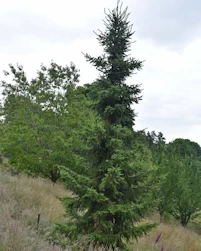
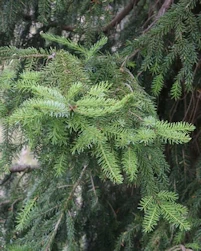

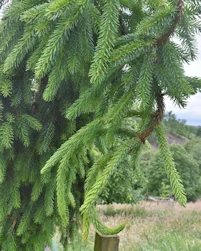
Picea omorika Picea Latin pix meaning pitch or tar, referring to spruce resin; omorika is the native Serbian/Bosnian name for spruce, and symbolizes slenderness in local folklore, fitting the tree's graceful, narrow shape; pendula drooping pendula
Serbian spruce
A.k.a. Pančić spruce, after the Serbian botanist Josif Pančić. A medium-sized evergreen coniferous tree growing to 20 m, native to W. Serbia, E Bosnia and Herzegovina. The two pictured here are the standard, upright conical version, and the drooping cultivar. The cones are 4–7 cm (2–3 in) long, fusiform spindle-shaped, broadest in the middle , dark purple when young, maturing to dark brown, with stiff scales. Grown widely as an ornamental, it is also used as Christmas trees, timber and paper production, particularly in N.northern Europe, though its slow growth makes it less important than Sitka spruce or Norway spruce. [Wikipedia]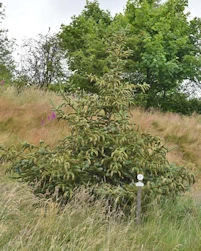
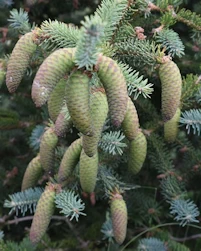
Picea retroflexa blidjenstein
Tapao Shan spruce
A.k.a. P. asperata var.retroflexa, a medium-sized subalpine evergreen growing 25-40m, which occurs between 3000 to 4000 metres above sea-level in W. China, often mixed with Abies squamata, but at lower elevations P. likiangensis var. rubescens, P. aurantiaca, Abies chensiensis and Tsuga chinensis may occur with it. The shoots are orange-brown, with scattered pubescence. Needles are 1–2.5 cm long, rhombic in cross-section, greyish- to bluish-green with conspicuous stomatal lines. Named after Benjamin Willem Blijdenstein, a Dutch banker who set up Pinetum Blidjenstein in Haversum, N. Holland.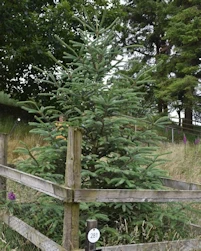
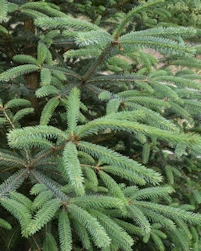
Picea smithiana
Morinda spruce
A.k.a. Western Himalayan Spruce, a large evergreen tree growing to 40-55m, at altitudes of 2,400-3,600 m in forests together with deodar cedar, blue pine and pindrow fir. It has a conical crown with level branches and usually pendulous branchlets. The cones are broad cylindric-conic, 9–16 cm long and 3 cm broad, green when young, maturing buff-brown and opening to 5–6 cm broad 5–7 months after pollination; the scales are stiff and smoothly rounded. Named after James Edward Smith, an English botanist, founder of the Linnaean Society.[Wikipedia]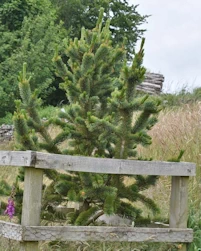
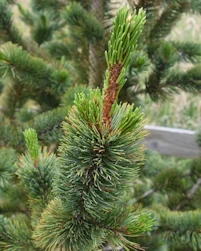
Pinus aristata
Bristlecone pine
A.k.a. Rocky mountain bristlecone pine, hickory pine, Colorado bristlecone pine. A small tree growing to 15m; strongly tapering, often twistedwith contorted branches. The crown is rounded, flattened or irregular. Bark is grey to red-brown, shallowly fissured, with long, flat, irregular ridges. Young branches resemble long bottlebrushes because of the persistent leaves.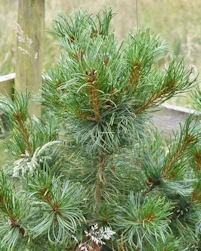
Pinus koraiensis x p. pumila Winton
Korean pine x dwarf Siberian pine
This dwarf pine is labelled as a cross between p. koraiensis and p. pumila Winton. The first is a medium to large evergreen, the second a somewhat dwarf form growing wider than tall and resembling a small shrubby tree, 3m x 5m. p. korainsis is native to Korea and parts of China and Russia. The tree is known for its attractive dark green needles and its large, edible seeds called pine nuts. P. pumila is a dwarf coniferous evergreen pine native to NE Asia. It bears bundles of long, needle-like leaves, contrasting with small purple pine cones. The 'Winton' cultivar is known for its dense and compact growth habit.
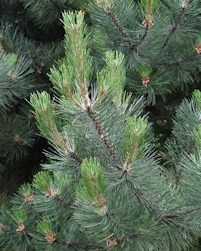
Pinus nigra
Austrian pine
A.k.a. black pine. A large evergreen tree native to C and SE European coastal areas, growing to 22-55.developing an irregular, dense crown with age. The bark is grey to yellow-brown, and is widely split by flaking fissures into scaly plates, becoming increasingly fissured with age. The ovulate and pollen cones appear from May to June. The mature seed cones are 5–10 centimetres (2–4 inches) (rarely to 11 cm) long, with rounded scales; they ripen from green to pale gray-buff or yellow-buff in September to November, about 18 months after pollination. The seeds are dark grey, dispersed by wind.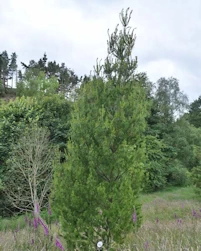
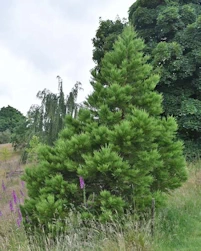
Pinus strobus torulosa
Twisted Needle White Pine
An fast-growing tall evergreen conifer growing to 17m, with unique, green-blue ‘twisted’ needles, and to a lesser extent twisted branches. Native to Newfoundland and the USA, they have a narrow form and sparse branching which, paired with their spindly tufts of needles, gives the tree an airy, fluffy appearance. They produce green female cones that ripen into a golden colour as the season progresses.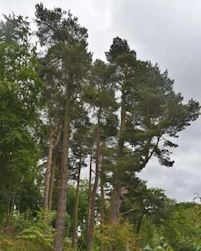
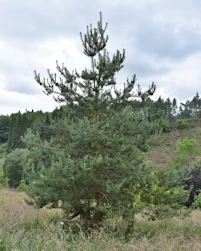
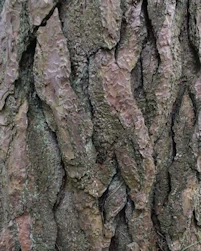

Pinus sylvestris
Scots pine
An evergreen conifer native to northern Europe. Mature trees grow to 35m and can live for up to 700 years. The needle-like leaves are blue-green and slightly twisted, and grow in pairs on short side shoots. Scots pine is monoecious both male and female flowers grow on the same tree. . Male flowers comprise clusters of yellow anthers at the base of shoots. Female flowers are small, red-purple and globular, and grow at the tips of new shoots. [Woodland Trust]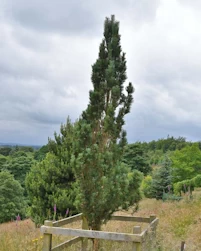
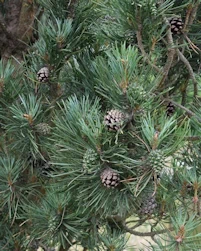
Pinus sylvestris fastigiata
Sentinel pine
A.k.a. upright pine. This variety was introduced to the UK in the mid-1800s, it has a tight, columnar crown that remains narrow and does not broaden with age, growing to 10-15m. The grey-brown bark peels off in rough strips. The cones are grey-brown in clusters of 2 to 5. Both bark and cones closely resemble those of the Scots Pine. . Strikingly orange-brown twigs and branches grow almost vertically.