×
![woodturning]()

Trees Gallery - Dawyck Botanial Gardens. Page 4
Near Peebles, Scottish Borders
 August 2024
 August 2024
 August 2024
 August 2024
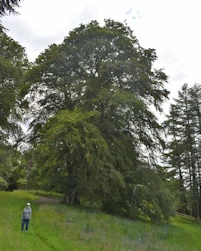
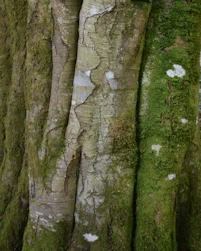
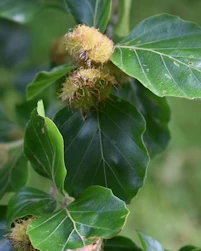
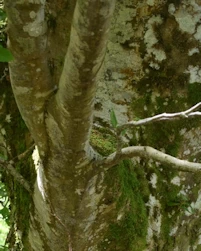
Fagus sylvatica Fagus - Latin for beech; sylvatica -from Latin silvanus, of the forest
Beech
Native across Europe, growing to a height of more than 40 m and develop a huge domed crown. The reddish brown, torpedo-shaped leaf buds form on short stalks and have a distinctive criss-cross pattern. Beech is monoeciousboth male and female flowers grow on the same tree . In April and May the tassel-like male catkins hang from long stalks at the end of twigs, while female flowers grow in pairs, surrounded by a cup. Beech woodland is shady and characterised by a dense carpet of fallen leaves and mast husks which prevent most woodland plants from growing. Only specialist shade-tolerant plants can survive beneath a beech canopy.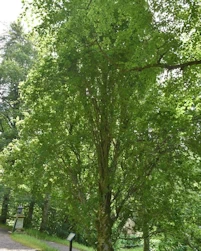 August 2024
 August 2024
 August 2024
 August 2024
 August 2024
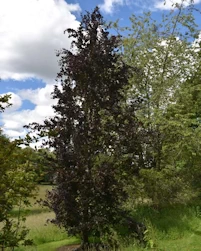
Fagus sylvatica Dawyck Fagus - Latin for beech; sylvatica -from Latin silvanus, of the forest; Dawyck - hybrid found at Dawyck
Dawyck Beech
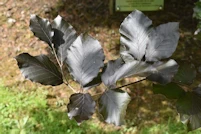
The information board says: This unusual upright form of the common European beech (Fagus sylvatica) was found by chance in the woodlands here at Dawyck during Naesmyths' tenure of the estate in the first part of the 19th century. Replanted to this location, closer to the house, this mother of all Dawyck beeches is now over 29m tall. It was from this plant in the early 20th century that new owner F R S Balfour began to make grafts and disribute material to other growers and eventually into the commercial nursery trade. As a result of his endeavours the tree became more widely cultivated and, in 1912, the clone was formally named Fagus sylvatica Dawyck. Such propogation of the Dawyck beech is the only way to perpetuate the unique character of this tree, which will not breed true from seed. A number of smaller specimens derived from the Dawyck original can be seen growing in various parts of the Garden, including at the car par entrance (17.5m tall) and on the south embankment above the Dutch Bridge (19m tall). Garden Delights The unusual architecture, with its restricted space requirement, has made the Dawyck beech a popular form to grow in gardens. In the late 20th century a Dutch nurseryman managed to generate both golden F. sylvatica Dawyck Gold - characterised by bright golden young leaves in spring, and purple Dawyck Purple - distinguished by striking deep purple foliage. All three forms received the RHS Award of Merit in 2002. August 2024
 August 2024
 August 2024
 August 2024
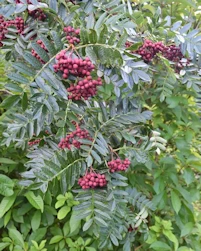
Hedlundia pseudofennica Hedlundia - after Swedish botanist Josef Teodor Hendlund; pseudofennica - false Finnish, as it resembles a sorbus native to Finland
Arran service-tree thought to derive from the Latin word for beer, cervisia because the fruits were used by the Romans to flavour beer.
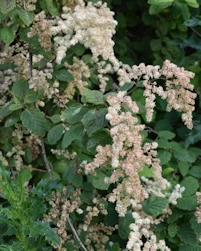
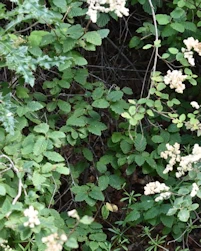
A.k.a. Arran cut-leaved whitebeam, a rare tree endemic to the Isle of Arran in Scotland, threatened by habitat loss. It is thought to be a naturally occurring hybrid between H. arranensis and Sorbus aucuparia. Hedlundia arranensis is itself a hybrid between Aria rupicola and sorbus aucuparia. Apomixis asexual development of seed or embryo without fertilization and hybridisation are common in some groups of sorbus species.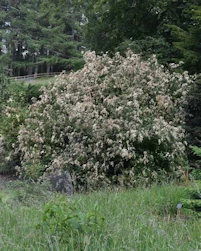 August 2024
 August 2024
 August 2024
Holodiscus discolor var.franciscus Holodiscus - from Greek holo - whole; discus - disc; referring to the unlobed disc lining the hypanthium. discolor: dis - two; color - colour; referring to the different colouring of the upper and lower surface of the leaf
Oceanspray - relating to the cascades of cream coloured flowers
A.k.a. creambush - relating to the cascades of cream coloured flowers , or ironwood, a shrub native to W North America growing to 2 m, a common understory shrub in woodlands. It is of special value as a pollinator plant for native bees and butterflies. Historically raw and cooked seeds were eaten, and leaves were used as seasoning. Noted for the strength of its wood, it was often used for making digging sticks, spears, arrows, bows, harpoons and nails.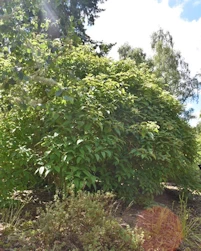 August 2024
 August 2024
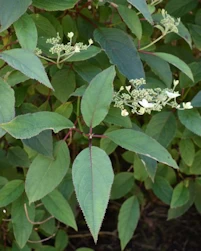
Hydrangea heteromalla Hydrangea: Derived from the Greek words hydor meaning water and aggeion meaning vessel. The name refers to the shape of the seed capsules, which resemble cups or jars. heteromalla comes from the Greek words heteros meaning another or different and mallos meaning wool. This refers to the leaves, which are covered in a dense, woolly layer of hairs (tomentose).
Woolly hydrangea
A.k.a. Himalayan hydrangea or Chinese hydrangea. A large shrub or small tree native to the Himalayas and China, growing to 5m in cultivation. It bears broad flat flower heads from late spring to early summer, with loose clusters of small true flowers surrounded by larger florets, usually white but sometimes turning pink as they mature.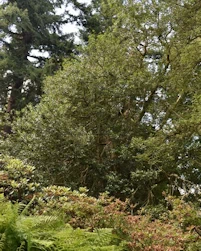 August 2024
 August 2024
 August 2024
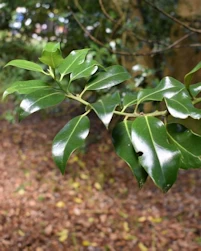
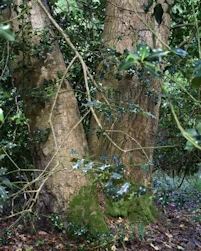
Ilex aquifolium Ilex: Derived from the Latin word for holm-oak, which it resembles. aquifolium comes from acus meaning needle and folium meaning leaf..
Holly
The Scottish Tree Trail information board says: Holly. (Gaelic: cuileann) With its prickly evergreen leaves, holly is possibly the easiest Scottish tree to recognise, although in mature trees the leaves can be quite smooth. It occurs naturally as an understory in deciduous woodlands. Its clean white wood is popular for use as inlays in furntiure making. Holly has separate male and female plants, with only the female bearing the lustrous red berries that have become a part of midwinter and Christmas festive decorations.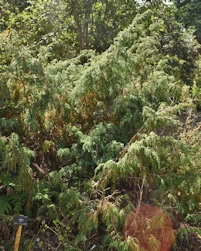 August 2024
 August 2024
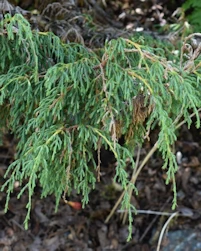
Juniperus recurva Juniperus - derived from the Latin/Greek word for the tree; recurva - means bent backwards, referring to the drooping branches
Himalayan juniper
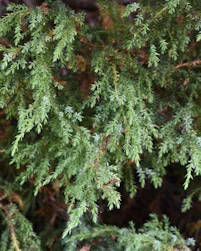
A.k.a. drooping juniper, a large shrub or small tree growing to 20 m, native to the Himalaya, from N Pakistan, through India, Nepal and Bhutan, to SW China. It is usually broadly pyramidal in shape, and clothed to the ground with branches, which are curved downwards at the ends. The glossy blue-black cones are berry-like, globose to ovoid, containing one seed, maturing over 18 months. The small male cones shed their pollen in early spring. It is largely monoecious pollen and seed cones produced on the same plants . August 2024
 August 2024
Juniperus squamata Juniperus - derived from the Latin/Greek word for the tree; squamata - means scaly or flaky, referring to the leaves and bark
Himalayan juniper
A.k.a. flaky juniper. An evergreen shrub or small tree growing to 10 m, native to Himalaya and China. with flaky brown bark,. The cones are glossy black berry-like, globose to ovoid, containing one seed, which matures in about 18 months. The small male cones shed their pollen in early spring. It is largely dioecious pollen and seed cones produced on separate plants .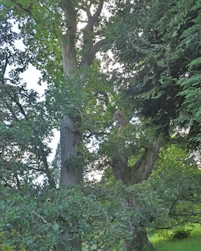 August 2024
 August 2024
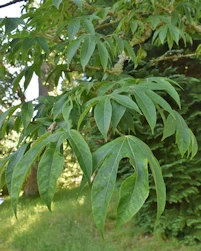
Kalopanax septemlobus Kalopanax - unkown origin; septemlobus - means seven lobes, referring to the leaves maximowiczii - after Russian botanist Carl Maximowicz
Tree Aralia
A.k.a. castor oil tree, Prickly castor oil tree The thick twigs are covered with sharp spines when young. A medium to large sized tree growing to 10-15 m, The individual flowers are arranged in globular bundles, which together form panicles loose branching clusters of flowers 30 cm long and wide, followed by small blue-black berries. The trunk can be 1m diameter, usually single-stemmed but prone to suckering in disturbed ground. The bark is thick, grey-brown, soon developing longitudinal ridges, prominently ridged and furrowed on old trees..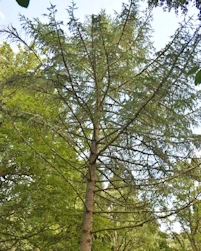 August 2024
 August 2024
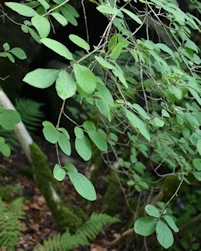
Larix - the Latin name for larch; principis-rupprechtii - after Prince Rupprecht of Bavaria, a keen botanist who collected this particular larch variety.
Prince Rupprecht's larch
A.k.a. Larix gmelinii - after botanist Johann Georg Gmelin var. principis-rupprechtii, is a vigorous form of larch native to the mountainous regions of the Shanxi and Hebei provinces of N China. In the wild, it grows to 20m, with a broad conic but open crown and horizontal branching. Bright green needles 3 cm long in brush-like clusters appear at the ends of spur-like shoots along the branches. Cones slightly larger than the species emerge purple but mature to light brown.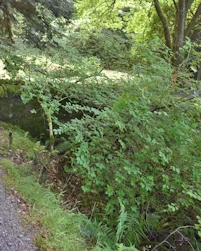 August 2024
 August 2024