×
![woodturning]()

Trees Gallery - Dawyck Botanical Gardens. Page 3
Near Peebles, Scottish Borders
 August 2024
 August 2024
 August 2024
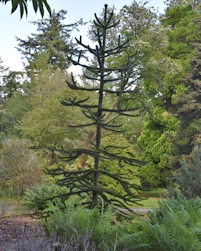
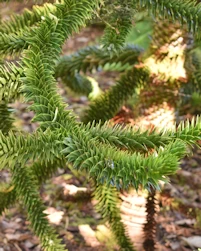
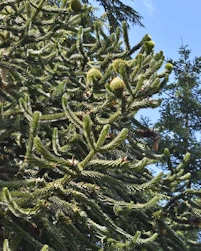
Araucaria araucana araucaria - after a region of Chile; araucana - the native tribe who used the tree's seeds for food.
Monkey puzzle
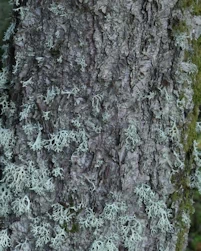
A.k.a. monkey tail tree, pewen, pehuen pine or piñonero, an evergreen tree growing to 30–40 m, native to C and S Chile and W Argentina. It is on the IUCN list as endangered in its native region due to logging, forest fires, and grazing. It is usually dioecious male and female cones on separate trees . The male (pollen) cones are oblong and cucumber-shaped. It is wind pollinated. The bark can be up to 15 cm thick, possibly an adaptation to resist wildfires.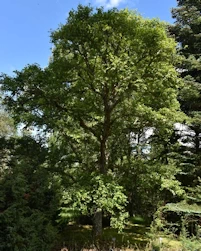 August 2024
 August 2024
 August 2024
Betula dahurica betula - birch, dahurica, from the region of Davuria (Dahuria) in SE Siberia and NE Mongolia
Daur's birch
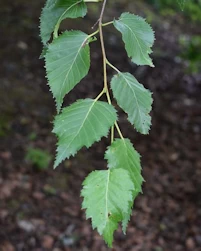
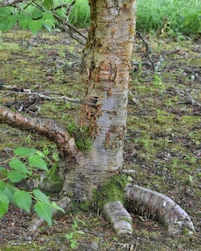
A.k.a. b. davurica, Dahurian birch, or Asian black birch, a medium sized deciduous tree growing to 20 m, native to China, Japan, Korea, E Mongolia, and Russian Far East. Tiny monoecious flowers are contained in drooping, brownish male catkins and smaller, upright, greenish female catkins, both of which appear in spring on the same tree. Most birches are self-incompatible, however, so two trees are needed to achieve production of seed. Female flowers are followed by drooping cone-like fruits containing numerous, small, winged seeds that typically mature in late summer.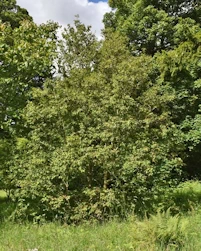 August 2024
 August 2024
 August 2024
Betula ermanii betula - birch, derived from the Gaulish betu- meaning bitumen or asphalt, referring to the tar extracted from birches; ermanii - after German natural scientist George Adolph Erman
Erman's birch
A.k.a. Russian rock birch, an extremely variable species growing to 20 m, found in NE China, Korea, Japan, and Russian Far East. It is Yellow-brown male catkins appear with the leaves in spring. The bright green, heart-shaped leaves are often the first to emerge in spring gardens, and first to fall in the autumn, turning a bright and clear yellow before they fall. If the central leader is retained, it retains a tidy, conical, pyramidal shape as it matures.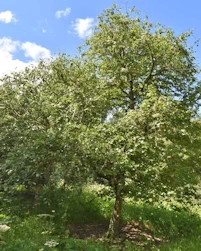 August 2024
 August 2024
Betula pubescensbetula - birch, derived from the Gaulish betu- meaning bitumen or asphalt, referring to the tar extracted from birches; pubescens - covered with soft, short hairs; glabrata glabrata - smooth, lacking hairs (on the leaves in this variety)
Smooth-leaved downy birch
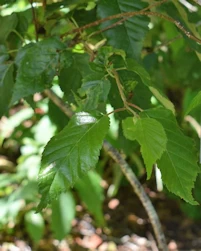
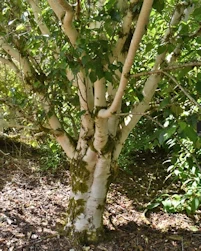
A.k.a. B. pubescens var. pubescens, moor birch, white birch, European white birch, or hairy birch, a native of N Europe and N Asia, growing further north than any other broadleaf tree. Young trees have smooth, silvery-white bark that darkens and develops horizontal lenticels as they mature. Young twigs are characteristically hairy, which is where the tree earns its name. It produces both male and female catkins on the same tree (monoecious).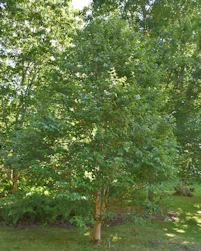 August 2024
 August 2024
 August 2024
Betula utilis jacquemontii betula - birch, derived from the Gaulish betu- meaning bitumen or asphalt, referring to the tar extracted from birches; utilis - useful, referring to the many uses of the tree; jacquemontii - honouring the French naturalist Victor Jacquemont
Himalayan birch
A.k.a. Himalayan birch, white-barked Himalayan birch or Indian paper birch, a fast growing, deciduous tree reaching 15 - 20 m, native to W Himalayas. It is graceful in appearance and offering light dappled shade with its open, conical crown. In spring, yellow catkins appear, closely followed by dark green ovate leaves. In autumn, the foliage turns golden yellow before falling.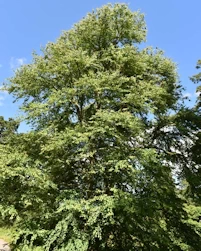 August 2024
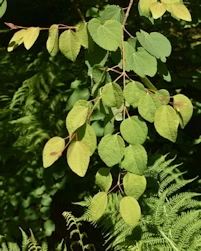 August 2024
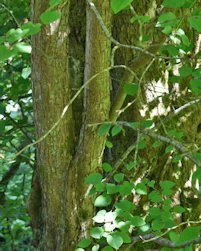 August 2024
Cercidiphyllum japonicum cercidiphyllum: Greek Cercis - redbud and phyllon -leaf, referring to the leaf shape's resemblance to the redbud genus cercis; japonicum - of Japan;
Katsura tree Katsura - Japanese name for the tree (カツラ, 桂).
A.k.a. caramel tree for the light caramel smell it emits during leaf fall, and candyfloss tree because of the scent. A deciduous tree growing 10–45 m tall, a native of Japan and E China. The flowers are inconspicuous and produced in early spring among the opening leaves, with male and female flowers on separate plants (dioecious). The fruit is a cluster of two to four follicles a dry, dehiscent fruit derived from a single carpel that splits open along one side (a single suture) to release its seeds. , each containing several winged seeds. August 2024
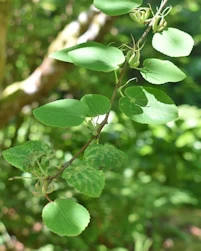 August 2024
Cercidiphyllum cercidiphyllum: Greek Cercis - redbud and phyllon -leaf, referring to the leaf shape's resemblance to the redbud genus cercis; magnificum magnificum - magnificent, large (relating to the leaves);
Large-leaf KatsuraKatsura - Japanese name for the tree (カツラ, 桂).
A.k.a. caramel tree for the burnt sugar smell it emits during leaf fall, and candyfloss tree because of the scent. This variety is smaller that c. japonicum, only reaching 10 m; only native to Japan, not China. The species is dioecious having separate male and female trees , with small inconspicuous flowers appearing early in spring that are wind pollinated. The flowers lack petals, the male being reddish and the female greenish. Female trees produce woody, pod-like fruit in clusters of 2–4, each about 1–2 cm long. The pods contain many small flattened seeds that are winged at both ends.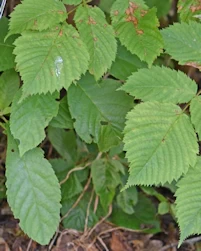 August 2024
Clethra barbinervis Greek klethra - alder, (the leaves resemble alder but it is not related) barbinervis - barbed or bearded veins;
Japanese clethra
An upright shrub growing to 3 m, native to E Asia, where it is found in open mountain forests of S China, Korea, and Japan. Its leaves are deciduous, dark green, and are 5 cm long. Racemes of small, fragrant, white flowers 15 cm long are produced in late summer and autumn. Mature specimens have peeling bark. The bark is plain, blackish brown with twigs turning back.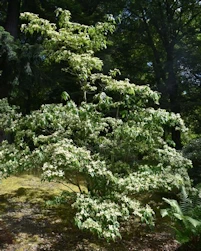 August 2024
 August 2024
Cornus kousa Latin Cornus - horn, from the cornel tree, (not clear) kousa - the Japanese name for the tree
Kousa dogwood possibly from dagwood - dags being sharp skewers, which the dogwood could furnish (cf. dagger)
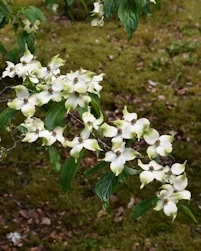
A.k.a. Chinese dogwood, Korean dogwood, or Japanese dogwood. A small deciduous tree growing 8–12 m, native to E Asia including Korea, China and Japan. Like other Cornus, C. kousa has opposite, simple leaves, 4–10 cm long. The fruit is a globose red compound berry 2–3 cm in diameter. It is edible, with a sweet and creamy flavour, and is sometimes used for making wine.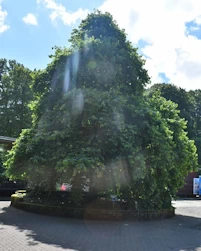 August 2024
 August 2024
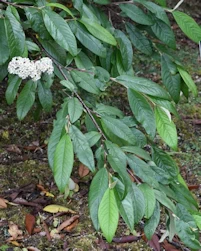
Corylus Colurna Greek Korylos -hazelnut Colurna - Latinised name of the Turkish hazel
Turkish hazel
The information board says: This tree was first planted in the Royal Botanic Gardens Edinburgh, as part of a collection of street trees being trialled for training. It was then transplanted to Dawyck where it was tended to carefully, surviving - with careful protection - the building works as the Visitor Centre was developed through 2007-8. This is a true hazel, bearing nuts not unlike our British cobs - but smaller and lacking their taste - and surrounded by a softly spiny husk. Native across south east Europe and into western Asia, it is indeed found in Turkey. Its characteristic pendulous yellow catkins appear in late winter, with the nuts maturing in autumn as the leaves fade to a lustrous yellow. Its elegant conical shape and thick corky bark are features that can be admired year round. Although its nuts are inferior, Turkish hazel is important to commercial hazelnut production. Its non-suckering habit makes it an ideal rootstock for orchards, onto which to graft the common hazel cultivars.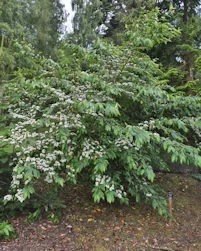 August 2024
 August 2024
Cotoneaster cornubia cotoneum - Latin name for quince, aster, 'resembling'; cornubia - the Latin name for Cornwall, though the cross was raised in Exbury, Hampshire.
Cotoneaster cornubia
A.k.a. c. x watereri - in honour of English horticulturalist and explorer Anthony Waterer cornubia, c. frigidus cornubia, a vigorous, arching semi-evergreen shrub or tree to 6m, native to the Himalayas. White summer flower clusters are followed by heavy trusses of large, bright red berries. Although the flowers are not particularly pleasant smelling, they attract beneficial insects, and the berries are appealing to birds.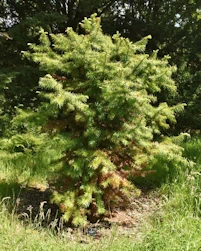 August 2024
 August 2024
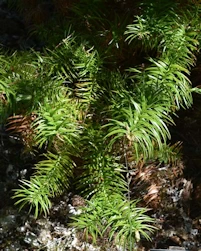
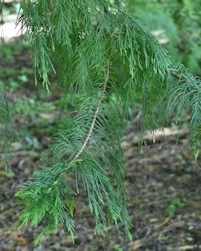
Cunninghamii konishii Cunningham - after both Allan Cunningham (botanist) and Dr. James Cunningham, (British doctor who introduced the trees into cultivation in 1702); konishii - probably after a Japanese plantsman N.Konishi, possibly with its Japanese meaning 'small west'.
Taiwan cunninghamia
A large evergreen tree native to SE China, Taiwan, Laos and Vietnam. of large size with reddish-brown bark. It differs from C. lanceolata by the leaves of adult trees being much smaller, in their standing out all round the branches, and in their having stomata on both surfaces in the adult state; they are said to persist on the branches for eight years instead of about five as in C. lanceolata. The ovoid-conical cones, too, are considerably smaller. It thrives less well in cultivation.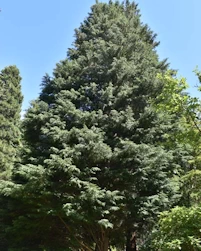 August 2024
 August 2024
 August 2024