×
![woodturning]()

Trees gallery - Isle of Mull
Scotland
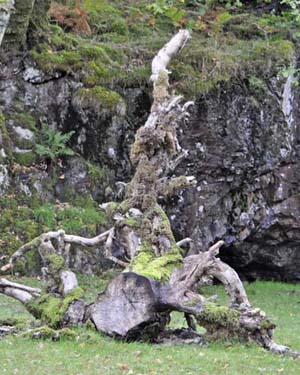

Root sculpture
Loch Spelve
This old root structure continues to provide habitat for mosses and lichens, and has a sculptured form to it, with its trunk cut off and roots upended.Was this accidental or was it left this way on purpose?
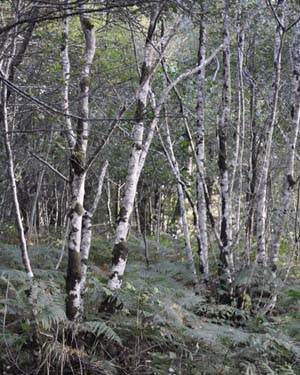

Betula pendula
Silver birch
This line of silver birch at Aros Park, near Tobermory, looks like they have been coppiced cut back to ground level periodically to stimulate growth at some time in the past. Further along were more standard growths of birch, with a single tall trunk.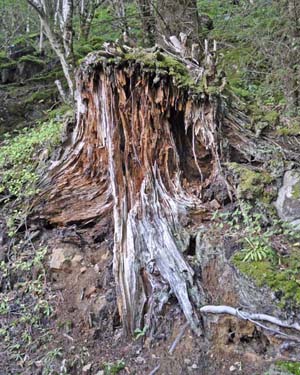

Stump with stagshorn fungus
Aros Park
A large stump by the lochan at Aros Park. Yellow stagshorn fungus was growing in the decaying wood.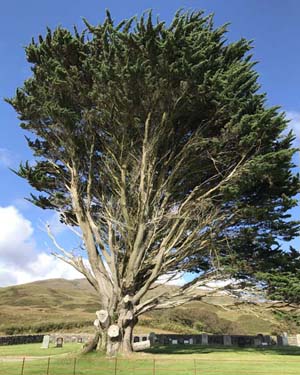
Taxus baccata
Yew
A massive yew growing in an isolated burial ground, on the shores of Loch Spelve. I beileve this is Killean Cemetery, and the place is called Balure. No habitation nearby, just a fish farm. Balure could be from the Gaelic Ball-y-ure meaning "place of the yew". The yew dominates the roadside landscape, out of character with the scrub and oakland along the loch side. One of the graves is of an unknown sailor, washed up iin Loch Spelve during the second world war, and buried here in 1940.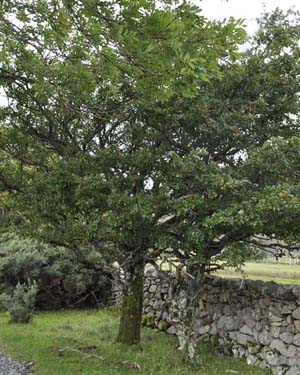
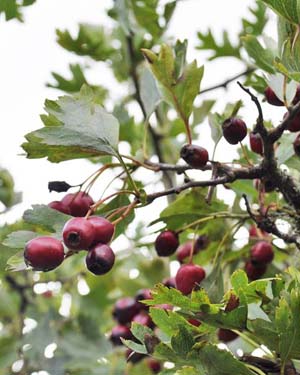
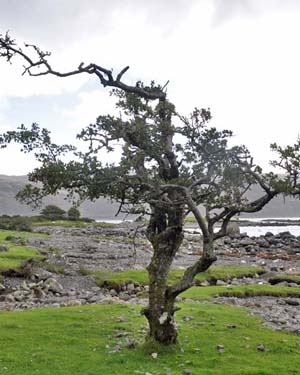
Crataegus monogyna
Hawthorn
Often clipped as a hedge, but if allowed to grow naturally it will turn into a fine, usually contorted, small tree. Battered by the coastal winds, it can be a struggle for survival (left), but with a little shelter a handsome tree can shape up as well (right). Both trees pictured here were growing at Lochbuie, only a hundred yards apart.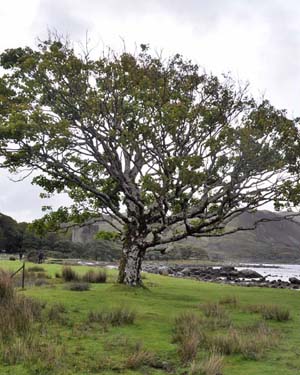
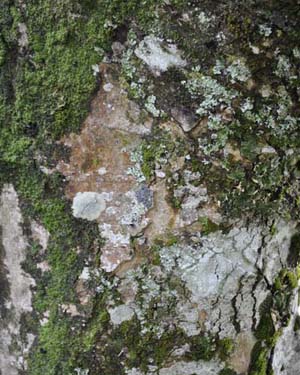

Acer pseudoplatanus
Sycamore
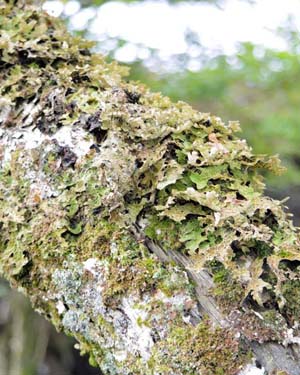
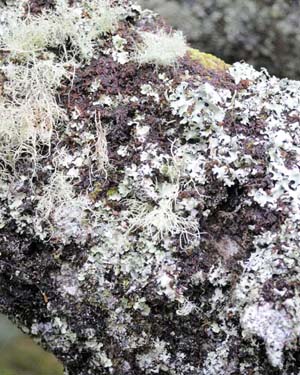
We didn't see many sycamores in the coastal woodland on Mull, but there were two large specimens near Moy castle at Lochbuie. One standing almost as a specimen tree on the shore, the other on the edge of the estate grounds of Lochbuie House. The characteristic flaking bark just shows through the moss and lichen.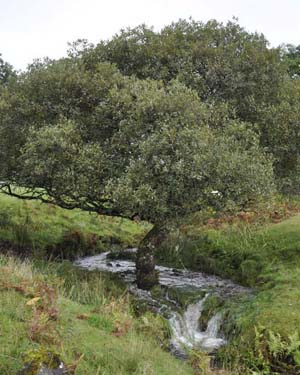
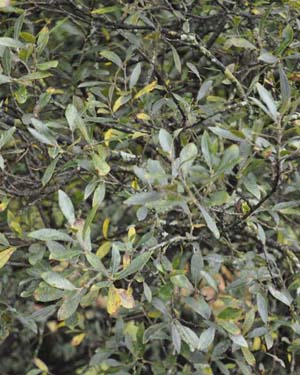
Salix fragilis?
Willow
A small but sturdy tree growing in the middle of a stream at Croggan, by Loch Spelve. A willow of some sort I think, possibly the crack willow, but possibly something more unusual.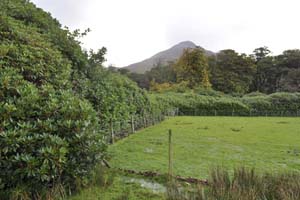

Rhododendron ponticum
Rhododendron
Introduced to many stately home gardens in Victorian times, prized for their showy flowers in May, rhododendron has now escaped to many natural areas and has become a major pest. Large swathes along the shore at Lochbuie have escaped from Lochbuie House estate. It colonises by seeds and by root, and blocks out light for all competitors, and makes the ground around it toxic to other species, becoming an unnatural monoculture extremely difficult to eradicate. Millions of pounds are being spent on mechanical, biological and chemical clearances to try and check the spread. It is proving a very difficult task, with cleared soil not recovering to its previous state, and shoots reappearing even after burning or chemical warfare is waged. Native to the Iberian peninsula, Lebanon, Turkey, Caucasus, SE Europe. A neophyte a plant not native to a region, introduced and escaped into the wild in recent history (after 1500) .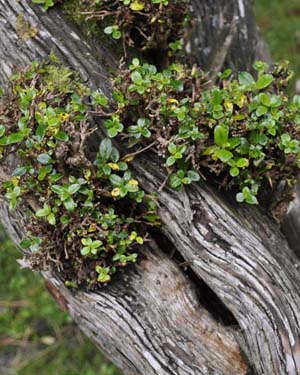


Escallonia
Escallonia
Another escape, though this time not invasive. When I saw this tree growing at the side of Moy Castle, at first I thought it was a holly. Closer inspection revealed it was an escallonia, a common garden plant, often used as a flowering hedge, and common in seaside gardens due to its resistance to sea air. This has probably escaped from Lochbuie House estate many years ago, and although growing almost horizontally, has developed into a fascinating rugged small tree. Not fully hardy in the UK, this one has no doubt benefitted from Mull's relatively mild west-coast climate.