
Trees Gallery - Nunnington Hall
Ryedale, North Yorkshire
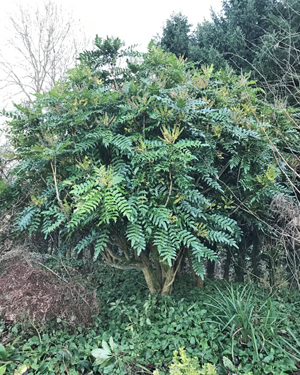
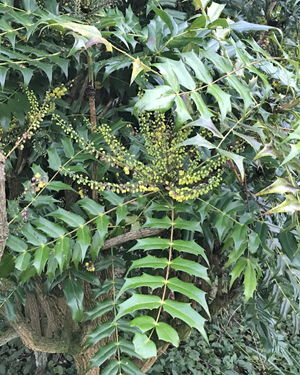
Mahonia aquifolium
Oregon grape
A vigorous, low, spreading, evergreen shrub with glossy green, slightly prickly leaves becoming purplish in winter. Large clusters of yellow flowers begin to emerge in winter, followed by the small black berries which give it the common name. Native to W North America , it has recently been re-classified by POWO Plants of the World Online as Berberis aquifolium, without a distinct mahonia sub-species.
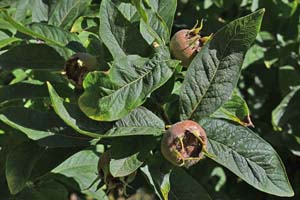
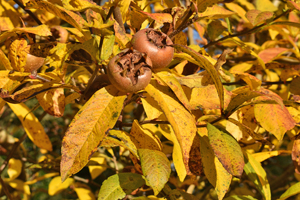
Mespilus germanica
Medlar tree
A medlar tree grows in the tea garden at the rear of the hall. An insignificant looking tree until these unusual, fascinating fruits form in summer, and the leaves turn brlliant colours in late autumn. A member of the rose family, the fruits are tart and need to be bletted placed in sawdust and left to rot until soft, releasing the sugars before eating. The open calyx led to some crude alternative names, such as "open-arse" – or in France, it was variously known as la partie postérieure de ce quadrupede (the posterior part of this quadruped), cu d'singe (monkey's bottom), cu d'ane (donkey's bottom), and cul de chien (dog's bottom).
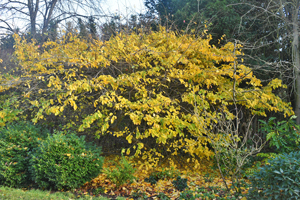
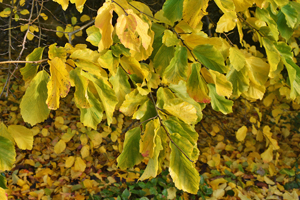
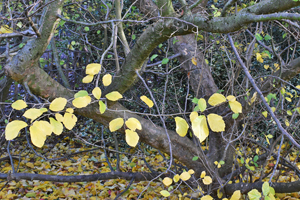
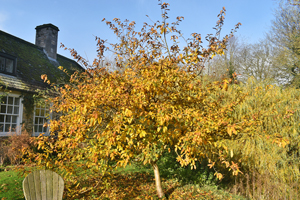
Parrotia persica
Persian ironwood
A bright coloured leaf-show in late November. Leaves stay on the tree for an extended period as they turn a multitude of colours from yellow to deep red. The leaf show is followed by ruby-red flowers which resemble witch-hazel (they are closely related) in winter. Usually multi-stemmed, the tree oftern spreads much wider than its height. It is critically endangered (IUCN) International Union for Conservation of Nature in its native Iran, but is widely planted as an ornamental plant in parks and gardens across the country.


Piptanthus nepalensis
Himalayan laburnum
A semi deciduous medium sized (3-4m) shrub which can develop a single trunk, though multiple shoots are more common. Quick growing and vigorous but fairly short lived as a result. It bears bright yellow pea-like flowers in upright racemes a flower cluster with the separate flowers attached by short equal stalks at equal distances along a central stem. . The flowers have hairy bracts and appear in May/June.

Pyrus communis 'Beurre Hardy'
French butter pear
This pear is trained as an espalier a tree that is trained against a support with a central vertical stem and several tiers of horizontal branches , growing on the house wall as you enter the garden. There were some good looking pears borne on its tiered branches. Nick Fraser, head gardener, told me this variety is 'beurre hardy' beurre - butter (French), Hardy - after Jeanne Alexandre Hardy, chief gardener at the Luxembourg gardens in Paris in the 1800s - an old French variety still very popular for its melting butter taste. There are many other fruit trees trained on the walls around the garden.


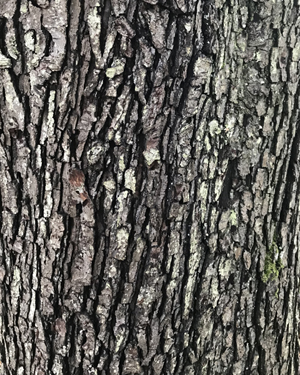
Pyrus communis 'Black Worcester'
Black Worcester pear
Another probable Roman introduction, but certainly present since medieval times. The fruits store well, so provided a welcome ingredient of the winter diet, though ideally should be cooked to eat. These two large trees dominate the pear orchard on the east of the garden, showing what can be if pears are not pruned and trained. Three pears appear on the Worcester coat of arms, the county having a long tradition of growing these pears.
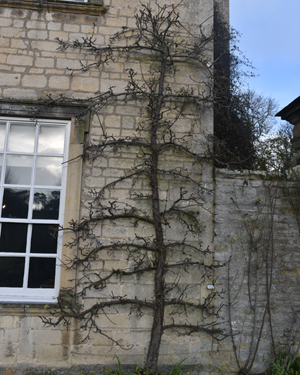
Pyrus communis 'jargonelle'
Pear 'jargonelle'
Yet another possible Roman introduction, but certainly noted in Britain by 1629. An early cropping variety with good flavour, trained here as an espalier to keep it sheltered and offer some warmth from the south facing wall.
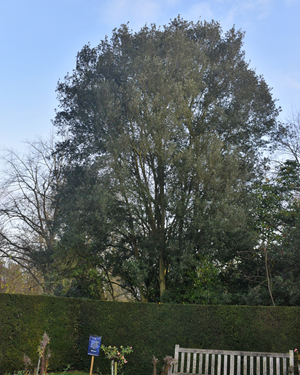

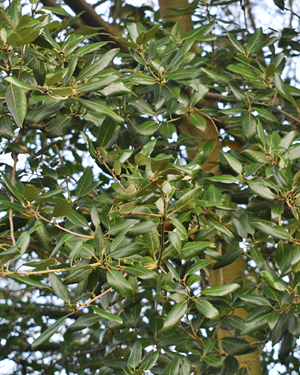
Quercus ilex
Holm oak
An evergreen broadleaved tree commonly used in shelterbelts protective border formed of tall trees and shrubs (over 4.5m) planted in three or four staggered rows due to its resistance to wind and salt. It was introduced to Britain in the late 1500s. Here it is growing as a specimen tree planted in the mixed tree and shrub border of the lime avenue.
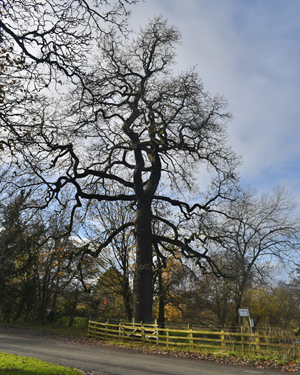
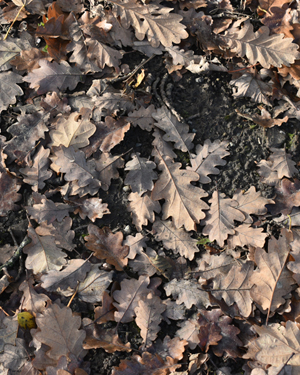
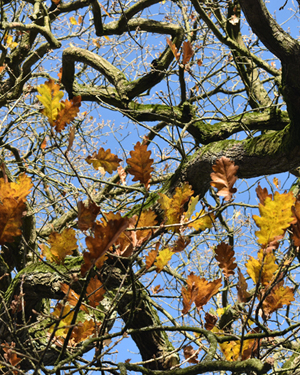
Quercus Robur?
Oak
This impressive oak is just across the road opposite the entrance to the car park. I think it is the English oak, Q. robur, but looking at the leaves on the ground they look more like sessile oak: they have stalks, and they do not appear to have intercalary veins comparatively large veins from the midrib to the sinus between two lobes. . Against this they do appear to have auricles a small ear-like projection from the base of a leaf or petal at their base, and the Ancient Tree Inventory appears to list a pedunculate oak just about here, along with 9 others around the car park . Could it be a hybrid of the two? They do hybridise quite readily. I couldn't find any acorns - peduncles a stalk bearing a flower or fruit or absence of peduncles on the acorn usually fix the identification.
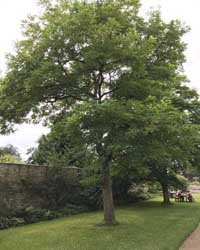
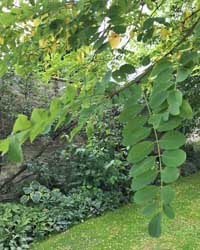
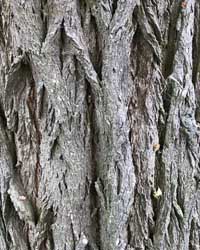
Robinia pseudoacacia
False acacia
Two trees planted by the wall near the entrance to the garden. There used to be three here, but the end one suffered during severe flooding and had to be felled. There are 5 - 21 pairs of oval leaflets on the pinnate leaves. Fast growing, they can reach 25m in height. Native to North America, introduced to the UK in 1626, now a common feature on many urban roadsides. Also known as Black locust.
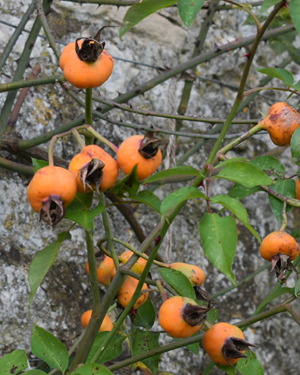
Rosa 'Madame Gregoire Staechelin'
Spanish Beauty rose
Not really a tree, but too good not to include these wonderful large rose hips on this climbing hybrid-tea rose. A vigorous climber cultivated by Pedro Dot, a Spanish rose breeder. I cannot find out who Madame Gregoire was.
As well as the glorious hips, this is one of the first roses to bloom in the garden, pink with a wonderful scent.
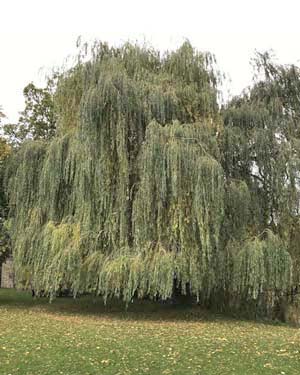
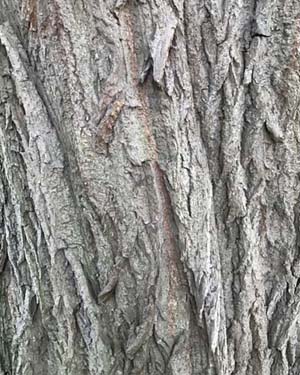
Salix babylonica
Weeping willow
I am guessing at S. babylonica There are other species names for weeping willow, and many cultivars of S. babylonica. Native to China, a deciduous tree which grows rapidly but is relatively short lived (40-75 years). It is dioecious having male and female reproductive parts on separate plants , with male and female yellow catkins on different trees.
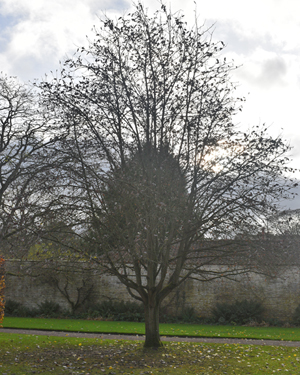
Sorbus aria
Whitebeam
A poor picture taken in late November of a whitebeam in the area close to the bridge. I must return in spring when the leaves show off their white undersides, and flower panicles a loose branching cluster of flowers are in abundance, and in early autumn when the profusion of red berries is in evidence. Whitebeam is native to scrub and open woodland in Britain, though is more commonly seen planted in parks and gardens than growing in the wild.
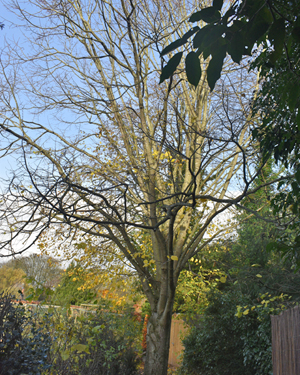
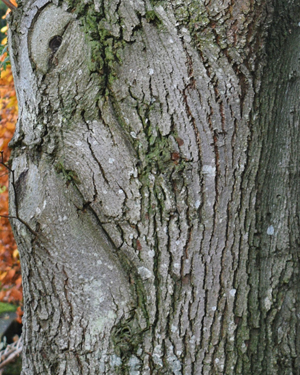
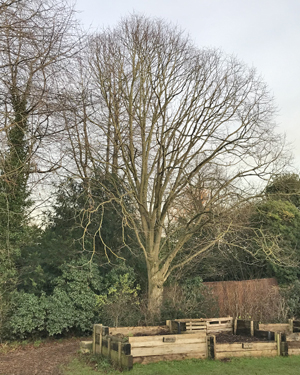
Tilia x europaea
Common lime
This lime and others in the garden are probably the common lime, a naturally occurring hybrid between the small leaved (T. cordata) and large leaved (T. platyphyllos) species. This one is near the bird observation area; more line the grassed hill leading to a view of the house, known as the lime avenue, a common feature in stately homes. I find it very difficult to distinguish between the three types.
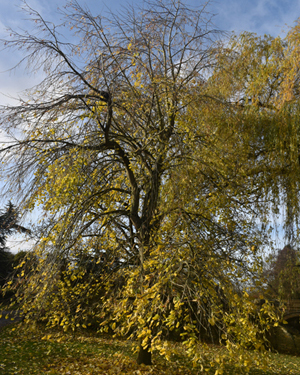
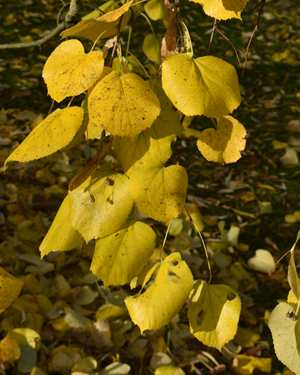
Tilia tomentosa petiolaris
Weeping silver lime
Planted as Nunnington’s Millenium tree (in 2000), this vigorous cultivar has turned from a young sapling into a large tree. 'Silver' refers to the underside of the leaves, which are felt-like, hairy and white. Tomentosa references the hairy leaves, petiolaris the small foot on the stalk below the leaves. It has a modest weeping habit - though some branches are heading upwards rather than drooping down. When I visited in November 2023, head gardener Nick Fraser suggested these may need trimming to retain the pendulous habit.
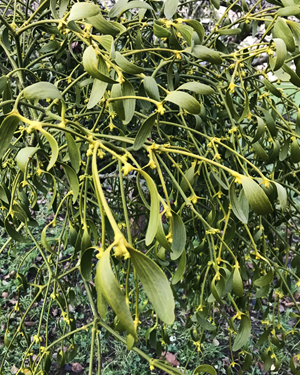
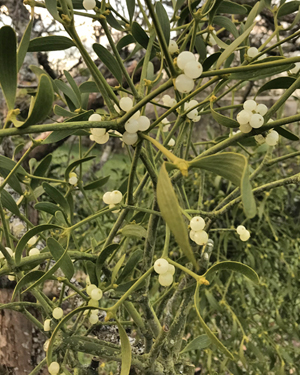
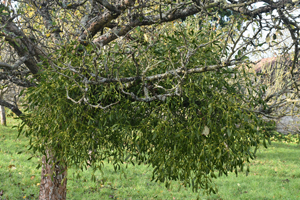
Viscus album
Mistletoe
A parasitic evergreen shrub that grows in abundance on the apple trees in the orchard. Mistletoe leaves, stems and berries are all poisonous. The fruit is a waxy, white berry which grows in clusters of two to six. The seeds inside are coated in a sticky substance which sticks to the beaks of birds feeding on the fruit, helping to spread the seeds as they try to wipe it off.