×
![woodturning]()

Trees Gallery - Branklyn Gardens. Page 2
Perth, Scotland
 July 2024
 July 2024
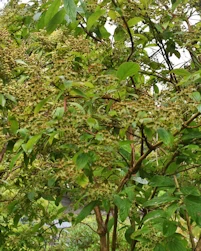
Deutzia longifoliadeutzia - genus name honours Johann van der Deutz, a 18th-century Dutch botanist; longifolia longifolia; veitchii - after British horticulturalist John Gould Veitch Veitchii
Beauty bush
A native of W China. An upright medium-sized deciduous shrub with arching branches and lanceolate, dull greyish green leaves, sprinkled with pale, flat, stellate hairs. Flowers are a deep lilac-pink, in large corymbose panicles loose branching flowers with lower flowers having longer pedicels than the upper ones, creating a flat-topped appearance .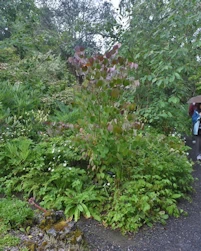 July 2024
 July 2024
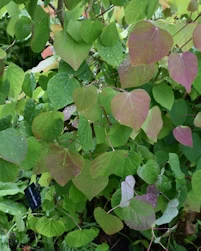
Disanthus cercidifolius from Greek dis, twice and anthos, flower, referring to the paired flowers; cercidifolius - leaves resemble those of the redbud (cercis).
Red-bud hazel
A medium-sized deciduous shrub native to the woodlands of China and Japan, growing to 3 m tall. It is noted for its heart-shaped leaves which turn to shades of red, purple and yellow in autumn. It is a calcifluge requiring lime-free soil.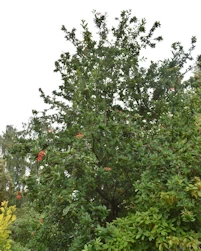 July 2024
 July 2024
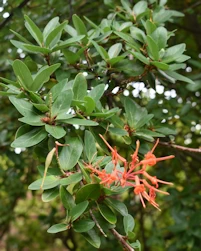
Embothrium coccineum - embothri Greek for 'little pits', referring to the small indentations where the anthers are inserted; Coccineum, Latin for scarlet, referencing the vibrant red flowers
Chilean fire bush
A tree native to Chile, growing up to 15 m.. The bark is dark grey with light spots and the wood is light pink in colour. It produces clusters of deep red flowers (occasionally pale yellow), with flowering occuring in spring. The fruit is a dry follicle, with about 10 seeds inside. The wood being very soft but durable is used for making spoons, kitchen vessels and other craft articles.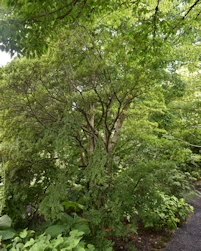 July 2024
 July 2024
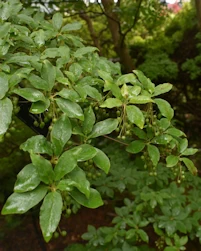
Enkianthus deflexus - from Greek enkyos, swollen or pregnant; anthos, flower; referring to each flower seemingly holding another within. deflexus from Latin, 'bent down' or 'curved downwards', referring to the pendulous bell-shaped flowers.
Himalayan red bells
A vigorous, upright, deciduous shrub with red shoots and glossy, oval, bright green leaves turning red and orange in autumn. It produces hanging clusters of bell-shaped, red flowers in late spring and early summer.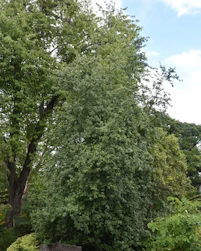 July 2024
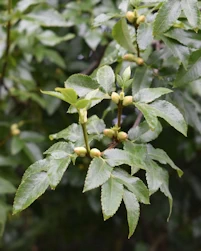 July 2024
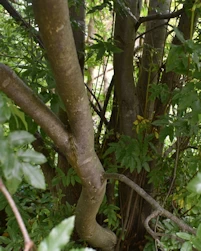 July 2024
Eucryphia glutinosa - from Greek eu, well; kruphios, 'hidden', referring to the way the small sepals cover the flower buds; glutinosa, from Latin glutino, 'sticky'.
Brush bush
A.k.a. as nirrhe, a large deciduous shrub or small tree growing to 10 m, native to moist woodland habitats in Chile. Single (or occasionally double) four-petalled, fragrant white flowers with prominent stamens appear in late summer. The fruiting capsule is woody, 1–2 cm long.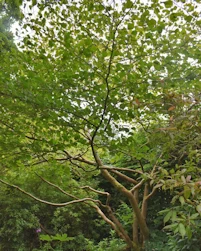 July 2024
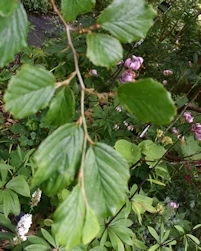 July 2024
 July 2024
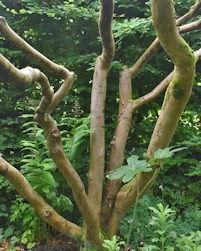
Hamamelis japonica - from Greek hama, 'together'; and melis , 'fruit', referring to simultaneous flowering and fruiting. Japonica, 'from Japan'.
Japanese witch hazel
A native to Japan but widely cultivated in temperate situations elsewhere. A horizontally spreading, hardy deciduous shrub or small tree, notable for the slightly fragrant yellow blooms which clothe its naked branches in the depths of winter through to early spring (usually in January and February). The green leaves follow, and in favourable locations they turn yellow before dropping in autumn. H. japonica is one parent of the hybrid Hamamelis × intermedia, an extremely popular and widespread award-winning garden shrub, whose other parent is H. mollis.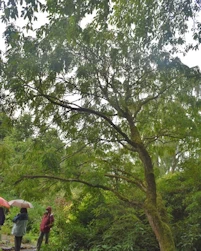 July 2024
 July 2024
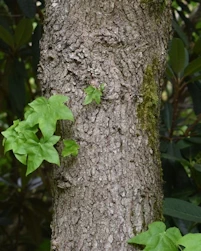
Koelreuteria paniculata - after German botanist Joseph Gottlieb Koelreuter (1733-1806), known for his plant hybridization experiments. Paniculata, from Latin referring to the tree's inflorescence, which is in panicles (branched clusters of flowers).
Golden rain tree
A.k.a. pride of India, China tree and the varnish tree. A small to medium-sized deciduous tree growing to 7 m, with a broad, dome-shaped crown. The leaves are pinnate, 15–40 cm long, with 7–15 leaflets, with a deeply serrated margin; the larger leaflets at the midpoint of the leaf are sometimes themselves pinnate. The flowers are yellow, with four petals, growing in large terminal panicles. The fruit is a three-part inflated bladderlike pod, that is green, then ripening from orange to pink in autumn. It contains several dark brown to black seeds 5–8 mm in diameter. [Wikipedia]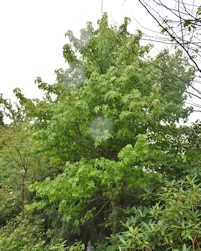 July 2024
 July 2024
 July 2024
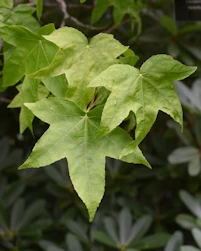
Liquidambar styraciflua - from Latin liquidus - liquid; and Arabic ambar, amber, referring to the liquid amber-like resin. Styraciflua - 'flowing with styrax' or 'flowing with resin'
Sweetgum
A deciduous tree growing to 20m, broadly conical in outline, with rather glossy, maple-like leaves. Unisexual, greenish flowers appear in spring and persist into autumn; with some persisting into winter. Staminate male flowers are in terminal racemes 5–8 cm long, pistillate female are in a solitary head on a slender peduncle borne in the axil of an upper leaf. The distinctive compound fruit is hard, dry, and globose, up to 40 mm in diameter, composed of numerous (40–60) capsules.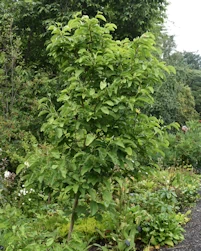 July 2024
 July 2024
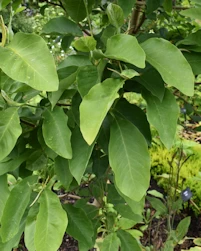
Magnolia daphnemagnolia- after botanist Pierre Magnol (1638 - 1715); daphne - a name applied to the cultivar
Magnolia daphne
Compact, upright, deciduous shrub or small tree growing to 7m, with an upright habit, with broad, pointed mid-green leaves to 10cm long, and producing rich yellow, long-lasting tulip-shaped flowers 10cm across, in mid to late spring after the leaves, and after the frosts; born upright at the tips of each branch.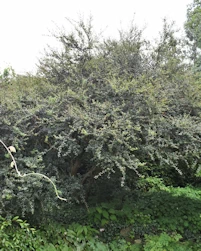 July 2024
 July 2024
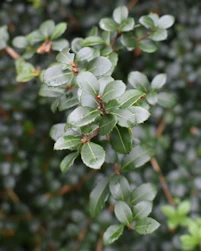
Osmanthus delavayi osme - from Greek, smell, fragrance, anthus - flower, referring to the fragrant flowers; delavayi - after Pierre Jean Marie Delavay (1834-1895), a French missionary and plant collector who introduced the species from China to Europe.
Tea olive
Commonly referred to simply by it latinised name, osmanthus delavayi. A dense, rather slow-growing medium-sized evergreen shrub, eventually reaching up to 4 m. Over several weeks in late winter to spring, it bears abundant small, highly-scented white flowers in clusters, followed by small, blue-black berries. July 2024
 July 2024
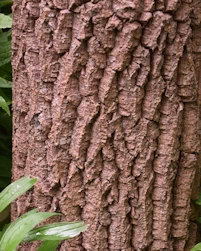
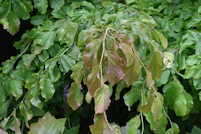
Oxydendron arboreum - from Greek oxys (acid) and dendron (tree), and Latin arboreum (tree like).
Sourwood
A.k.a sorrel tree, a deciduous small tree native to E North America, growing 10–20 m. Alternate leaves are 8–20 cm long, heavily laden with , a finely serrated margins; they emerge bronze green, turning darker in summer, then vivid red in autumn. The bell-shaped flowers are cream-white, up to 9 mm long; the fruit is a small woody capsule.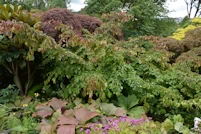 July 2024
 July 2024
Parrotia persica - named after Georg Friedrich Parrot (1767 - 1852), a German naturalist; and persica refers to the tree's native habitat, Iran (i.e. Persia).
Persian ironwood
A quick growing multi-stemmed tree growing to 30 m and 15 m wide. The bark is smooth, pinkish-brown flaking to leave a mosaic of cinnamon, pink, green, and pale yellow patches in a similar manner to plane trees. The flowers are somewhat similar to witch-hazel flowers but dark red; they are likewise produced in late winter on bare stems, but differ in having only four rounded sepals with no petals. The fruit is a two-part capsule containing two seeds, one in each half.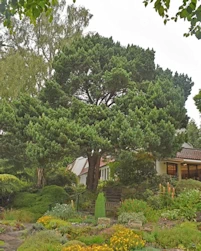 July 2024
 July 2024
 July 2024