×
![woodturning]()

Trees Gallery - RHS Harlow Carr - page 4
Crag End, Harrogate
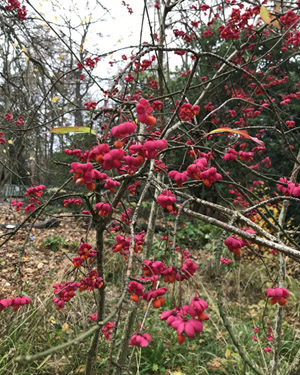 November 2021
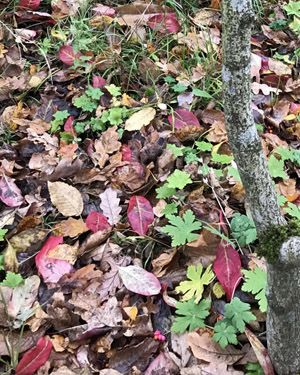 November 2021
Euonymous europaeus 'Red Cascade'
Common spindle
A large deciduous shrub or small tree which grows on the edges of forests across Europe. Autumn turns the leaves to scarlet, and then as they fall winged red fruits develop to continue the show of colour.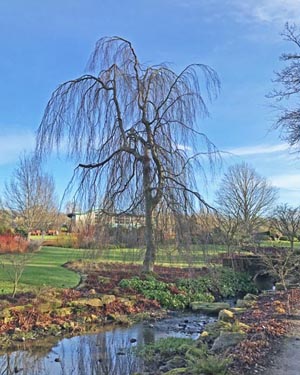 January 2022
Fagus sylvatica pendula
Weeping beech
This cultivar of the European beech, on which the branches droop from a tall central stem, was found in an English parkland in the 1830s, and propagated by cuttings ever since, being sold as a popular ornamental tree. It can grow to 25 metres. This picture shows the tree in January. When it comes into leaf, it will be thick and heavy. January 2022
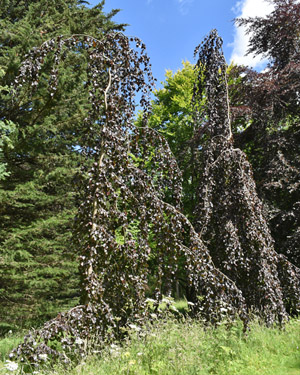 July 2022
Fagus sylvatica purpurea 'Purple Fountain'
Weeping Beech
Another variety of the common European beech, though its key feature - purple leaves - is not visible in winter. The variety grows in a fastigiate (columnar) way, with weeping branches tumbling down. Relatively small, reaching 10 metres. The variety was introduced to the UK in 1975 as a seedling from a tree in Holland. This particular specimen has an unusual 90 degree kink in it two thirds of the way up.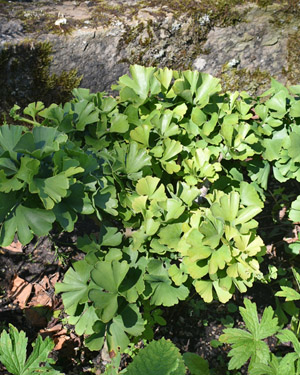 August 2023
 May 2022
Ginkgo biloba 'Troll'
Dwarf maidenhair tree
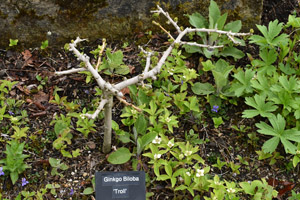
A very slow-growing, dwarf, compact, bushy tree with dark green, fan-shaped, ruffled leaves turning butter yellow in autumn. It might eventually reach 0.9m in height. The common name of maidenhair refers to the resemblance of its leaves to the maidenhair fern, (adiantum). The Latin name, biloba, refers to the two-lobed leaves. A native of China, ginkgo biloba is the last survivor of plants that grew 270m years ago, as witnessed by fossil remains. 'Troll' is a male cultivar with insignificant flowers, avoiding the unpleasant smells that female ginkgos exude.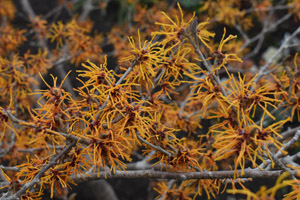 March 2023
 March 2023
Hamamelis intermedia
Hybrid witch hazel
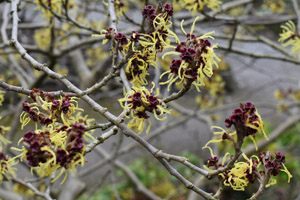
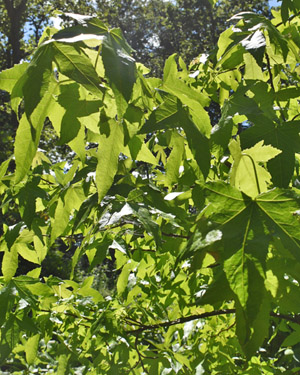
H. x intermedia is a hybrid of garden origin between H. japonica and H. mollis, with numerous named varieties. It is a deciduous shrub growing to 4 m tall, with zig-zagging stems and alternate, simple leaves which turn yellow in autumn. The yellow, orange or red flowers with twisted petals appear on bare stems in midwinter through to early spring.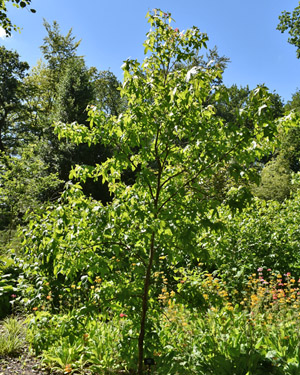 July 2022
 July 2022
Liquidambar styraciflua 'Palo alto'
Sweet gum
This cultivar forms a neat, conical tree to about 20m with glossy, maple-like foliage, providing reliable orange-red autumn colour over a long period. Inconspicuous clusters of small, yellow-green flowers are followed by long-lasting, hanging, spiky, dark brown fruit. ‘Palo Alto’ has regular growth, beautiful autumn colours and conspicuous corky fissures.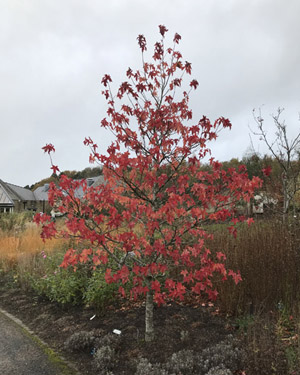 November 2021
Liquidamber styraciflua 'Lane Roberts'
Sweet gum
A broad-crowned medium-sized deciduous tree with maple-like, dark, glossy green leaves which turn to deep blackish-crimson for several weeks in autumn. This is a young specimen - eventually it will grow to 12 metres, with an 8 metre spread. Native to Central and NE North America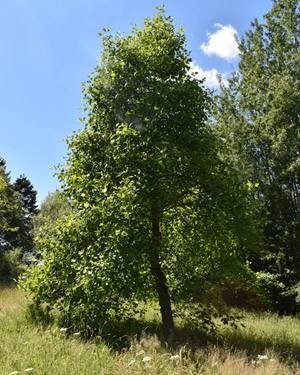 July 2022
 July 2022
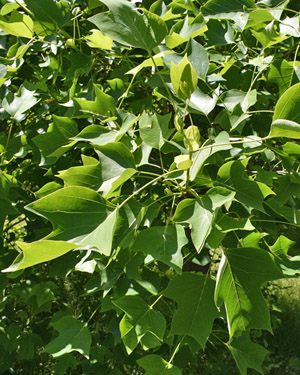
Liriodendron tulipifera
Tulip tree
One of the largest trees native to E North America, growing up to 50m, with trunk diameter to 1.8m. Named tulip tree because of its flowers, which look like tulips. A very important commercial timber. Probably one of the earliest American trees grown in England - from 1688. Older trees in Britain tend to have many burrs on their trunks.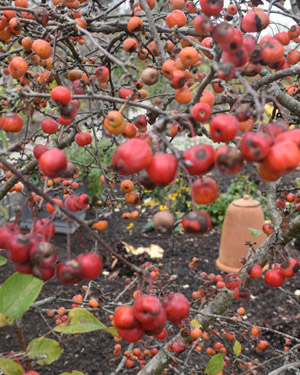 November 2022
Malus evereste
Crab apple
An ornamental cultivar of crabapple that was developed by INRA France's National Research Institute for Agriculture, Food and Environment' in 1974, and is registered under their trademark with the name Malus PERPETU. It is a small deciduous tree that grows to a height of 7m, and spread of 6m. The tree is conical in shape and has somewhat lobed, elliptical leaves. It flowers in spring, producing a large number of red buds which open into flowers with white petals tinted with pink. The fruits can be used for crab apple jelly, apple sauce or for pressing into a mixed cider brew. The crabapple can also be used as a pollenizer for domesticated apples that are self-sterile. [Wikipedia]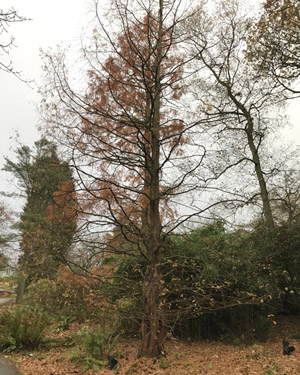 November 2021
 November 2021
 November 2021
 May 2022
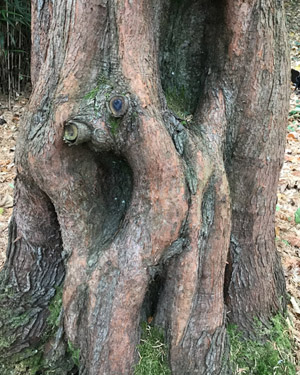
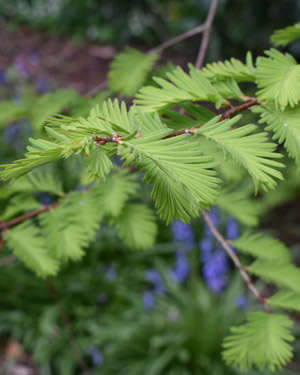
Metasequoia glyptostroboides
Dawn redwood
The dawn redwood is a deciduous conifer, fast growing, narrowly conical, tall (37m). An endangered species, growing in pockets in China. It is the sole living species (monotypic) of the genus Metasequoia , an example of a living fossil an extant taxon that cosmetically resembles related species known only from the fossil record. To be considered a living fossil, the fossil species must be old relative to the time of origin of the extant clade . The tree faces considerable risks of extinction in its wild range due to deforestation; however, it has been planted extensively in arboreta worldwide, where it has proved a popular and fast-growing ornamental plant.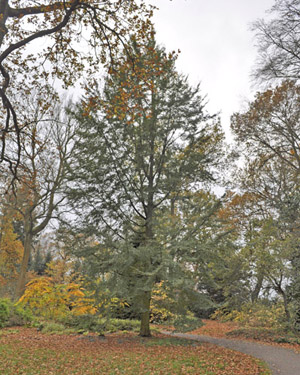 November 2021
 November 2021
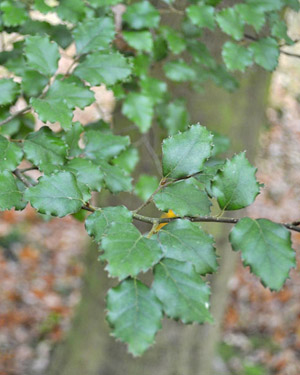
Nothofagus fusca
Red beech
A southern red beech, endemic to New Zealand. A medium sized (35m), fast growing evergreen tree.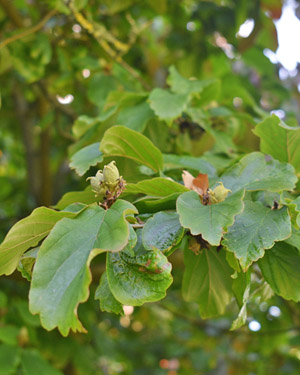 August 2023
 August 2023
 August 2023 ('Vanessa')
 August 2023 (Vanessa)
 December 2023