Trees gallery - Isles of Scilly - Hedges
Although The Isles of Scilly have a very mild climate, they are also battered by strong winds which are full of salt-laden air. To grow crops such as narcissi and other flowers, potatoes and vegetables, land has been divided up in to relatively small enclosures, bordered with high windbreak consist of a line of defence such as a hedge, fence, single or double row of trees hedging. In addition large shelter-belt formed of tall trees and shrubs (over 4.5m) planted in three or four staggered rows trees have been planted to reduce the effect of the gales.
Initially trees such as the elm were used for tall hedgerows, but being deciduous elm didn't do its job well when it was most needed, in the winter months. As trees and shrubs from across the world became known and available in the 19th century, many varieties were tried as tall hedging. The most successful were evergreens from New Zealand and Japan - Karo, Akeake, evergreen spindle. Tamarisk was also planted, but was not as successful. These hedges are now found in abundance across the islands, often intermingled, often up to 6 metres high. There are many escapes as well, naturalised on the moors and coasts.
There are other less prolifice exotic evergreen shrubs in evidence - escallonia, hedge veronica (shrub hebe), coprosma, even privet and rosa rugosa, but these tend to be more as garden hedging, not crop protection.
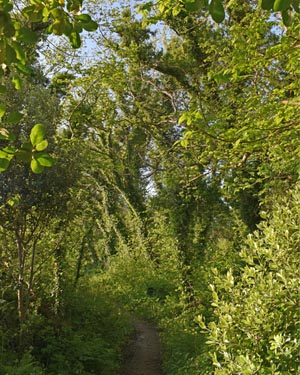
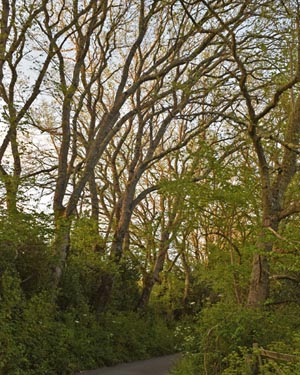
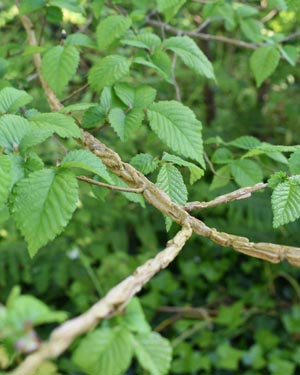

Ulmus procera
English elm
Elms on Scilly appear to have escaped the Dutch Elm blight, and prosper in lines of hedgerows, noticeably around Holy Vale on St Mary's. Considered something of a pest by farmers, due to their rampant suckering habit. Difficult to say which variety, probably with some hybridisation, but probably English elm. Other possibilities are Dutch Elm (Ulmus x Hollandica) and Cornish Elm (Ulmus Angustifolia Cornubiensis). I think Wych Elm (Ulmus Glabra) is also present, flagged up by the tell-tale papery samaras a winged achene, a type of fruit in which a flattened wing of fibrous, papery tissue develops from the ovary wall on paths, though once again these may be from one of the other varieties.
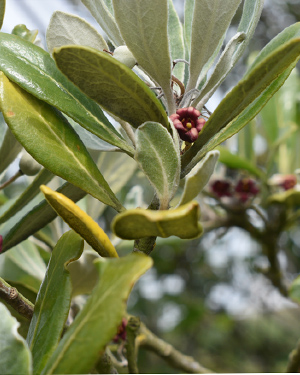

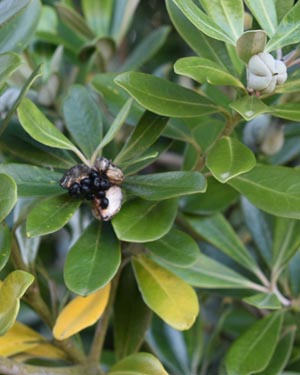
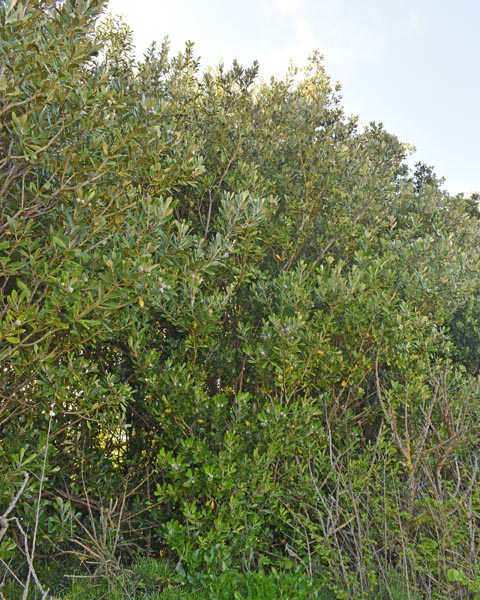
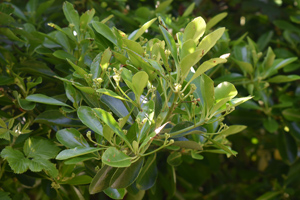
Pittosporum crassifolium
Kara
A native of New Zealand, planted widely across the Isles of Scilly to provide shelter for potato and flower crop fields because of its ability to withstand high winds and salt air. Its thick evergreen leaves can do the job throughout the year, unlike the elm hedges that preceded it before the 1830s. Hedges grow to anything from 2 to 6 metres high, and of course it has spread invasively as well, so it seen almost everywhere, by itself or mixed in with other plants.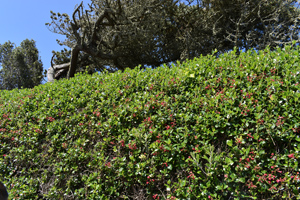
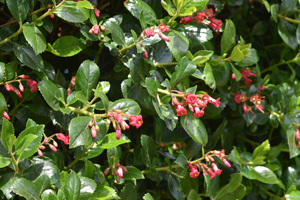
Escallonia rubra macrantha
Red escallonia
Seen all around the islands, mainly as garden hedging up to 2m tall, but also mixed in with other species in wilder places. It ticks lots of boxes for hedging - salt tolerant, quick growing, evergreen, dense growth, and with the added advantage of a long flowering period making it very bee friendly.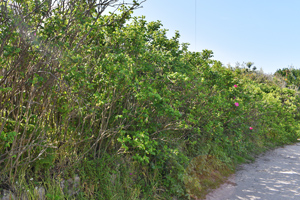
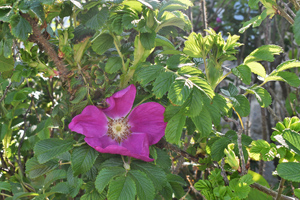
Rosa rugosa
Beach rose, Japanese rose
Seen around the islands, mainly as garden hedging up to 2m tall, but it also grows through other plants all over the islands, particularly on beaches and sand dunes.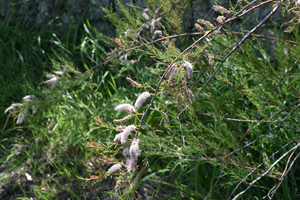
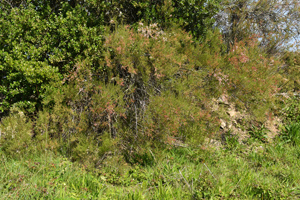
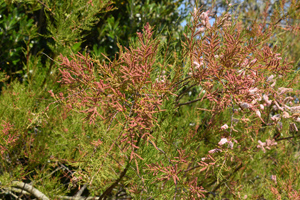
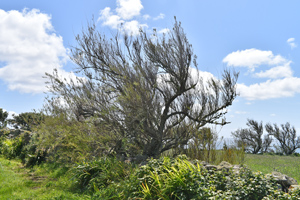
Tamarix gallica
Tamarisk
Planted extensively as a hedge due its high resistance to wind, and tolerance of salt. Can be long lived, spreads by seed and by suckering. In its native mediterranean climate it can grow into a medium sized tree. I seemed to spot it only occasionally in the Scillies, having been superceded by other more effective hedge plants.
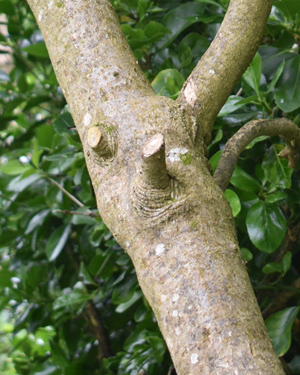
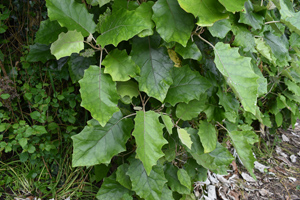
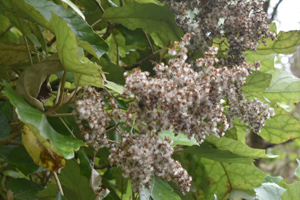
Brachyglottis repanda
Hedge ragwort, rangiori
I was tipped off by Julian Branscombe at Isles of Scilly Wildlife Trust to look out for this at Watermill Cove on the north of St Mary's. A New Zealand introduction, probably early 1800s. It will only survive in the mildest of climates, so it is rarely found in Britain other than in the Scillies. It can grow into a small tree 5 - 7 m, though this one is about 3 m. The large, white, almost rectangular leaves fallen on the ground explain its more unfortunate name as the " bushman's toilet paper"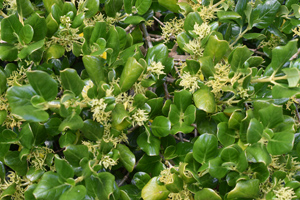
Coprosma repens
Tree bedstraw
An evergreen from New Zealand, introduced in the 1860s as a windbreak. It has naturalised into rock crevices and sand dunes. The flowers have long tendril-like anthers The part of the stamen where pollen is produced and stigmas the part of the pistil where the pollen germinates . I tended to find it mixed in with other hedging plants rather than building a hedge all of its own.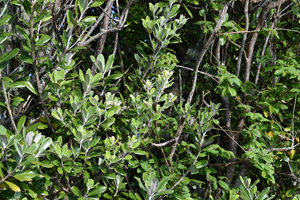
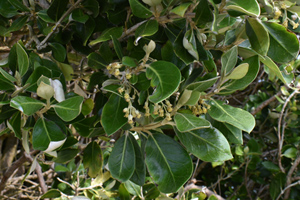
Olearia traversii
Ake-ake
I am fairly sure this is olearia, though I find olearia, pittosporum and quercus ilex all very similar and, unless there are flowers or seeds, difficult to distinguish. Another Chatham Island (New Zealand) import planted in the 1880s. It can be covered in daisy like flowers in late spring or summer, though it is noted for being reluctant to flower at times. Fast growing, salt tolerant, evergreen and happy to be clipped.