×
![woodturning]()

Trees Gallery - The Yorkshire Arboretum -page 10
Castle Howard, North Yorkshire
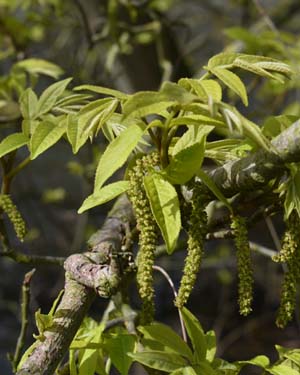 October 2023
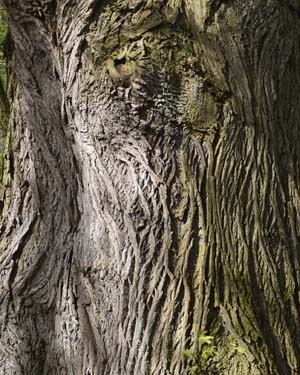 October 2023
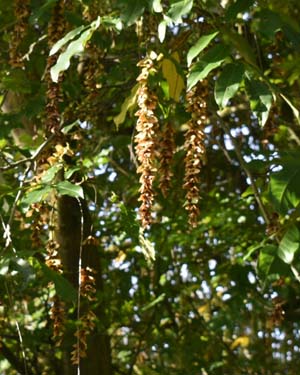 April 2024
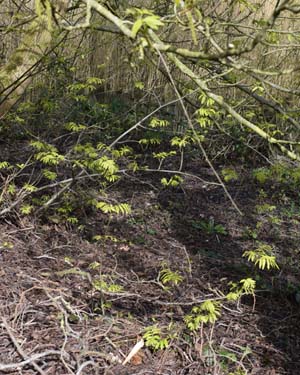 April 2024
Pterocarya fraxinifolia
Caucasian wingnut
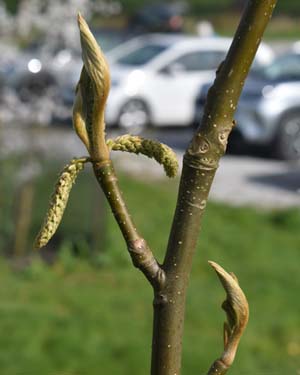
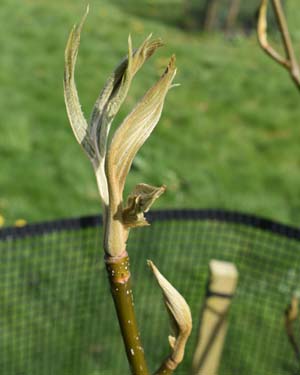
A large wingnut tree grows on the bank at the end of the lake at the arboretum. Native to Caucasia Armenia, Azerbaijan, Georgia, Iran, Russia, Ukraine and Turkey , growing up to 30m. The ash-like pinnate leaves can be over half a metre in length, with up to 25 leaflets. The strings of winged nuts again can be up to half a metre in length; green in summer, turning brown in autumn as here. It has been grown in Britain for over 200 years. This one is around 70 years old, and is suckering freely down the adjacent bank.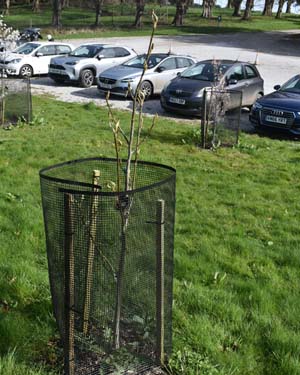 April 2024
 April 2024
 April 2024
Pterocarya macroptera
Large-winged wingnut
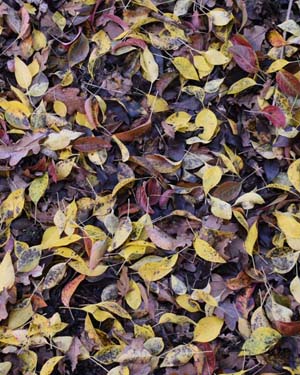
A large, hardy, deciduous tree to 15m, with bronze coloured new shoots maturing to pinnate green foliage. Wingnuts are a genus of six living species native to riparian relating to or situated on the banks of a river habitats in Asia. P. macroptera is widespread in central China, typically seen as scattered individuals in species-rich forests in the upper reaches of river valleys.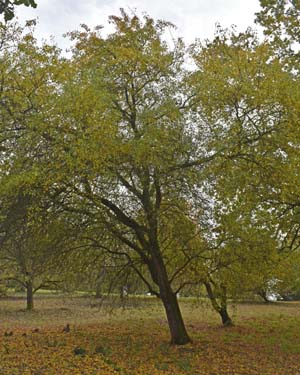 October 2022
 October 2022
Pyrus betulifolia ansilonii
Birch leaved pear
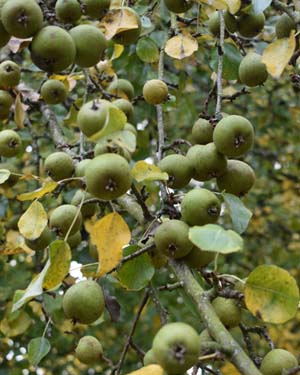
The label on this pear tree does say ansilonii, but I suspect it is after the ansaloni nurseries in Bologna. The species is a deciduous wild pear tree native to N and C China and Tibet. It can grow to 10m. Thorns (which are modified stems) protect its leaves from predation.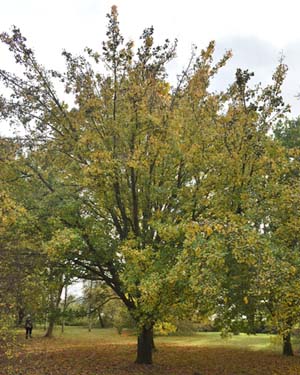 October 2022
 October 2022
Pyrus cossonii
Plymouth pear
I believe this is also known as p. cordata (according to Kew's Plants of the World Online), the heart-leaved pear, but the tag on the tree says p. cossonii and notes it as a native of Algeria. The Plymouth pear is treated as a rare wild pear in Britain, restricted to small areas of Devon and Cornwall, an archaeophyte - long established alien plant, ie found in the wild before 1500 , possibly brought across the channel as hedging.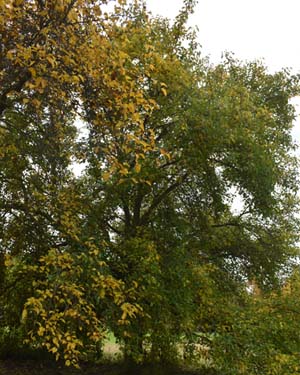 October 2022
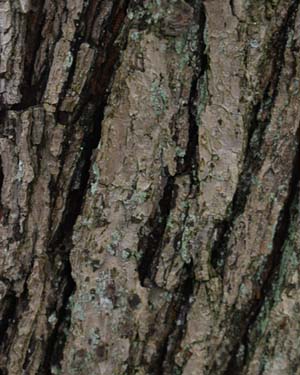 October 2022
Pyrus x lecontei
Le Conte pear
A cultivated hybrid of P. communis x P. pyrifolia. It is frost hardy, grows from 6 - 9m, is hermaphrodite containing both male and female floral organs: pistils and stamens and is pollinated by insects. The fruit is edible cooked or raw, and is ready to eat when picked.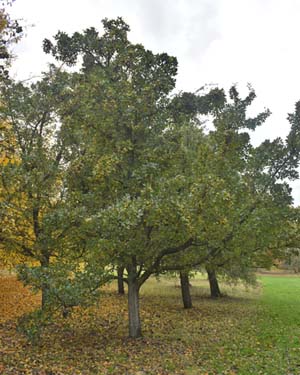 October 2022
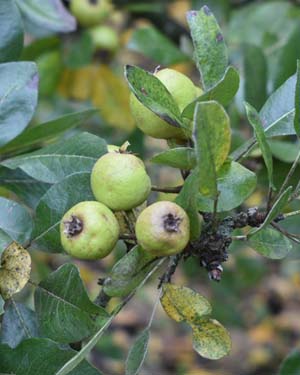 October 2022
Pyrus syriaca
Syrian pear
A native of Lebanon, Turkey, Syria and Israel. It grows to 10m, it is deciduous, hermaphrodite containing both male and female floral organs: pistils and stamens , and is pollinated by insects. It has short thick spines. It is sometimes used as a rootstock for cultivated pears, for its tolerance of drought.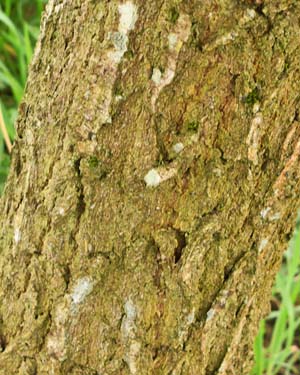 April 2024
 April 2024
Quercus dentata
Japanese emperor oak
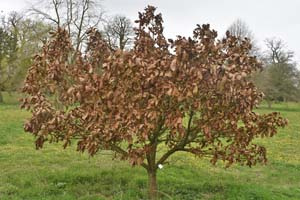
A.k.a. daimyo oak. It grows to 30m in its native Japan, Korea and China, but in Europe only to 15m. It has unusually thick twigs, hairy at first but later bare. The leaves are remarkably large, 15-30cm long, with a shallow-lobed to undulating margin. The upper side is matt dark green, the underside lighter green with velvety hairs. The acorns are in small bundles, half enclosed by the cupules, which are covered with long narrow bent backwardsscales. Prone to marcescence retaining of leaves over winter on a deciduous (or everciduous) tree , as in this photo.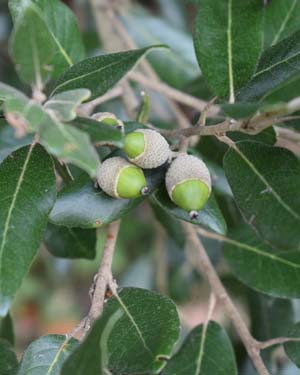 October 2022
Quercus ilex
Holm oak
Also called holly oak or evergreen oak, due to the similarity of its leaves to the holly. A native of the mediterranean, it was planted extensively in Britain as tall hedging and coastal shelter belts, and is now naturalised across much of the suthern part of the country, a spread likely to continue northwards as climate change improves conditions for it here.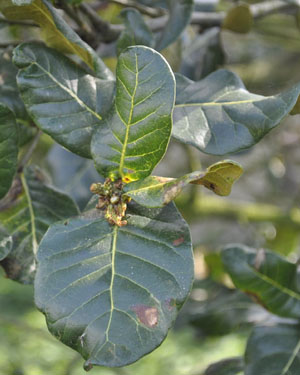 May 2018
Quercus semecarpifolia
Chinese oak
An evergreen oak from China, rarely seen in Britain. It has lustrous green, leathery leaves with a conspicuous midrib vein running from the base to the apex of a leaf , and they are often clothed in golden felt beneath when young. The species ranges across the Himalayas from Afghanistan to Western China.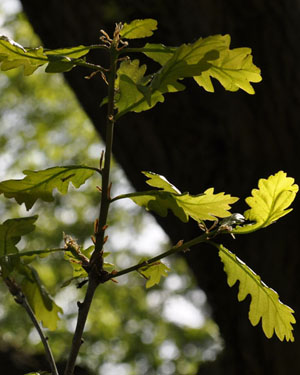 May 2018
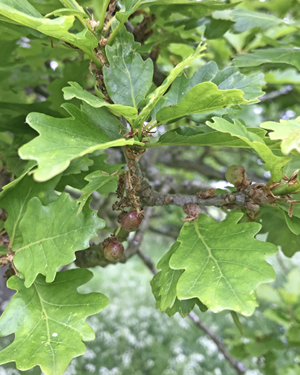 May 2022
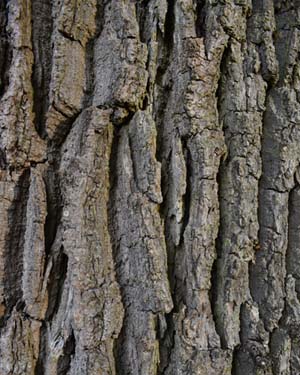 October 2022
Quercus robur
English oak
Delicate young leaves of the native English oak, highlighted in the spring sunshine. The second picture shows oak apple galls - caused by a small wasp.This tree is dedicated to the memory of Jean Grand, 1925 - 2010, with one of many similar memorial plaques seen across the arboretum.