×
![woodturning]()

Trees Gallery - The Yorkshire Arboretum -page 4
Castle Howard, North Yorkshire
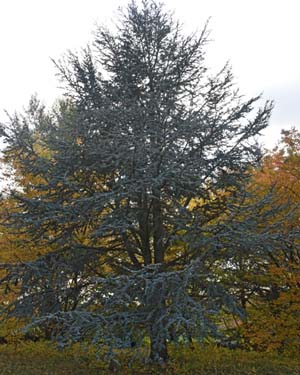 October 2022
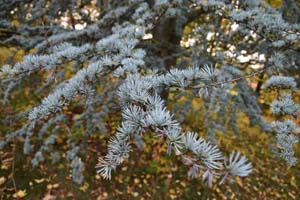 October 2022
Cedrus atlantica glauca
Blue Atlas cedar
A large conifer native to the Atlas mountains of Morocco and Algeria, where it forms large forests on mountainsides, though numbers are declining due to logging and fires. It can reach 35m in its native terrain. It bears the typical egg shaped cones common to all three true cedars - C. deodora, C. atlantica and C. libani. One test is that C. atlantica branch tips usually point upwards, those of C. libani are flat, and those of C. deodar tend to droop.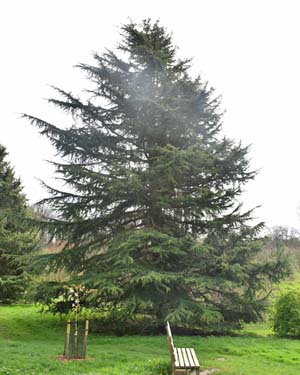 October 2022
Cedrus deodara
Deodar cedar
A large evergreen coniferous tree reaching 40–50m, exceptionally 60m with a trunk up to 3m in diameter. It has a conic crown with level branches and drooping branchlets. The leaves are needle-like, borne singly on long shoots, and in dense clusters of 20–30 on short shoots; they vary from bright green to glaucous blue-green in colour. The female cones are barrel-shaped, and disintegrate when mature to release the winged seeds. The male cones are 4–6cm long and shed their pollen in autumn.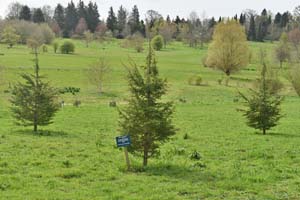 April 2024
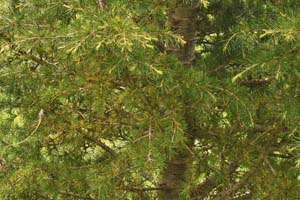 April 2024
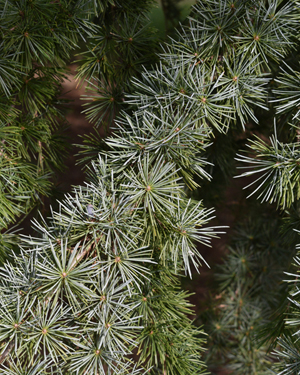
Cedrus libani
Cedar of Lebanon
A large evergreen conifer native to the mountains of the E Mediterranean basin. It can reach 40m, with a columnar trunk up to 2.5m in diameter. The trunks of old trees often fork into several large, erect branches. The rough and scaly bark is dark grey to blackish brown, and is run through by deep, horizontal fissures that peel in small chips. It produces cones after 40 years. Male cones appear in early September followed later in the month by the female. Male cones occur at the ends of the short shoots; they are solitary and erect, maturing from a pale green to a pale brown. The female seed cones also grow at the terminal ends of short shoots. Young seed cones are resinous, sessile, and pale green; they require 17 to 18 months after pollination to mature, forming woody cones, scaly, resinous, barrel-shaped, and grey-brown in color.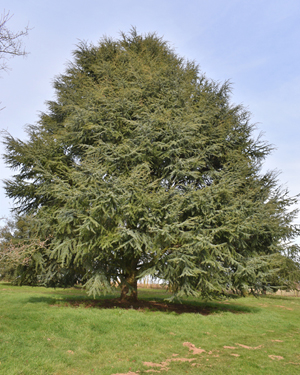 March 2022
 March 2022
 March 2022
Cedrus x tesi
Hybrid cedar
A nothospecies A hybrid which is formed by direct hybridization of two species, not other hybrids. hybrid of C. deodora and C. atlantica, it is named very recently (2021) after the Tesi nurseries in Italy. Its habit is wider spreading than C. deodara, broad-pyramidal in outline. The foliage is variably glaucescent bluish-grey , and it has long needles (a proportion >3 cm long). This is the girth and height champion for England. [Tree Register 2019]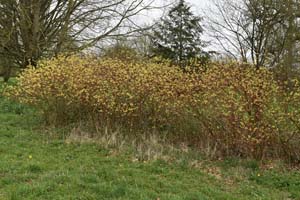 April 2024
 April 2024
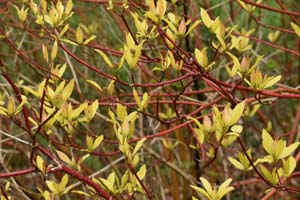
Cornus alba aurea
Red stemmed dogwood
A.k.a. golden Tartarean dogwood, a deciduous medium-sized shrub with soft yellow, ovate leaves and ruby red stems radiating from the base of the shrub. In late spring, flat-topped clusters of tiny creamy-white flowers appear in May and June. June 2023
 June 2023
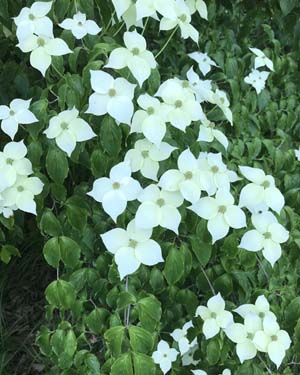
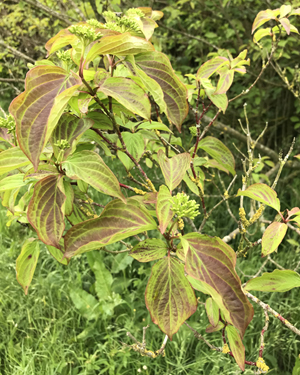
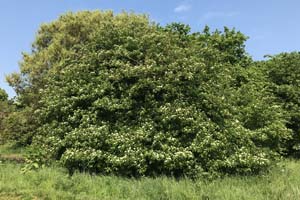
Cornus kousa 'chinensis'
Chinese dogwood
A small bushy tree which produces a profusion of large white flower bracts modified leaves, often positioned beneath a flower or inflorescence that slowly adopt pinkish hues as they mature. It flowers in May and June, weeks after the leaves. This variety will grow to around 3m in height and spread, unlike the species which can reach 12m. Native to E Asia. May 2022
 May 2022
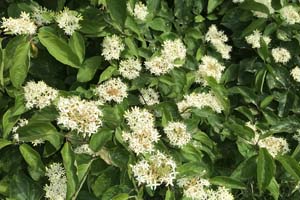 June 2023
Cornus sanguinea
Common dogwood
Dogwood is a small broadleaf shrub, typically found growing along woodland edges and in hedgerows of southern England. Mature trees can grow to 10m. The bark is grey and smooth with shallow ridges which develop with age, and its twigs are smooth, straight and slim. Leaf buds are black and look like bristles, forming on short stalks. Native throughout Europe, Asia and North America. [Woodland Trust]. The timber is very hard, used to make skewers ("dags" - cf. daggers - or dogs, hence the name), and said to have been used for the crown of thorns worn by Jesus.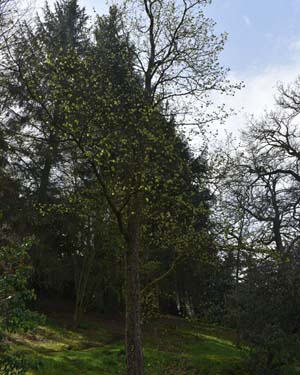 April 2024
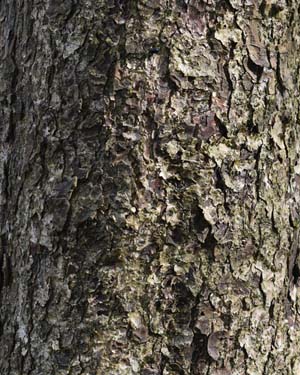 April 2024
Corylus jacquemontii
Western Himalayan hazel
A tree capable of growing to 25 m, often with a straight trunk. Young twigs are yellowish-grey, rather sparsely pubescent hairy and with longer, glandular hairs. Leaves are obovate egg shaped, with the narrower end at the base , with a deeply cordate heart-shaped base and abruptly acuminate tapering to a point tip, with a sharply double-toothed margin. Nuts occur in close clusters of 2 or more, thick-shelled, with husks finely pubescent, fringed with many jagged lobes. [Trees and Shrubs Onine]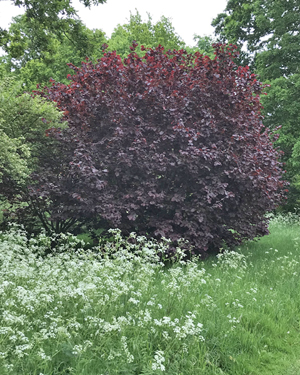 May 2022
Corylus maxima purpurea
Purple leaved filbert
A large deciduous shrub to 6m, with broad, deep purple leaves to 12cm in length. Pendulous pale yellow catkins on leafless twigs in late winter are followed by cluster of edible nuts concealed by tubular husks. [RHS].The filbert is native to SE Europe and SW Asia. It is similar to the common hazel, C. avellana, but the nuts are more fully enclosed by the involucre a ring of bracts around a flower (and subsequently the fruit) . The purple form is popular as an ornamental in gardens.
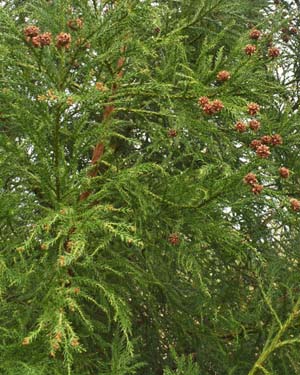 April 2024
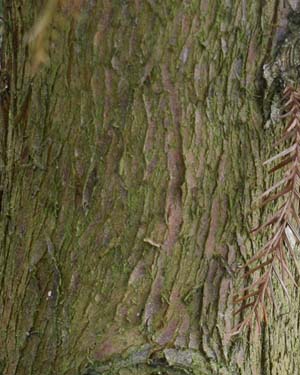 April 2024