×
![woodturning]()

Trees Gallery - The Yorkshire Arboretum -page 13
Castle Howard, North Yorkshire
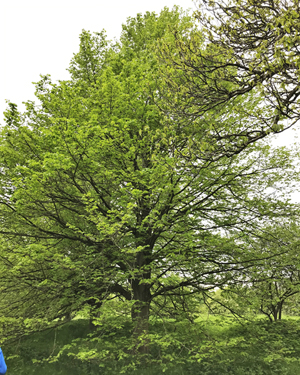 May 2022
 May 2022
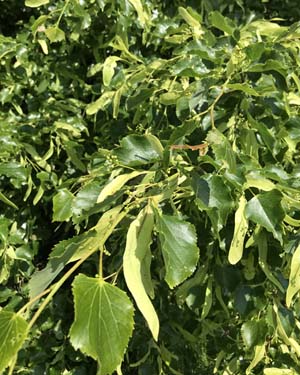 June 2023
Tilia cordata
Small leaved lime
Native to Britain, called pry in the SE, but the rarest of the three most common limes, now considered an indicator of ancient woodland. It is commonly planted as an ornamental, particularly in lime avenues on the entrances to large estates. It is possible to tell true species apart by the underside of the leaf. Common lime (T. x europaea) has tufts of white hairs between the vein joints, whereas these are rusty red in small-leaved lime. Large-leaved lime (T. platyphyllos) has hairs all over the underside. Common lime is a hybrid and is rare in the wild in the UK. Lime wood is soft and light, white-yellow and finely textured. It is easy to work and used in turnery, carving and furniture-making. The tree can grow to 40 m, with a trunk up to 1 m diameter. June 2023
 June 2023
Tilia japonica
Japanese lime
Native to the mountains of E China and Japan, this species is very similar to the small leaved lime, but it has double the chromosomes (164) and has some minor botanical distinctions. It is planted mainly as an ornamental, though is used for furniture on account of its straight grain. June 2023
Tilia platyphyllos laciniata
Cut-leaved lime
T. platyphyllos is the broad-leaved lime, and this Dutch cultivar is the cut-leaved version. It will grow to 22m. The leaves are 8 – 12 cm in size, round to ovoid with a tapered top and a slanted heart-shaped base. The leaf edge is sharply serrated. The upper side of the leaf is dark green while the underside is lighter with soft hair. They remain on the tree long into the autumn. Aromatic flowers appear in pendulous umbels. [Van den Berk] "large leaves" are only slightly larger than those of the small-leaved lime. One distinguishing feature is that T. platyphyllos does not produce suckers at the base of the trunk.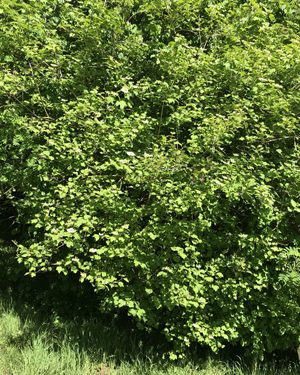 May 2022
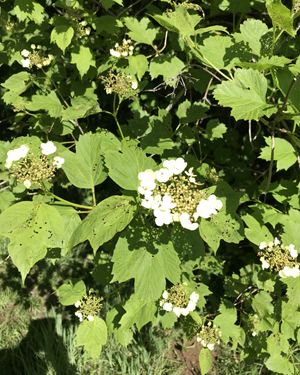 May 2022
Viburnum opulus
Guelder rose
A spreading, deciduous, upright shrub which can reach 4m high and can spread up to 5m. Distinct, branched clusters of creamy-white, or sometimes pink, flat-topped flowers appear in May to July. Each cluster of flowers is encircled by a ring of larger, sterile, flowers. These are followed by bright red berries. Native, an ancient woodland indicator.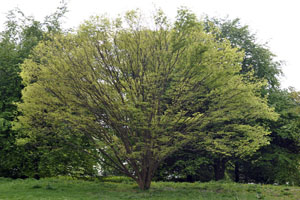 May 2018