Trees gallery - The Arboretum - Isle of Man - page 2
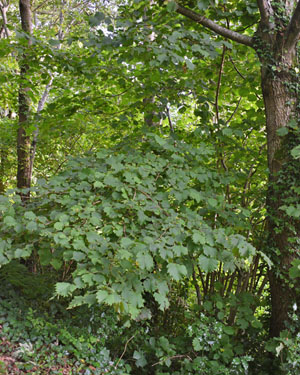

Corylus avellana
Hazel
Hazel is a common sight across much of Britain. It is native to Europe and N Africa. It is often coppiced to provide the wands so useful for bending and shaping into fencing and plant supports. The "cobnuts" are a valuable food source for us as well as birds and small mammals
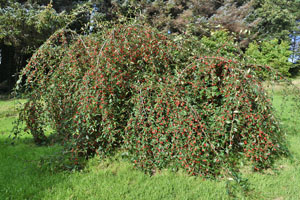
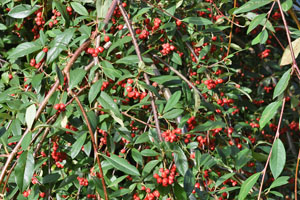
Cotoneaster hybridus pendulus ?
Weeping cotoneaster
This vigorous small shrub is not listed in the arboretum brochure, but it looks like a probable match. The genus is native to temperate Asia, Europe and N Africa, and generally is an unwelcome invasive family in the wild in Britain, spreading rapidly via the red berries which birds feed upon readily.
Cratageus persimilis 'prunifolia'
Broad leaved cockspur thorn
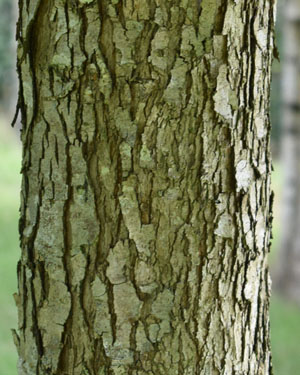
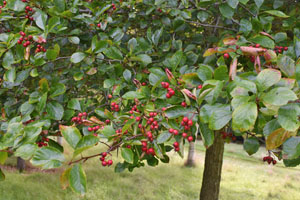
A thorn with a variety of names - C. persimilis, C. prunifolia, and C. persimilis prunifolia. Probably a naturally occuring hybrid from N America, of C. succulenta and C. crus-galli, with the prunifolia variety a cultivar. Whatever its name, it is a small spreading tree with oval leaves, rsembling those of a plum tree, and masses of bright red berries, carried on thorny branches.

Cupressocyparis leylandii 'Silver dust'
Leyland cypress
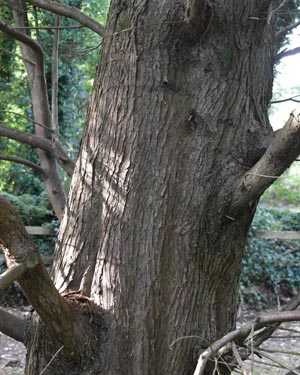
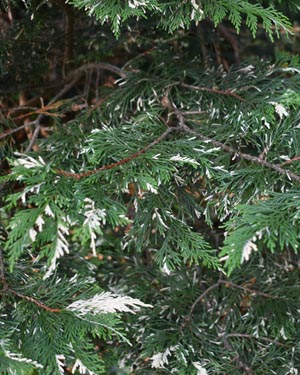
Leyland cypress are fast growing large trees that will reach 20m in less than 20 years, if allowed - they are often grown as hedging and need clipping regularly to avoid them escaping to this height. The tree is a hybrid of Monterey cypress (Cupressus macrocarpa) and Nootka cypress (Cupressus nootkatensis), which occured when the two trees were positioned next to each other on the Leighton estate in the 1850s (naturally their ranges are over 300 mles apart). It is almost always sterile, and is propagated mainly by cuttings. It is not listed in the arboretum guide.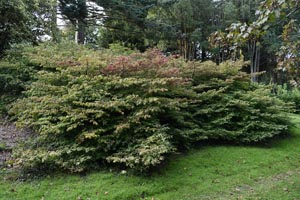
Euonymous alatus
Burning bush
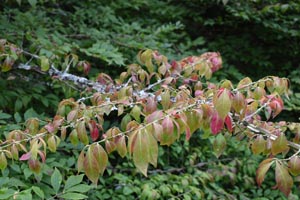
Also known as winged spindle, a native of C and N China, Japan, and Korea. It is prized for its bright red autumn colour - hence the common name - and also for its bright orange or pink fruits. The leaves were just beginning to turn when we visited in mid September. Its other name, wigned spindle, comes from the corky wings along the stems.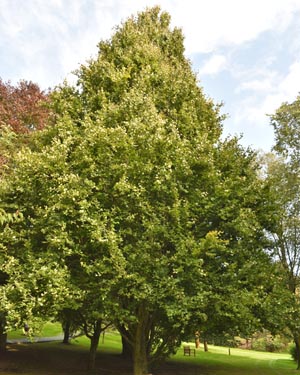
Fagus sylvatica 'Dawyck'
Fastigiate beech
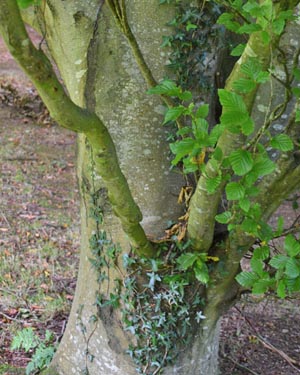
A columnar shaped beech tree that was found as a mutation of the species type in Dawyck, Scotland, in the 1850s. It can grow to 20m, but rarely exceeds 3m in width. There are gold and purple varieties.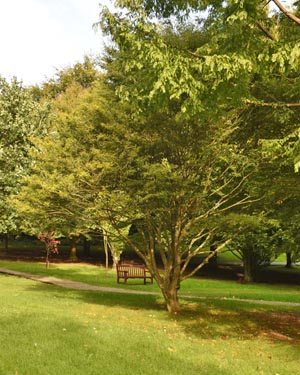
Fagus sylvatica
Common beech
The common beech, growing with varieties in a section of the arboretum. It has a native range across much of Europe, including Britain (at least in the south), arriving after the last glacial period (4000 BC). It can grow to 35 - 50m in height, with up to 1.5m diameter trunk. It is often kept as a hedge through regular clipping. Leaves usually stay on the tree over winter (marcescence) retaining of leaves over winter on a deciduous (or "everciduous") tree, as on beech and sometimes oak
Fagus sylvatica heterophylla
Cut leaf beech
A cut leaf version of the common beech, also known as the fern leaved beech. Heterophylla means "different leaves", and is sometimes replaced or added to with "asplenifolia" - fern like leaves. The leaves are narrow, lanceolate, feathery and deeply dissected into slender lobes. Throughout the summer, they are a dark glossy green turning a sumptuous golden yellow in autumn. It develops into a spreading medium sized tree as broad as it is high.
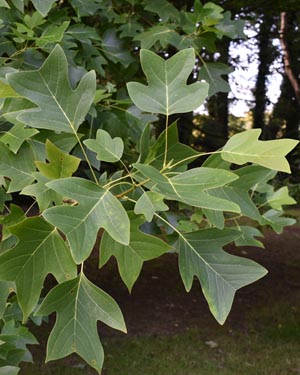
Liriodendron chinense
Chinese tulip tree
A native of C and S China, with slight variations on the American version, L. tulipifera. The leaves are more deeply lobed, and the flowers are smaller and greener, lacking the orange band of inner petals. A vigorous tree growing to 25 - 40m. Deciduous.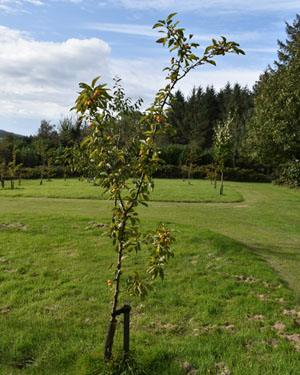
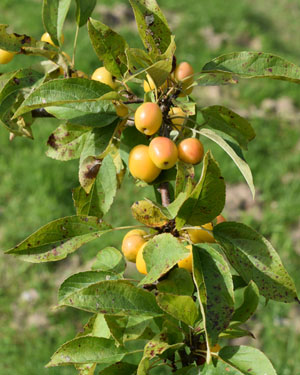
Malus x zumi 'Golden hornet'
Crab apple Golden hornet
A young sapling at the start of a small orchard in the arboretum. It will eventually grow to 5m in 20 years. The brightly coloured edible crab apples stay on the tree well inter winter, like many crab apples bringing some colour to the darker season.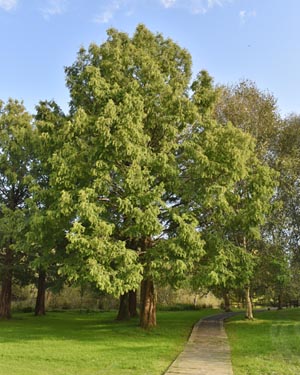

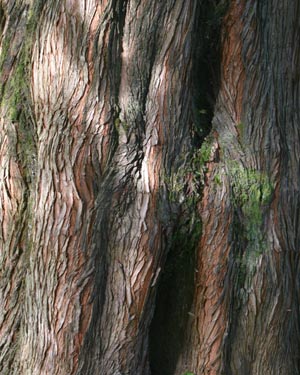
Matesequoia glyptostroboides
Dawn redwood
A deciduous conifer, native to China where it is endangered in its natural habitat, though popular and widely planted in cultivation since 1948. An example of a living fossil an extant taxon that cosmetically resembles related species known only from the fossil record. To be considered a living fossil, the fossil species must be old relative to the time of origin of the extant clade. species. Capable of growing to 50m or more, with massive trunks 5 - 8m in diameter.