Trees gallery - Milntown - Isle of Man
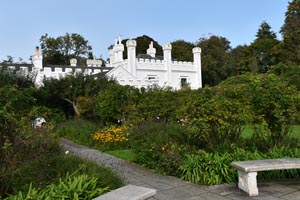
Milntown Estate is now owned by a private trust, having being left to its care by the previous owner Sir Clive Edwards. It spreads over 15 acres, and the gardens are partnered with the RHS. There is a wide variety of trees, from standard old woodland to rare specimen trees from around the world. A few have labels, but a number shown below I have guessed at, or not gone beyond the genus description. I have contacted the garden staff who perhaps will help with some identifications. There is a garden plan which might help with some of the locations.


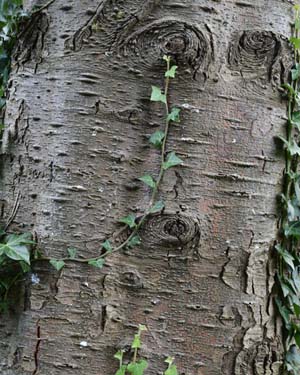
Abies alba?
Silver fir
There are a group of conifers in the woodland area of the garden, which I think are silver firs. Very tall, narrow trees, with bark showing resin blisters Horizontal scars on the bark of fir, hemlock and cedar. Inside is viscous, sticky, clear resin, also called pitch. It is not sap, more like turpentine. and knots from lower lateral branches that have died and fallen as the tree reaches upwards.
The silver fir is an evergreen conifer, often used as a Christmas tree. It is native to the mountains of Europe, where it can grow to 50m. The species name alba describes the white timber it yields.
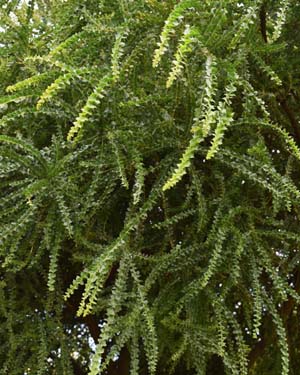
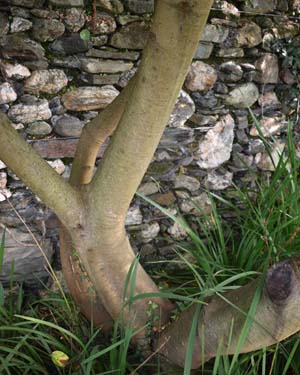
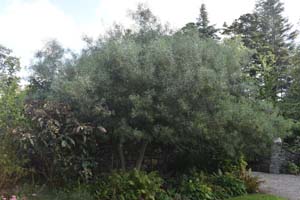
Acacia pravissima
Ovens wattle
A curious spiny plant, with triangular phyllodes modified petioles or leaf stems, which are leaf-like in appearance and function. In some plants, these become flattened and widened, while the leaf itself becomes reduced or vanishes altogether instead of leaves. It originates from Ovens Valley in Victoria, Australia. We were too late (September) for the show of bright yellow leaves which appear in early spring. There was an example growing in the car park as well as in the main gardens.
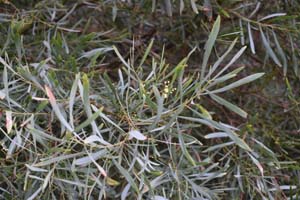
Acacia pendula
Myall
No label to help with this unusual tree, but the long thin leaves (which if I am correct will actually be phyllodes modified petioles or leaf stems, which are leaf-like in appearance and function. In some plants, these become flattened and widened, while the leaf itself becomes reduced or vanishes altogether ). suggest it could be an acacia, possibly A. pendula, although the branches are not very pendulous. The small yellow flower also fits the description - it would have masses of these in summer. Also called boree in its native Australia.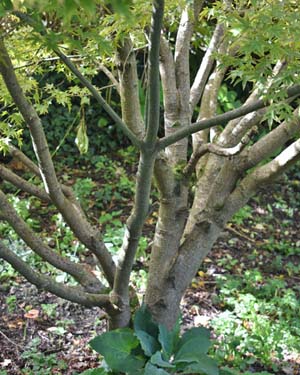
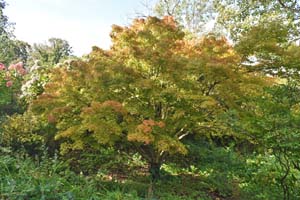

Acer palmatum
Japanese maple
A classically shaped spreading maple, just beginning to turn into autumn colours in late September. I am not sure of the variety, but the long fingered, salmon pink leaves suggest it could be katsura.
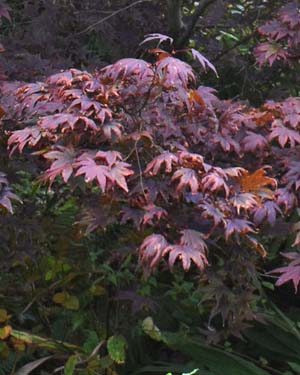
Acer palmatum bloodgood?
Japanese maple
Another beautifully coloured acer palmatum, growing next to the one above. I think they are in the corner of the old walled garden. Deep purple colouring suggests this one could be 'Bloodgood', or possibly 'atropurpureum'.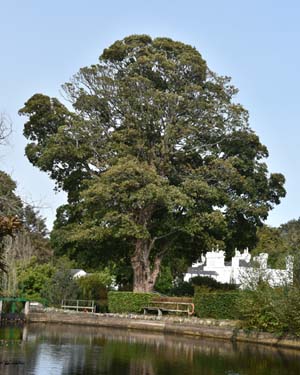

Acer pseudoplatanus
Sycamore
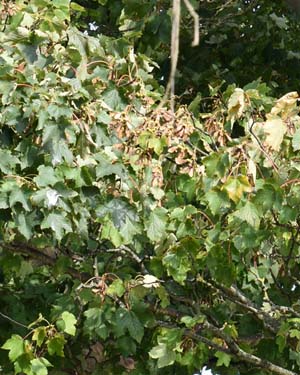
A stately old sycamore dominates the skyline near the mill pond, giving size and strength to the garden in this area. All the classic features are here - the palmate leaves, the flaking plates of bark, the 'helicopters' (samaras a winged achene, a type of fruit in which a flattened wing of fibrous, papery tissue develops from the ovary wall). So common across the UK, it is perhaps surprising that it is classed as a neophyte a plant not native to a region, introduced and escaped into the wild in recent history (after 1500). , and some still class it as a 'weed' due to its invasive nature. The perfect timber for turning and pyrographing. This one is a fine weed.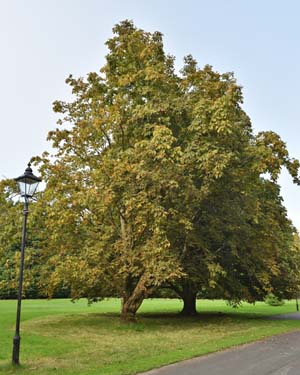
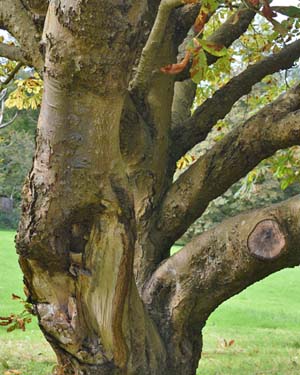
Aesculus hippocastanum
Horse chestnut
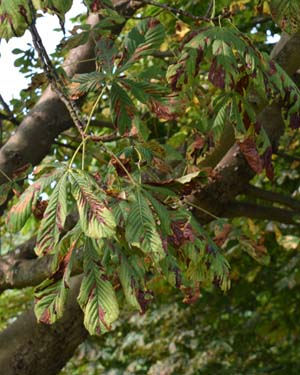
Two fine trees but suffering the inevitable damage to their leaves from leaf miner cameraria ohridella - a small moth with caterpillars that feed inside (horse chestnut) leaves, causing brown or white blotch mines to develop between the leaf veins. . Apparently this doesn't affect the overall health of the tree, and these two are loaded with conkers, but the leaves will all turn brown and fall early. Originally from the Balkans, introduced to cultivation in the 1600s, and now a neophyte a plant not native to a region, introduced and escaped into the wild in recent history (after 1500). covering all of the UK apart from the highest ground.