Trees gallery - Milntown, Isle of Man - page 2
Fagus sylvatica
Beech
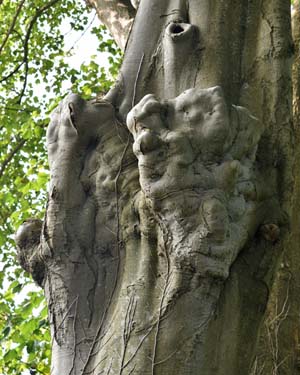
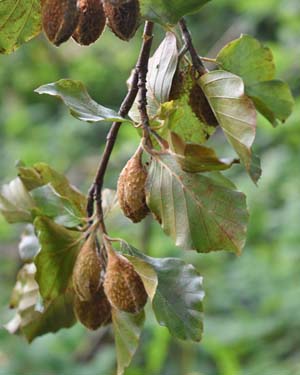
Amongst the old beech trees in the woodland was a large old wound, probably from a doctored or damaged branch, completely covered by new bark. Imagination allows a grotesque face at the bottom of the wound. Also beech nuts aplenty on the branches.

Callistemon
Bottle brush
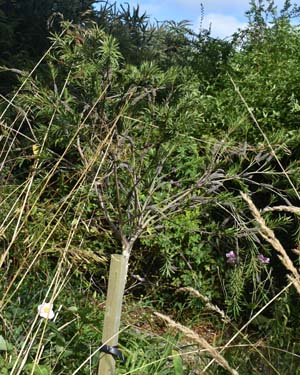
A cluster of pods is all that remain of the bright red bottle brush flowers on this small callistemon. They grow in the temperate regions of Australia, but can survive out in the open on the Isle of Man due to the milder climate. I seem destined to miss the flowers on my travels, either too early or too late.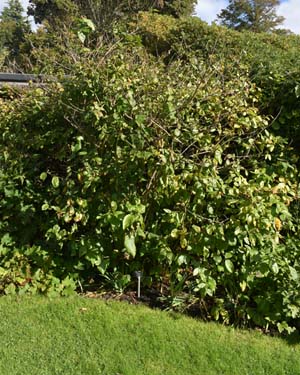
Calycanthus floridus
Carolina all-spice
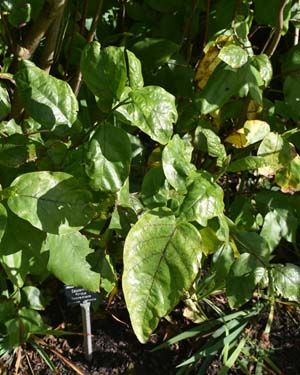
Not at its best in September, this spicebush will have had dark red solitary flowers and fragrant scent in summer. A native of SE USA. One of its key features is the fragrance - "like a bowl of stewed apples with cinnamon" (Thompson & Morgan).

Camellia sp.
Camellia
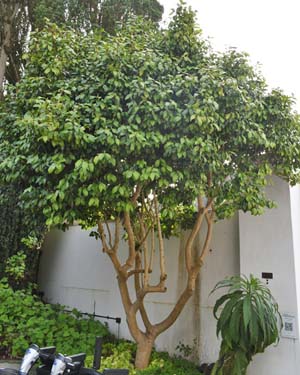
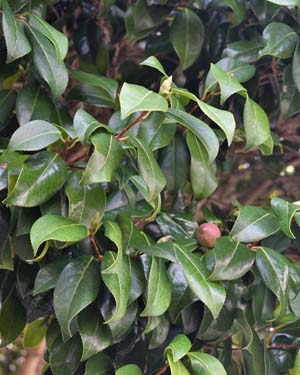
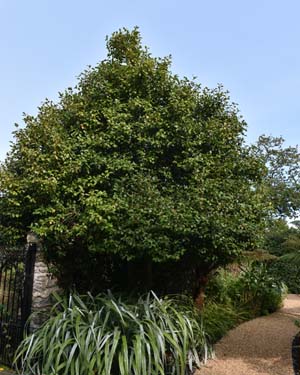
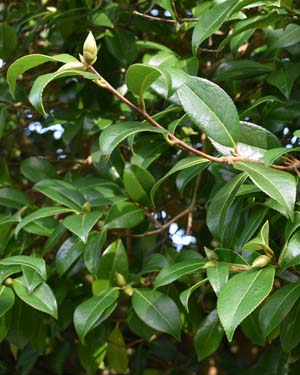
The walled garden used to be an orchard, with rhododendrons and camellias round the perimeter. It has been transformed since 1999, but there are still camellias. I am not sure of the varieties of these two. The one in the courtyard, by the cafe, is a particularly fine shape (the top pictures here). Camellias are of SE Asian origin, cultivated across the world for their tea leaves and bark oils, as well as their attractive flowers and glossy evergreen leaves.
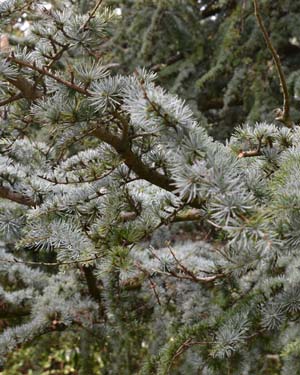
Cedrus atlantica glauca
Atlas blue cedar
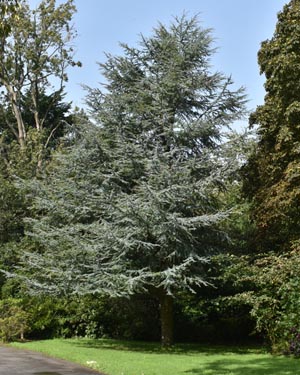
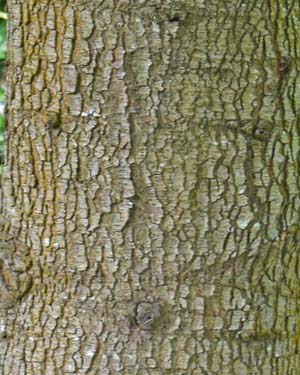
A blue cedar growing near the front entrance to the house. One of three true cedars, this one tends to have upward pointing branches. The glauca variety has silver grey-blue coloured needles. Native to the Atlas mountains of Morocco and Algeria. I often see it in gardens as a small shrubby specimen, no doubt bought due to its attractive colour, but without regard to its potential final height of 20 - 25m, with a trunk diameter over 1m. This one looks quite young.
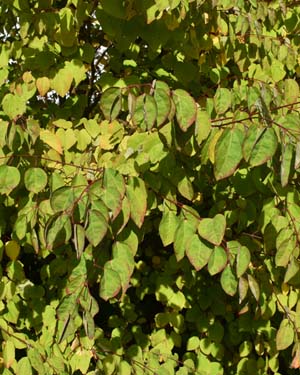

Cercidiphyllum
Katsura
No label on this shrub, but the leaves and the colouring suggest it could be a katsura tree of some variety. If it is, I don't recall noticing the toffee scent supposedly given off by the leaves, but then I wasn't looking out for it at the time. The species C. japonicum can reach 45m in the wild (it is native to Japan), much less in cultivation, C. magnificum is much smaller, perhaps to 10m. They are often pruned to keep them as modest sized bushes.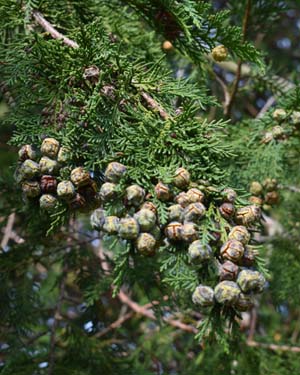
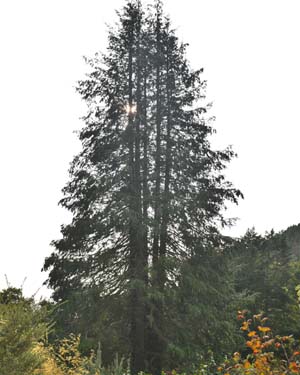
Chaemacyparis lawsoniana ?
Lawson cypress ?
Another puzzle for me. I think this may be a Lawson cypress, but I find these difficult to distinguish from Leyland Cypress (leylandii). It has split into five stems, and I believe split stems are a common featue of Lawson cypress.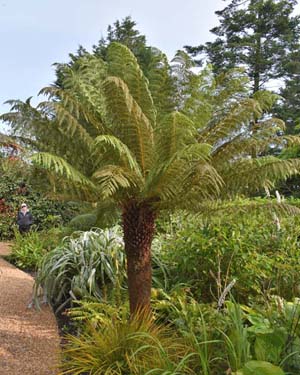
Dicksonia antarctica
Man fern
Native to SE Australia, these evergreen trees can grow to 15m. The "trunk" is the decaying remains of earlier growth, and forms a medium through which the roots can travel downwards and grow. The rosette of green fronds the leaf or leaflike part of a palm, fern, or similar plant, usually composed of leaflets on a petiole on the top can grow to 6m in diameter. It reproduces from spores as with ordinary ferns. It likes damp conditions, and hates drought.


Dodonaea viscosa purpurea
Purple hop bush
This unusual bush is growing near the entrance to the walled garden, and it had a label on it! It's common name comes from the flowers, which resemble hops. Native to SW USA and Mexico, but also spread across Australia and New Zealand.