×
![woodturning]()

Trees Gallery - Acorn Bank
NE edge of the Lake District
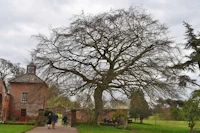 Large oak at the entrance to Acorn Bank, April 2022
Acorn bank
Acorn Bank is a National Trust property near Temple Sowerby, just off the A66. A regular stopping off place on our journeys to the Lakes. There is a medicinal herb walled garden, an orchard, and woodlands which include a working watermill and a hidden gypsum mine. We tend to visit at Easter, so the gardens are lacking colour in most photos shown on this page.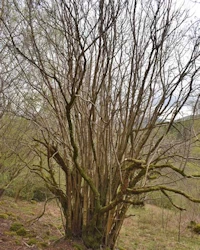 April 2022
Corylus avellana korys - Greek for helmet or hood, referring to the shape of the husk aroun the nut; avellana after the town of Avella in the Italian province of Avellino, which was known for its hazelnut production
Common hazel
A shrub growing 3–8 m on multiple stems, native to Europe and Western Asia. The hazelnut, or cob nut, the kernel of the seed, is edible and used raw, roasted, or ground into a paste. The nut is round, in contrast to the longer filbert nut. Historically, the shrub was an important component of the hedgerows used as field boundaries in lowland England. April 2022
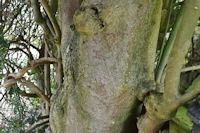
Cydonia oblonga cydonia - after the ancient city of Kydonia in Crete, where quince was cultivated; oblonga - describes the shape of the fruit or leaves; lusitanica - Roman for the region that is now Portugal, where the plant originated lusitanica
Portuguese quince
A deciduous, thornless tree, growing to 6m, with crowded branches and a low habit. Dark green leaves are ovate or elliptical, pale with a dense felt of grey wool beneath, especially when young, stipules hairy, glandular. Flowers are 5 cm. across, pink or white, each one solitary at the end of a short twig, produced during May. Fruit is a light golden yellow, pear-shaped, and very fragrant. The Portuguese quince is more vigorous than the type, but not quite so hardy in Britain.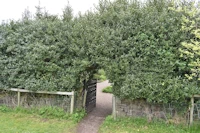 April 2022
 April 2022
Ilex aquifolium ilex : - holm oak; aquifolium - acus 'needle', folium, 'leaf'
Holly
One of very few native British hardwood evergreen trees. It can exceed 10 m in height, but is more often 2–3 m. It can live 500 years, but usually does not reach 100. The flowers are white, four-lobed, and pollinated by bees. Holly is dioecious there are male plants and female plants , with fruits only appearing on female plants, which require male plants nearby to fertilise them. The fruit is a bright red (or yellow) drupe stone fruit .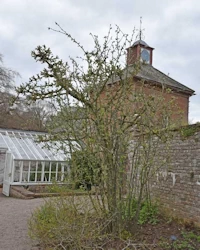 April 2022
Laburnum anagyroides Laburnum : - possibly related to Lebanon, the tree's native region; anagyroides - resembling the genus Anagyris, a genus of shrubs in the pea family.
Laburnum
A.k.a. Cytisus laburnum, common laburnum, golden chain or golden rain, a small deciduous tree or large shrub growing to 7 m, with dark green spreading branches and pendulous and pubescent twigs. It has a fine flowering display during May and June, with pea-like, golden yellow flowers densely packed in pendulous racemes up to 25 cm long, but is rather drab the rest of the year. The black seeds contain cytisine, an alkaloid somewhat poisonous to humans as well as goats and horses, especially when not ripe. The wood is hard and heavy, of a yellow/brown colour, ideal for making posts, for woodturning and as fuel. The tree is also known as false ebony since the heartwood darkens with age to almost black, one of the few dark woods native to the UK.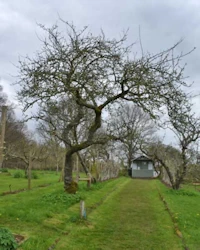 April 2022
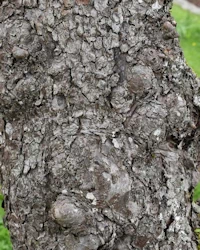 April 2022
Malus domestica Malus : - Latin for apple tree; domestica - Latin, indicating cultivated; Blenheim - the variety was discovered near Blenheim Palace; Orange - referencing the fruit colour. Blenheim Orange
Malus domestica Blenheim Orange
One of many old varieties in the orchard. Found at Old Woodstock, near Blenheim in Oxfordshire in about 1740. It is considered a dual-purpose apple, usable as a cooking apple in September, and later as an eating apple. It has a greenish-yellow to orange skin streaked with red. .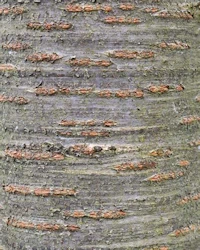 April 2022
 April 2022
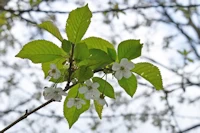
Prunus avium prunus - Latin for plum tree; avium -bird referring to the birds that eat the cherries, hence the birds' plum tree.
Wild cherry
A.k.a. gean or sweet cherry; a familiar presence in natural decidusous woodland, where its leggy form and above all its loose clusters of creamy-white summer flowers make it very recognisable. It is often encountered in hedgerows and has been widely planted in many urban areas. Its beautiful timber is highly prized by furniture makers and it is often used as a veneer. It is also much sought after by the makers of musical instruments.
April 2022
Quercus robur quercus - Latin name for oak, derived from the Proto-Indo-European root kwerkwu; robur - Latin for robust or strong, referencing the tree's sturdiness.
English oak
A native of mixed woodland areas from the British Isles to the Caucasus, and has been widely planted in North America since the 1600s. It is a large, majestic, deciduous tree of the white oak group that typically grows in cultivation to 30 m with a broad-spreading, rounded crown. Insignificant monoecious separate male and female catkins appear on the same tree yellow-green flowers appear in spring as the leaves emerge. Fruits are oval acorns 2.5 cm long, on long stalks (peduncles).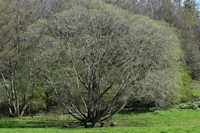 April 2022
Salix caprea Salix - Latin for willow. caprea - meaning goat, possibly related to the leaves being eaten by goats.
Goat willow or possibly grey willow
A.k.a. pussy willow or great sallow. Mature trees grow to 10m and can live for 300 years. The bark is grey-brown and develops diamond-shaped fissures with age. Unlike most willows, the leaves are oval rather than long and thin. They are hairless above, but with a felty coating of fine grey hairs underneath, and have a pointed tip which bends to one side. Goat willow is dioecious male and female flowers grow on separate trees . Catkins develop in early spring, the male catkins grey, stout and oval, becoming yellow when ripe with pollen; the female catkins longer and green. Once pollinated by wind, female catkins develop into woolly seeds. Most willows can also propagate themselves by lowering their branches to the ground, where they then develop roots.[Woodland Trust]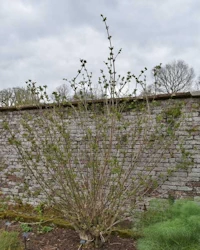 April 2022