×
![woodturning]()

Trees Gallery - Lowther Castle
Lake District
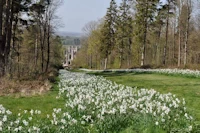 April 2022
Lowther Castle
Lowther Castle was built at the turn of the 19th century on the site of two previous houses, the castle was a grand affair boasting a room for every day of the year, and gardens the envy of the north. It was demolished in 1957, wih just the façade and outer walls remained standing. For over half a century, the place was empty. Wartime occupation by tank regiments left the lawns covered in concrete; and in the 1950s, once the castle was demolished, the gardens were filled with commercial chicken sheds, a pig farm and a spruce plantation. The gardens were lost to wilderness, and wild undergrowth soon came to dominate. Today it has dramatic ruins, gardens within gardens, an adventure playground, and gradual restoration of garden features.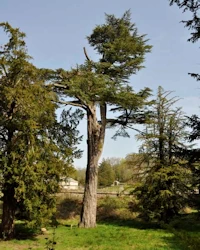 April 2022
Cedrus libani - cedrus - from Greek kedros, cedar; libani - from Lebanon.
Cedar of Lebanon
A native to the mountains of the E Mediterranean basin, a large evergreen conifer (growing up to 40 m), the national emblem of Lebanon. The trunks of old, open-grown trees often fork into several large, erect branches. The rough and scaly bark is dark grey to blackish brown, and is run through by deep, horizontal fissures that peel in small chips. It grows rapidly until the age of 45 to 50 years, then growth becomes extremely slow after the age of 70.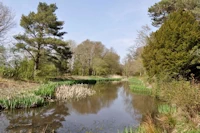 April 2022
Pinus sylvestris pinus- Latin for pine silva - woodland or forest, reflecting the tree's habitat.
Scots pine
An evergreen conifer native to northern Europe. Mature trees grow to 35m and can live for up to 700 years. The needle-like leaves are blue-green and slightly twisted, and grow in pairs on short side shoots. Scots pine is monoecious both male and female flowers grow on the same tree. Male flowers comprise clusters of yellow anthers at the base of shoots. Female flowers are small, red-purple and globular, and grow at the tips of new shoots. [Woodland Trust]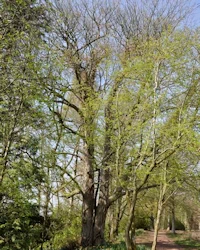 April 2022
Fagus sylvatica Fagus - Latin for beech; sylvatica -from Latin silvanus, of the forest
Beech
Native across Europe, growing to a height of more than 40 m and develop a huge domed crown. The reddish brown, torpedo-shaped leaf buds form on short stalks and have a distinctive criss-cross pattern. Beech is monoeciousboth male and female flowers grow on the same tree . In April and May the tassel-like male catkins hang from long stalks at the end of twigs, while female flowers grow in pairs, surrounded by a cup. Beech woodland is shady and characterised by a dense carpet of fallen leaves and mast husks which prevent most woodland plants from growing. Only specialist shade-tolerant plants can survive beneath a beech canopy. April 2019