Trees gallery - Hutton in the Forest - page 1
Near Penrith, Cumbria
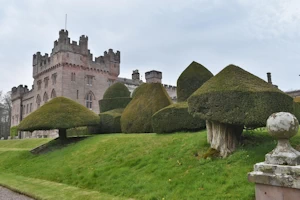
Hutton Hall at Hutton in the Forest is the home of Lord and Lady Inglewood, and is open to the public on selected days, with free admission to Historic Houses members. They have a wonderful mature walled garden, and also many acres of woodland, in which they have created a woodland walk, and provided a list of the key specimen trees. They list three categories - "the big broad leaved trees, mainly beech, oak and lime, many of which are over 200 years old and nearing the end of their lives. Some are blowing over. 2 The big conifers, some of which are 150 years old and in their prime. 3 Mixed broadleaves and conifers, planted more recently. As the conifers (softwoods) generally grow faster, it is necessary to prevent broadleaves (hardwoods) being overwhelmed by them."
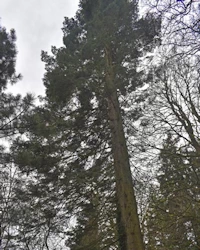
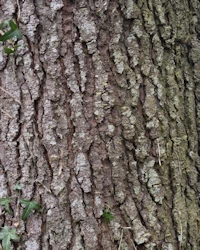
Abies alba
Silver fir
Native to the Mountains of Europe, from the Pyrenees to the Balkans. Introduced to the UK in 1603. Now common in upland woodlands in the W and N. Needles have 2 white bands underneath, giving the silver effect.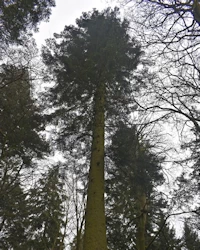

Abies grandis
Grand fir
Abies grandis is a large evergreen conifer growing to 40–70 metres tall, exceptionally 100 m, with a trunk diameter of up to 2 m Probably the largest of the firs. Native to NW North America
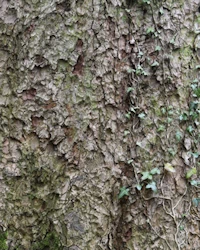
Abies Nordmanniana
Caucasian fir
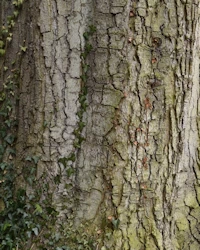
This is a large conifer (55 m) native to mountainous regions in Turkey, Georgia and Russia arond the Black Sea. This one has a large right-angled branch almost forming a second trunk.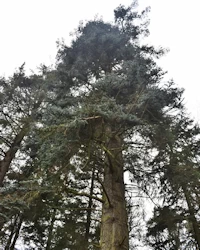
Abies procera
Noble fir
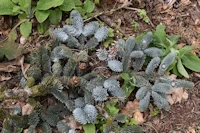
A.k.a. red fir and Christmas tree, native to NW USA. Discovered and named by David Douglas in the early 19th century. Glaucous blue-green needles arranged spirally. It can live for 200 years, and grows to 70 metres or more in height.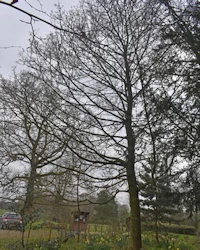

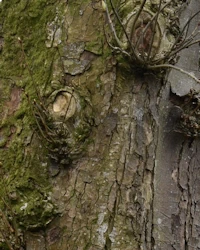
Acer platanoides
Norway maple
Native to E. and C. Europe and W. Asia. It grows to 20 – 30 m tall with a trunk up to 1.5 m. The bark is grey-brown and shallowly grooved. Unlike many other maples, mature trees do not tend to develop a shaggy bark. It has the classic acer five lobed palmate leaves. Leaf-stalks will ooze a milky sap when squeezed or broken.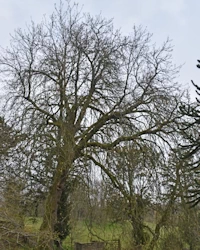

Aesculus hippocastanum
Horse chestnut
A relatively small specimen, which could eventually grow to 40 metres in height with a broad canopy. This is early spring, with the signature palm-like leaves emerging, alongside what will become a large spike of flowers.
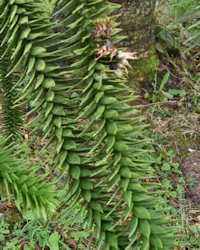
Araucaria araucana
Monkey puzzle
A native of Chile (a.k.a. Chilean Pine). Tough thick leaves are sharp - hence a puzzle for monkeys. Leaves can last 25 years, and trees for 1000 years.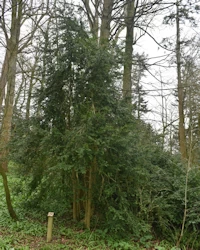

Buxus sempervirens
Common box
A large box shrub, allowed to grow beyond the usual tightly clipped topiary specimens we see in gardens. Showing its bright yellow small flowered spring blossom between the glossy leaves.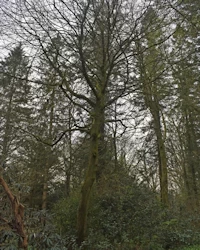
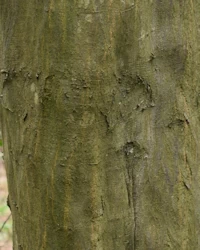
Carpinus betulus
Hornbeam
A deciduous, broadleaf tree. Pale grey bark with vertical markings, and sometimes a short, twisted trunk which develops ridges with age. Mature trees can reach a height of 30m and live for 300 years.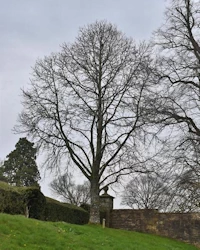
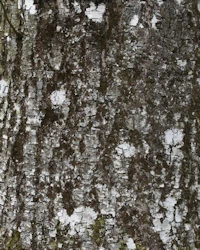
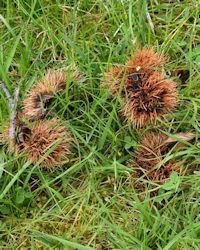
Castanea sativa
Sweet chestnut
A relatively young sweet chestnut growing at the top of the grass terrace. They can live for 700 years, and reach a girth of 2 metres.