×
![woodturning]()

Trees Gallery - Grizedale Forest
Southern Lake District
 April 2024
Grizedale Forest
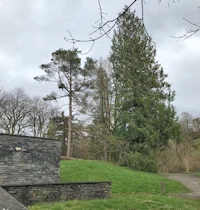
Forestry Engand have a visitor centre in Grizedale Forest, near Hawkshead, based around the remaining buildings and garden terrace of Grizedale Hall, which was built by Harold Brocklebank in 1905, passed to the Forestry Commission on his death in 1936, served as a Prisoner of War camp during WWII, and was demolished as too expensive to maintain in 1957. Numerous trails radiate from the Centre, and there is a small tree trail with some information boards.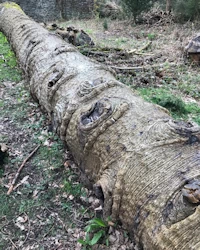 2 April 2024
Araucaria araucana araucaria - after a region of Chile; araucana - the native tribe who used the tree's seeds for food.
Monkey puzzle
A.k.a. monkey tail tree, pewen, pehuen pine or piñonero, an evergreen tree growing to 30–40 m, native to C and S Chile and W Argentina. It is on the IUCN list as endangered in its native region due to logging, forest fires, and grazing. It is usually dioecious male and female cones on separate trees . The male (pollen) cones are oblong and cucumber-shaped. It is wind pollinated. The bark can be up to 15 cm thick, possibly an adaptation to resist wildfires. Sadly this large specimen had been felled due to disease.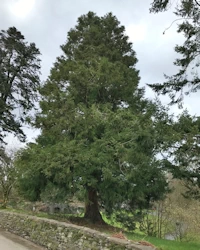 2 April 2024
 2 April 2024
 2 April 2024
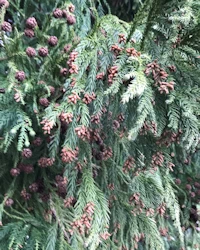
Cryptomeria japonica krypto - from Greek, hidden; meros - part; referring to the concealed reproductive parts japonica - of Japan.
Japanese cedar
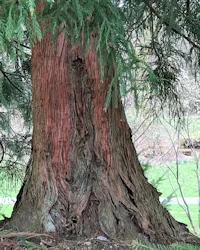
A.k.a. Japanese redwood, a very large evergreen tree native to Japan, reaching up to 70 m with 4 m trunk diameter. It is superficially similar to the related giant sequoia (Sequoiadendron giganteum), from which it can be differentiated by the longer leaves and smaller cones , and the harder bark on the trunk (thick, soft and spongy in giant sequoia).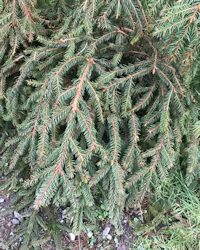 2 April 2024
Picea abies picea- from Latin pix - pitch, meaning pitch pine, abies - from the Latin for fir tree, referring to the tree's original classification or similarity to a fir
Norway spruce
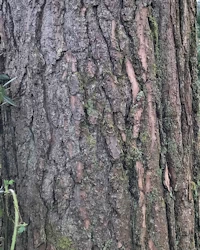
A fast-growing evergreen conifer which can reach 40m and live for up to 1,000 years. They are tall and straight and of a triangular appearance, with a pointed crown. The young bark is a coppery grey-brown and appears smooth, but is rough with papery scales. Mature trees have dark purple-brown bark, with cracks and small plates. Twigs are orange-brown, grooved and hairless. Male flowers consist of clusters of stamens, which turn from red to yellow in spring when laden with pollen. Female flowers are red, upright and oval, and tend to form at the top of the tree. Once pollinated by wind, female flowers turn green and enlarge to become red-brown cones with diamond-shaped, rounded scales. Seeds are released in spring. [Woodland Trust]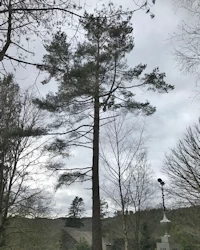 2 April 2024
 2 April 2024
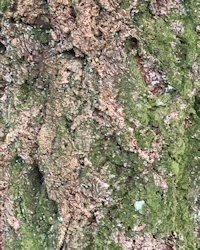
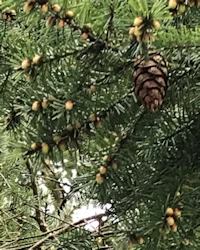
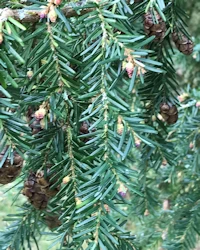
Pinus sylvestris pinus- Latin for pine silva - woodland or forest, reflecting the tree's habitat.
Scots pine
An evergreen conifer native to northern Europe. Mature trees grow to 35m and can live for up to 700 years. The needle-like leaves are blue-green and slightly twisted, and grow in pairs on short side shoots. Scots pine is monoecious both male and female flowers grow on the same tree. Male flowers comprise clusters of yellow anthers at the base of shoots. Female flowers are small, red-purple and globular, and grow at the tips of new shoots. [Woodland Trust]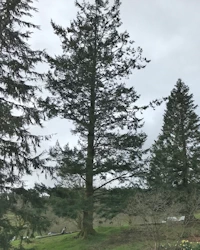 2 April 2024
 2 April 2024
 2 April 2024
 2 April 2024
Pseudotsuga menziesii pseudo - Greek for false; tsuga - hemlock - the tree resembles hemlock but isn't hemlock menziesii - after Archibald Menzies, a Scottish naturalist and physician who first documented the tree on Vancouver Island in 1791
Douglas Fir after David Douglas, another Scottish botanist who collected and sent seeds of the tree back to Britain in 1827.
A tall, conical-shaped evergreen conifer that can grow to 55m and live for more than 1,000 years, native to W North America. The scales on cones are distinctive, with three pointed tips. When crushed, the leaves have a sweet resin smell. Its bark is non-flammable, offering good resistance to forest fires.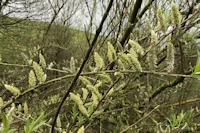 2 April 2024
 2 April 2024
Salix viminalis Salix - Latin for willow. vimen - meaning 'wicker' or 'withes', referring to the long, flexible shoots characteristic of this tree.
Osier
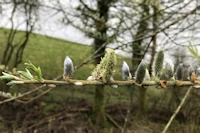
A.k.a. basket willow or common osier, a multistemmed shrub native to Europe, Western Asia, growing 3 to 6 m. It has long, erect, straight branches with greenish-grey bark. The leaves are 10–25 cm long, but very narrow; dark green above, with a silky grey-haired underside. 2 April 2024
 2 April 2024
 2 April 2024
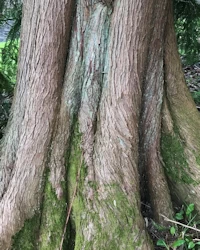
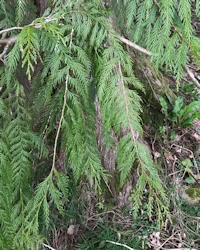
Sequoiadendron giganteum Sequoia - probably relating to the cherokee tribe, possibly from Latin sequoia, relating the sequence of seeds per cone; dendron - tree; giganteum - giant.
Giant redwood
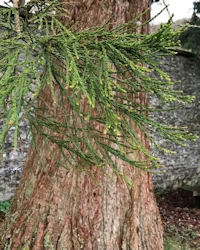
Giant Redwood is arguably the world's most impressive tree. It is the largest tree by volume and can live for more than 3000 years. Publication of its discovery in the Sierra Nevada. California, in 1852 caused a sensation. The first seed to reach Europe arrived in Scotland in August 1853 with John Matthew, narrowly beating a consignment for Veitch Nurseries in Exeter. The main use of this tree is as a grand specimen, but some experimental forestry has been conducted in Britain.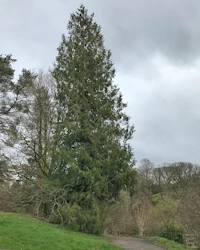 2 April 2024
 2 April 2024
 2 April 2024
Thuja plicata thuia - from Greek, a name for an aromatic evergreen wood. plicare - from Latin, meaning folded or pleated, referring to the arrangement of the scale-like needles on the branches.
Western red cedar
A large to very large tree, ranging from 45 to 70 m. It can live well over a thousand years, with the oldest verified aged 1,460. The cones are slender, up 18 mm long, and 5 mm broad. They are green to yellow-green, ripening brown in autumn about six months after pollination, and open at maturity to shed the seeds.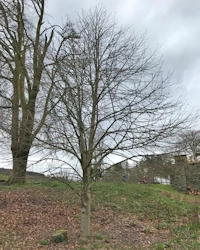 2 April 2024
Tilia cordata tilia - from the Latin for linden or lime tree; cordata - from Latin, meaning heart shaped.
Small leaved lime
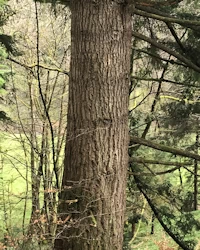
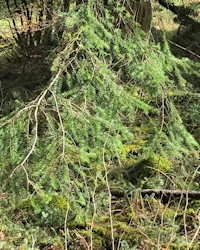
Difficult enough to distinguish from other limes even with its leaves on, but this one had an information board on the Grizedale Tree ID Trail. This gives its Latin and English names, states its origin as Europe, and its eventual height as 20 m. Timber uses are for piano keys and sounding bards, woodturning and carving. Under "Did You Know?" it mentions that " the tree has no relation to the citrus fruit but has often been planted for shade and shelterbelts. It was also planted along village streets to protect against evil spirits!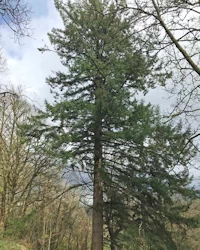 2 April 2024
 2 April 2024
 2 April 2024