×
![woodturning]()

Trees Gallery - Wray Castle
Lake District
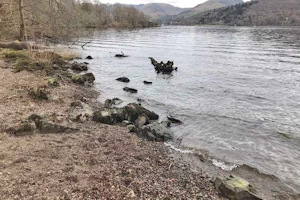 Lake Windermere
Wray Castle
Wray Castle is a National Trust property on the West shore of Lake Windermere. It has large grounds leading down to the lake, including a Specimen Tree Trail with a dozen mature, large, unusual trees (not all of which I managed to photograph, not having found the Tree Trail leaflet in time.). Many of the trees were planted by the Dawson family in the 1860s. Wray Castle is accessed down narrow lanes, and can be a bit tight for parking.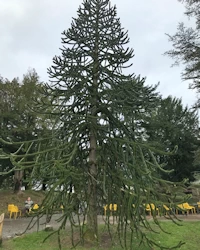 4 April 2024
Araucaria araucana araucaria - after a region of Chile; araucana - the native tribe who used the tree's seeds for food.
Monkey puzzle
A.k.a. monkey tail tree, pewen, pehuen pine or piñonero, an evergreen tree growing to 30–40 m, native to C and S Chile and W Argentina. It is on the IUCN list as endangered in its native region due to logging, forest fires, and grazing. It is usually dioecious male and female cones on separate trees . The male (pollen) cones are oblong and cucumber-shaped. It is wind pollinated. The bark can be up to 15 cm thick, possibly an adaptation to resist wildfires. This specimen is abut 50 years old.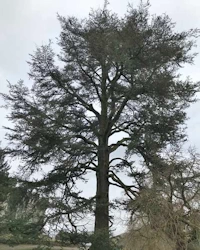 4 April 2024
 4 April 2024
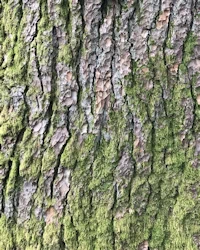 4 April 2024
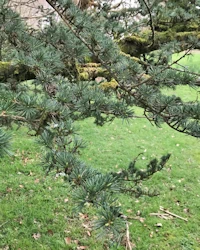
Cedrus atlantica glaucacedrus - from Greek kedros, cedar; atlantica - from Latin, 'from the Atlas Mountains'
Altas cedar
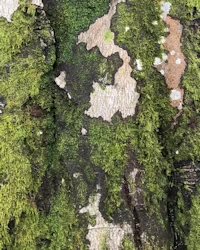
A large coniferous evergreen tree, 30 to 35 m, with a trunk diameter of 1.5 to 2 m. A native of the Rif and Atlas Mountains of Morocco and Algeria. It is very similar to the other true cedars; some authorities consider it a subspecies of c. libani; others rank it as a distinct species. This glaucous variety has a blue tinge to the needles.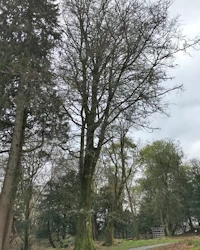 4 April 2024
 4 April 2024
Fagus sylvatica - from Greek phagein beech tree meaning to eat, possibly referencing the edible beech mast; silva - from Latin, indicating a tree that grows in the woods; cristata - Latin for crested or tufted, describing the curled and ruffled leaves that resemble a cock's comb. cristata
Cock's Comb Beech
A.k.a. crested beech, a slow-growing, small cultivar of European Beech. It is characterized by its distinctive, small, green, irregularly dissected and curled leaves that grow densely at the branch tips. It develops a broad, fan-shaped crown, reaching 10m. This specimen is the largest of its type in Britain.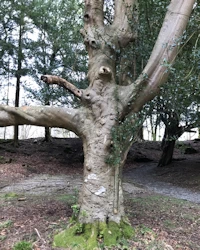 4 April 2024
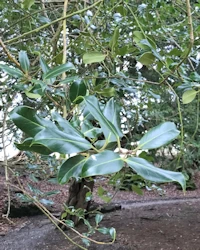 4 April 2024
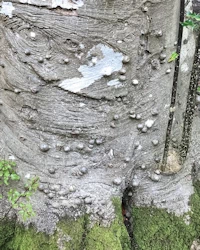 4 April 2024
Ilex aquifolium ilex : - holm oak; aquifolium - acus 'needle', folium, 'leaf'
Holly
One of very few native British hardwood evergreen trees. It can exceed 10 m in height, but is more often 2–3 m. It can live 500 years, but usually does not reach 100. The flowers are white, four-lobed, and pollinated by bees. Holly is dioecious there are male plants and female plants , with fruits only appearing on female plants, which require male plants nearby to fertilise them. The fruit is a bright red (or yellow) drupe stone fruit .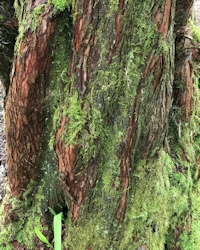 4 April 2024
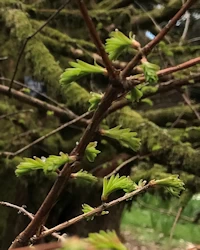 4 April 2024
Metasequoia - meta - changed or transformed; so the genus name means like a sequoia glyptostroboides - oides is a Greek suffix meaning resembling, so the tree resembles glyptostrobus, the Chinese swamp cypress (glypto - carved, grooved, strobus - cone).
Dawn redwood
A vigorous, fast-growing deciduous conifer with fibrous, orange-brown bark, making a large, narrowly conical tree to 25m tall. The globose pollen cones are 5–6 mm long, produced on long spikes in early spring, but only on trees growing in regions with hot summers. Older trees may form wide buttresses on the lower trunk, and distinctive "armpits" under each branch. The bark is vertically fissured and tends to exfoliate in ribbon-like strips.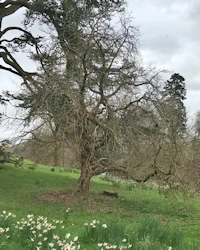 4 April 2024
 4 April 2024
Morus nigra Morus Latin for mulberry; nigra - Latin for black, referencing the dark purple or black color of the mulberry fruit.
Black mulberry
A deciduous tree growing to 12 m, originating in Mesopotamia and Persia, but cultivated across Europe and Asia. The richly flavoured fruit is a compound cluster of several small drupes that are dark purple, almost black when ripe, 2.5 cm in diameter.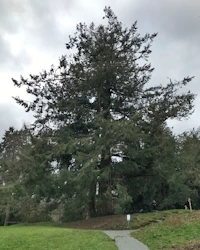 4 April 2024
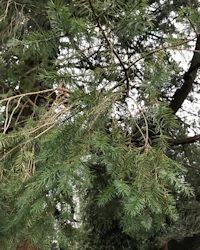 4 April 2024
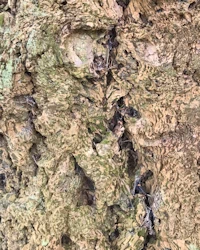 4 April 2024
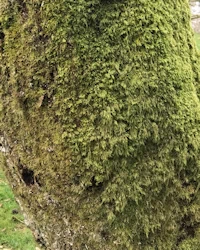
Pseudotsuga menziesii pseudo - Greek for false; tsuga - hemlock - the tree resembles hemlock but isn't hemlock menziesii - after Archibald Menzies, a Scottish naturalist and physician who first documented the tree on Vancouver Island in 1791
Douglas Fir after David Douglas, another Scottish botanist who collected and sent seeds of the tree back to Britain in 1827.
A tall, conical-shaped evergreen conifer that can grow to 55m and live for more than 1,000 years, native to W North America. The scales on cones are distinctive, with three pointed tips. When crushed, the leaves have a sweet resin smell. Its bark is non-flammable, offering good resistance to forest fires.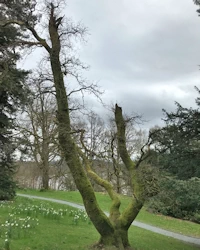 4 April 2024
 4 April 2024
Quercus robur quercus - Latin name for oak, derived from the Proto-Indo-European root kwerkwu; robur - Latin for robust or strong, referencing the tree's sturdiness; variegata - variegated (leaves). variegata
Variegated oak
The Specimen Tree Trail notes say: This tree was planted by the Dawson’s and is around 160 years old. It suffered some damage in Storm Arwen in 2021 and has looked a little worse for wear over the past two years but seems to be recovering. This is a cultivated form of the Common Oak. 4 April 2024
 4 April 2024
 4 April 2024
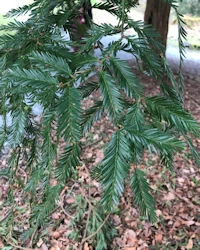
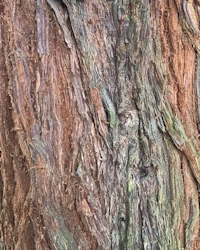
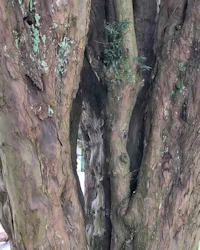
Sequoia sempervirens sequoia - ossibly a tribute to Sequoyah, the Cherokee scholar who invented the Cherokee writing system; semper - from Latin, meaning always; virens - green, indicating it is an evergreen.
Coast redwood
A.k.a. California redwood. An evergreen, long-lived (1200 - 2200 years), monoecious tree. This species includes the tallest living trees on Earth, reaching up to 116 m, and 8.9 m in diameter. Coast redwoods have a conical crown, with horizontal to slightly drooping branches. The trunk is remarkably straight. The root system is composed of shallow, wide-spreading lateral roots. The species is monoecious, with pollen and seed cones on the same plant. 4 April 2024
 4 April 2024
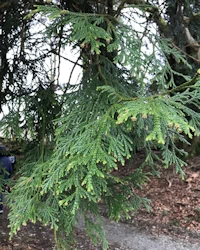
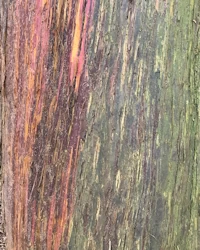
Taxus baccata taxua - probably from the Greek word taxon, meaning bow, referring to the us of yew for bow making; bacca - from Latin, meaning berry, referring to the tree's distinctive berry-like arils
Yew
A.k.a. common yew, European yew, or English yew. An evergreen tree native to Europe, NW Africa, and parts of SW Asia. The plant is poisonous, with toxins that can be absorbed through inhalation, ingestion, and transpiration through the skin. Consuming any part of the tree, excluding the aril, can be deadly and the consumption of even a small amount of the foliage can result in death.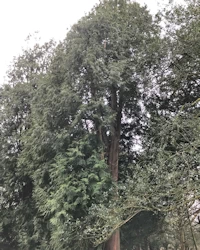 4 April 2024
 4 April 2024
 4 April 2024