×
![woodturning]()

Trees Gallery - Sizergh Castle
Southern Lake District
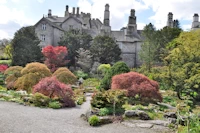 Rock garden 2017
Sizergh Castle
Sizergh Castle gardens are registered Grade II. There is a lake, a kitchen garden and a rock garden. The rock garden, constructed in the 1920s, is the largest limestone rock garden belonging to the National Trust, and has a number of mature acers and conifers. Sizergh houses part of the National Collection of ferns, which are to be seen in the rock garden, the stumpery and the orchard. We visited on a very wet day at the beginning of April, so did not venture far. Also there were no labels, apart from on the orchard trees, (come on NT - let's have more labelling!) so there is some guesswork on the photo descriptions below.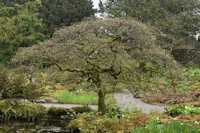 1 April 2024
 1 April 2024
 1 April 2024
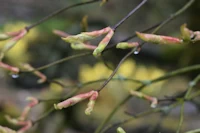
Acer palmatum acer - Latin for maple; palmatum - hand shaped - referring to the leaves having 5 lobes
Japanese maple
There are a number of mature Japanese maples in the gardens, mainly planted in the rock garden. Leaves were only just emerging on this 1 April visit, but even with the leaves unfurled it is usually difficult to identify the variety from the thousands which exist.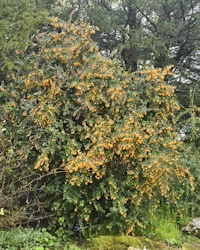 1 April 2024
 1 April 2024
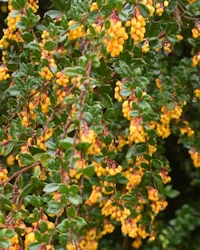
Berberis darwinii berberis - Latinised from the Arabic for the plant; darwinii - after Charles Darwin, who found the plant in South America
Darwin's barberry
An evergreen thorny shrub, native to S Chile and Argentina, growing to 3–4 m. It has dense branches from ground level. The flowers are orange, 4–5 mm long, produced in dense racemes a flower cluster with the separate flowers attached by short equal stalks at equal distances along a central stem. The flowers at the base of the central stem develop first 2–7 cm long in spring. The fruit is a small purple-black berry 4–7 mm diameter, ripening in summer. The berries are edible but are very acidic. It is regarded as invasive in New Zealand, and is naturalised in S Australia, and in California. 1 April 2024
 1 April 2024
 1 April 2024
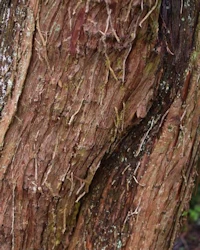
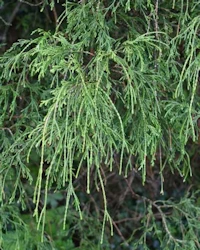
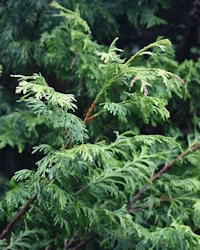
Chamaecyparis - from Greek chamai meaning on the ground or dwarf, . kuparissos - cypress; pisifera - pea-bearing. So, this is a small(ish) cypress tree with small round green cones. pisifera.
Sawara cypress
A slow-growing conifer which can grow to 35 m tall with a trunk up to 2 m in diameter. The foliage is arranged in flat sprays. The cones are globose, maturing in autumn about 7–8 months after pollination.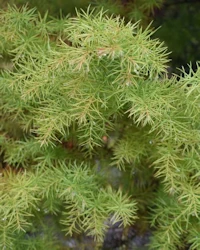 1 April 2024
Cryptomeria japonica krypto - from Greek, meaning to hide; meris - a part, referring to the concealed position of the reproductive organs; japonica - of Japan
Japanese cedar
This is probably c. japonica 'Elegans Compacta', a bushy, evergreen conifer to 2m, with horizontal branches and long, soft, feathery blue-green foliage in spring, turning green in summer then finally dark purple to red in the winter. 1 April 2024
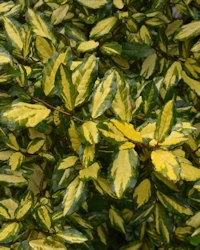 1 April 2024
Eleagnus pungenselaia - Greek for olive. abeo - to rise, to go up, agnos - possibly a type of willow; pungens - Latin for sharp or prickly, referring to the plant's spines; macula, meaning spot or blemish, describing the yellow spots on the leaves maculata
Oleaster maculata
A.k.a. thorny olive, spiny oleaster and silverthorn. A bushy evergreen shrub to 4m tall, native to Japan, with slightly spiny brown shoots bearing elliptical bright yellow leaves narrowly margined with dark green; small, fragrant white flowers in autumn.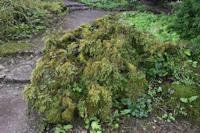 1 April 2024
 1 April 2024
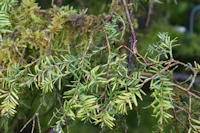
Juniperus communis Juniperus - derived from the Latin/Greek word for the tree; communis - common.
Common juniper
Highly variable in form, ranging from a small tree at 10 m, to a low, often prostrate spreading shrub. The bark is scaly and grey-brown with resin blisters. It is dioecious male and female cones on separate plants so requiring wind pollination to transfer pollen from male to female cones. Male trees or shrubs naturally live longer than female trees or shrubs; a male tree or shrub can live more than 2000 years. The fruit are berry-like cones known as juniper berries. They are initially green, ripening in 18 months to purple-black with a blue waxy coating; the seeds are dispersed by birds after eating the berries.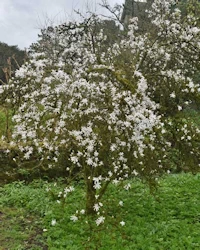 1 April 2024
 1 April 2024
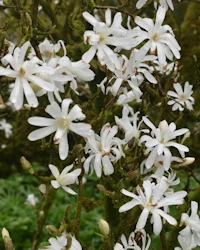
Magnolia stellata magnolia - from L. magnolia - in honour of Pierre Magnol, a 17th-century French botanist, stellata - star shaped
Star magnolia
A deciduous shrub or small tree native to Japan, growing up to 2.5 m. It bears large, showy white or pink flowers in early spring, before its leaves open. The leaves open bronze-green, turning to deep green as they mature, and yellow before dropping in autumn. The fruit is a reddish-green, knobby aggregate fruit about 5 cm long that matures in early autumn. Mature fruit opens by slits to reveal orange-red seeds. 1 April 2024
 1 April 2024
 1 April 2024
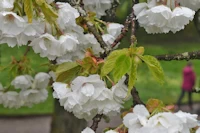
Prunus prunus - from Latin meaning plum tree.
Flowering cherry
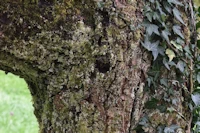
I am not sure of the variety of this flowering cherry, but in full bloom it was too good not to include. A small, deciduous tree, flowering cherries usually have simple, alternate, usually lanceolate, unlobed leaves. The flowers are usually white to pink, sometimes red, with five petals and five sepals. Numerous stamens are present. Flowers are borne singly, or in umbels of two to six or sometimes more on racemes. The fruit is a fleshy drupe a fleshy fruit with thin skin and a central stone containing the seed (a prune) with a single relatively large, hard-coated seed (a stone). [Wikipedia]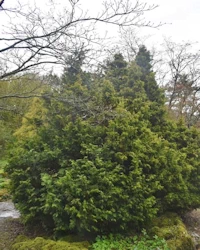 1 April 2024
 1 April 2024