×
![woodturning]()

Trees Gallery - Guernsey
Hedges on Herm
Return to the first hedging page showing hedges on Guernsey and Sark.
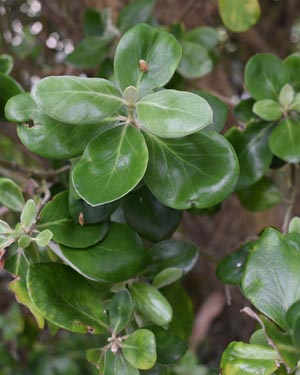
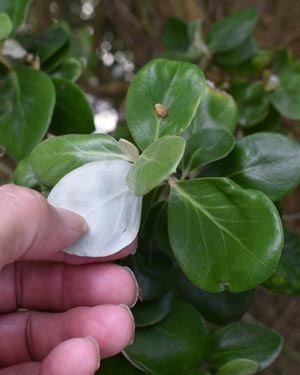
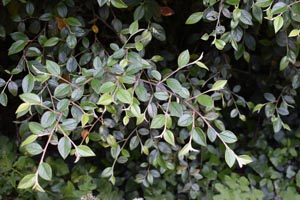
Coprosma repens
Tree bedstraw
A.k.a. taupata, , mirror bush, looking-glass bush, New Zealand laurel and shiny leaf. A native of New Zealand, it has been cultivated here in coastal gardens due to its resistance to salt spray, often s a windbreak to protect more tender plants. Prostrate in exposed situations, such as cliffs, but in more sheltered areas it can grow as a small tree up to 8 metres in height. It has naturalised on the Isles of Scilly, but not yet on the Channel Islands. It is classified as an environmental weed in Australia.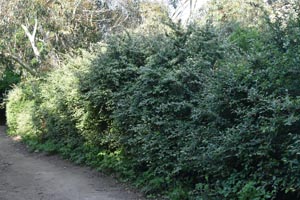
Cotoneaster (simonsii?)
Himalayan cotoneaster
One of the cotoneasters, probably c. simonsii. Growing as a substantial hedge by the side of the road leading up to Le Manoir on Herm. It was probably planted though possibly an escape sown by birds eating the bright red berries. It is a neophyte a plant not native to a region, introduced and escaped into the wild in recent history (after 1500). across much of Britain.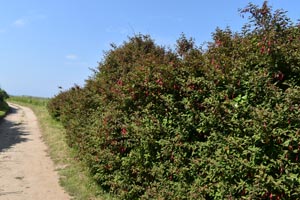
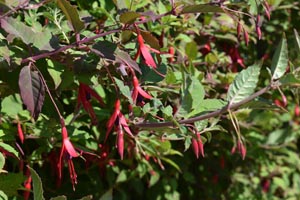
Fuschia magellanica
Hardy fuschia
A native of Argentina and Chile, this sub-shrub a dwarf shrub, especially one that is woody only at the base with long, arcuate shaped like a bow stems can grow to 3m in frost-free climates. They tolerate wind and coastal conditions, and can provide rabbit proof hedging. They can be allowed to reach their natural height and spread, as here, or can be pruned back with secateurs, or cut down to the ground and allowed to regrow.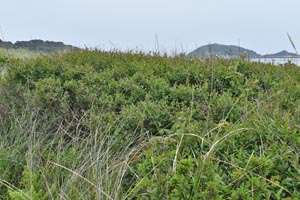
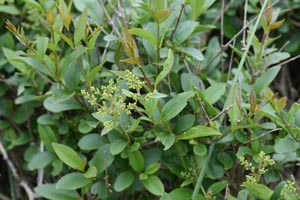
Ligustrum vulgare
Wild Privet
A British native, semi-evergreen shrub very commonly grown as hedging. Here it is spreading in a clump on the dunes to the north of Herm Island. Small white flowers are very pungent, attractive to bees and butterflies though not necessarily to humans.
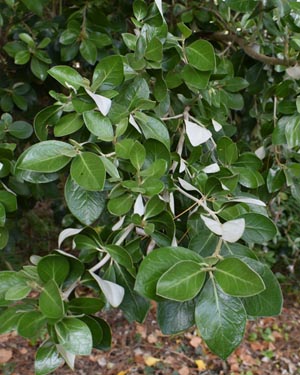
Olearia traversii
Daisy bush
A.k.a. akeake, a native of the Chatham Islands. A popular coastal hedging plant due its resistance in extreme conditions. Flower panicles 3 - 5cm long are produced during June in the leaf-axils and carrying usually five to twelve flower-heads, with five to fifteen dull greyish florets in each head.

Pittosporum crassifolium
Karo
A.k.a. stiffleaf cheesewood, kaikaro or kihiki, a relatively fast-growing large shrub or small tree native to New Zealand, capable of growing to 10m. During the spring to early summer, karo produce fragrant burgundy red flowers borne in terminal umbels they grow in clusters similar to the shape of an umbrella. These are followed by green capsules, that then develop into woody seed pods with black, sticky, shiny seeds.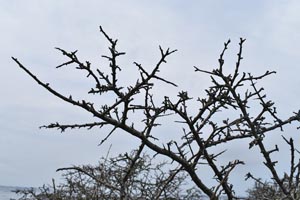

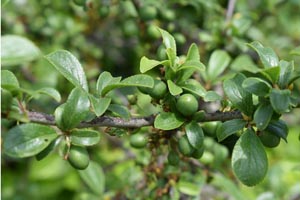

Prunus spinosa
Blackthorn
A.k.a. sloe, native to Europe, western Asia, and regionally in northwest Africa. The fruits are used to make sloe gin in Britain, and the wood to make walking sticks, and the Irish shillelagh. It can grow to 5m with blackish bark and dense, stiff, spiny branches. The and are hermaphroditic, and insect-pollinated. It is often intermingled with other hedging plants in hedgerows, forming an impenetrable spiky mass.

Quercus robur
Common oak
Normally a large tree, oak on the exposed coast of an island such as Herm can be shaped by the wind, stunted in growth to form a windbreak hedge.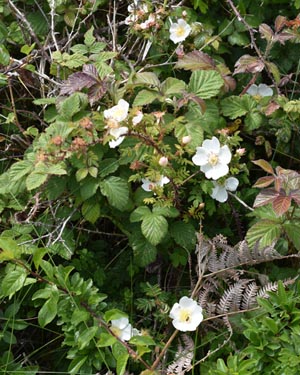

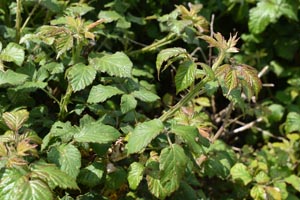
Rubus fruticosus
Bramble
Bramble grows through most hedges across the country, (including as an unwelcome visitor in my own garden), but here on Herm it has formed an entire hedgerow of some length.