×
![woodturning]()

Trees Gallery - La Seigneurie, Sark
Sark is an island about an hour's ferry ride from Guernsey, with high cliffs round a rugged coastline. There are no cars on the island, just tractors and horse-driven carriages. La Seigneurie is the home of the Seigneur of Sark, with a beautiful walled garden and grounds.
La seignurie is the home of the Lord, or Dame, of the island. There is an impressive garden there.
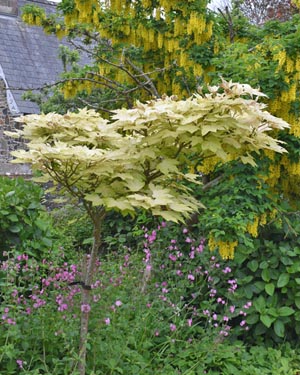
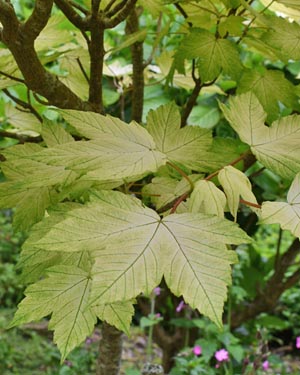
Acer pseudoplatanus brilliantissimum
Sycamore brilliantissimum
A small deciduous cultivar of a. pseudoplatanus, growing to 4m, with a rounded crown. The greenish yellow flowers are followed by winged red fruit in the autumn, though not in great quantity.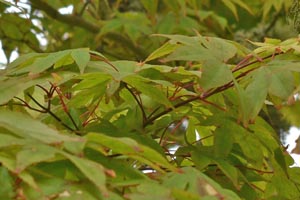
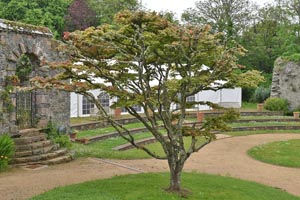
Acer palmatum
Japanese maple
A maple growing by the amphitheatre. I am uncertain of the variety, often the case with a. palmatum cultivars.
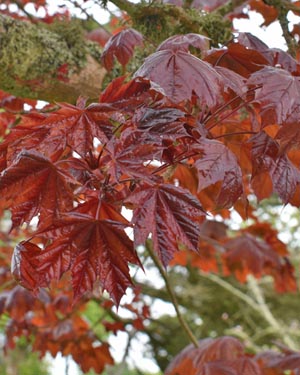
Acer platanoides Crimson King
Norway maple 'Crimson King'
A vigorous medium-sized purple maple, growing alongside the path bordering the east of the formal garden. Flowers are reddish-orange, appearing in clusters on leafless branches, followed by paired samaras with widely divergent wings, distinguishing them from those of sycamore.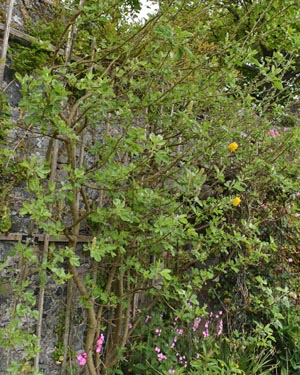

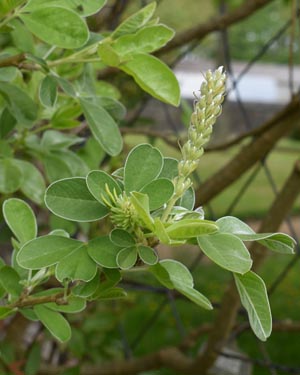
Argyrocytisus battendieri
Pineapple broom
A.k.a cytisus battandieri, silver broom and Moroccan broom, a large shrub or small tree growing to 4m. It appears to be completely hardy in our temperate climate. Large, cone-shaped, terminal racemes a flower cluster with the separate flowers attached by short equal stalks at equal distances along a central stem. The flowers at the base of the central stem develop first of pineapple-scented, deep yellow, pea-shaped flowers bloom late spring to early summer (June to early August). Flowers are followed by pea pod-like seed capsules which are covered with silver-gray hairs.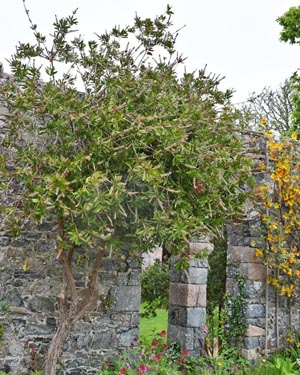
Callistemon rigidus
Stiff bottlebrush
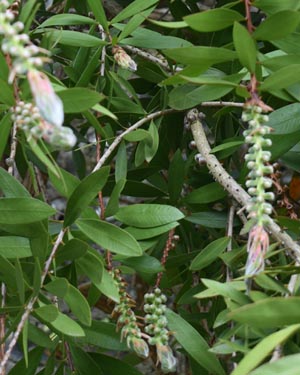
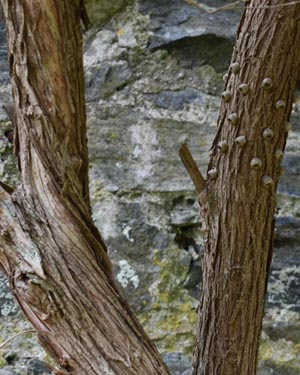
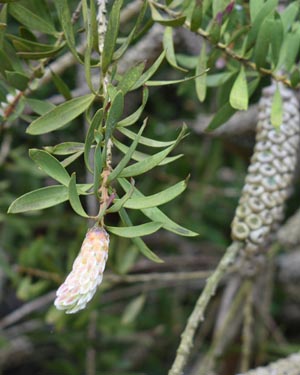
A bushy shrub native to Australia. A little early here (May) for the bright deep red flowers in spikes to 10cm long. A peculiarity of Callistemon (and of Melaleuca) is that the growing-point does not abort after flower production but grows on beyond the inflorescence to produce further stem, leaf, and, in due season, flower. A tender plant, benefitting from the increasingly warmer climate across the UK.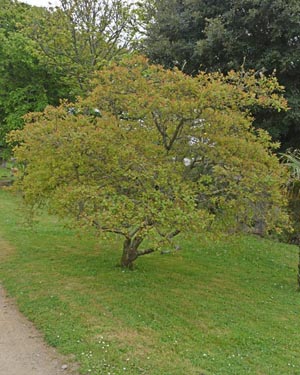


Cotinus coggygria
Smoke bush
A.k.a Venetian sumach or dyer's sumach, a Eurasian multiple-branching deciduous shrub growing to 5–7 metres, with an open, spreading, irregular habit, only rarely forming a small tree. The flowers are numerous, produced in large inflorescences each flower 5–10mm in diameter, with five pale yellow petals. Most of the flowers in each inflorescence abort, elongating into yellowish-pink to pinkish-purple feathery plumes which have a wispy 'smoke-like' appearance, hence the common name.
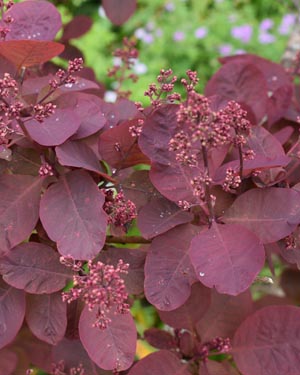
Cotinus coggygria Royal Purple
Purple smoke bush
A purple cultivar with ruby red leaves. Apart from the colour many of the species characteristics are retained - in July and August, it is festooned with fluffy plumes of purplish-pink flowers that look like a haze of smoke.

Crataegus laevigata (Paul's scarlet?)
Red hawthorn
The Midland hawthorn can have white or pink-red flowers; cultivars have been developed to emphasise the red colouring. A small, rounded deciduous thorny tree with lobed, glossy leaves and fully double, light red flowers which appear in spring. These are followed by orange-red berries in the autumn.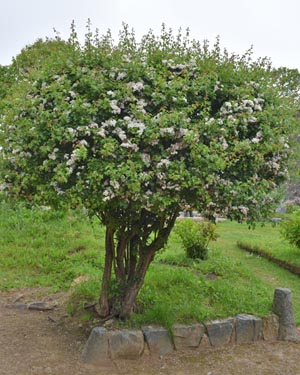
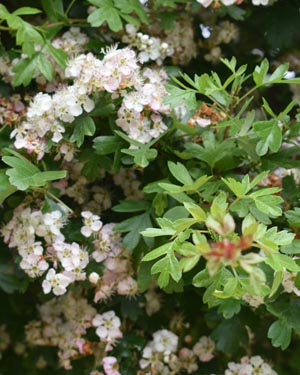
Crataegus monogyna
Hawthorn
Mature trees can reach a height of 15m and are characterised by their dense, thorny habit, though they can grow as a small tree with a single stem. The bark is brown-grey, knotted and fissured, and twigs are slender and brown and covered in thorns. It often hybridises with the UK’s other native hawthorn, Midland hawthorn (c. laevigata). Both species are similar and can be hard to tell apart.