×
![woodturning]()

Trees Gallery - Herm
Sark
Sark is an island about an hour's ferry ride from Guernsey, with high cliffs round a rugged coastline. There are no cars on the island, just tractors and horse-driven carriages. La Seigneurie is the home of the Seigneur of Sark, with a beautiful walled garden and grounds.
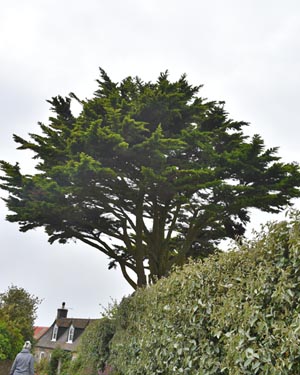
Cupressus macrocarpa
Monterey cypress
A.k.a. Hesperocyparis macrocarpa, a medium-sized coniferous evergreen tree to 40m, which often becomes irregular and flat-topped as a result of the strong winds, being regularly planted in coastal areas as a shelterbelt tree. The foliage grows in dense sprays which are bright green in color and release a deep citrus aroma when crushed. Seed cones are globose, 20–40 mm, green at first, maturing to brown about 20–24 months after pollination.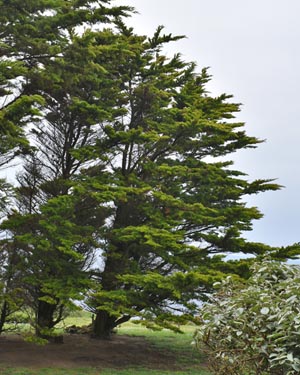
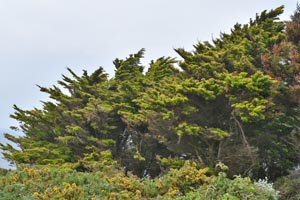
Cupressus macrocarpa (Goldcrest?)
Golden Monterey cypress
A good coastal conifer, grown either as a hedge or as a specimen tree. The stand pictured here may well be a hedge that has outgrown its original purpose. Developed in Truro in the 1940s, it likes sunshine on its sprays of bright yellow foliage.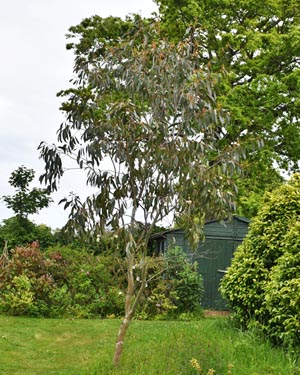
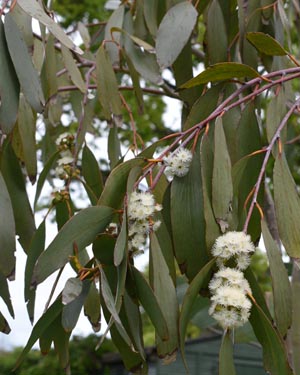
Eucalyptus (pauciflora?)
Snow gum
A.k.a. cabbage gum or white sally. The owner of a garden on the Rue de la Seignuerie kindly had a sign out inviting people to have a look around. THere were a number of interesting plants, and trees, in the garden. This young eucalyptus was one such. I think it is a snow gum, which might eventually reach 20m.
Fraxinus excelsior
Ash
An unusual ash tree at Stocks Hotel, with the trunk splitting into multiple tems at around 2m, probably due to some injury or pruning back in the past. A little straggly with perhaps some early signs of die-back on some of the branches. Ash dieback (Hymenoscyphus fraxineus) is a fungus which originated in Asia. It doesn’t cause much damage on its native hosts of the Manchurian ash (Fraxinus mandshurica) and the Chinese ash (Fraxinus chinensis) in its native range. However, its introduction to Europe about 30 years ago has devastated the European ash (Fraxinus excelsior) because our native ash species did not evolve with the fungus and this means it has no natural defence against it. [Woodland Trust]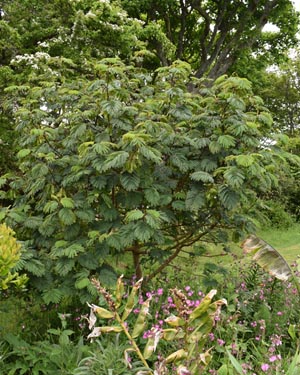

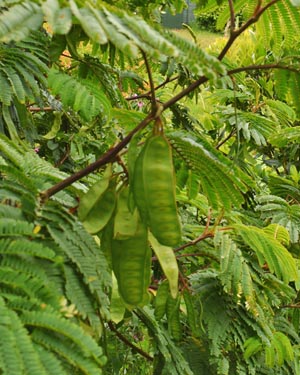
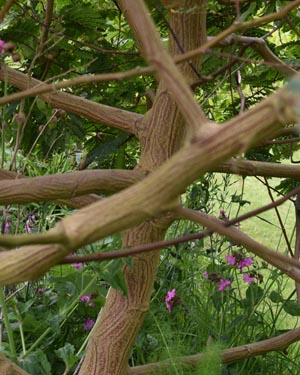
Paraserianthes iophantha
Cape wattle
A.k.a. Cape Leeuwin wattle, Bicol wattle, crested wattle or plume albizia. Native SW Australia, Java and Sumatra, a semi-deciduous tender shrub or small tree growing to 5 - 15m, with a spreading crown and a straight bole which can be up to 30cm in diameter. Fast growing, it is considered a weed in the parts of Australia where it is not indigenous, as well as in New Zealand, South Africa, the Canary Islands, the Philippines and Chile. The tree is sometimes harvested from the wild for local use of its edible seed.
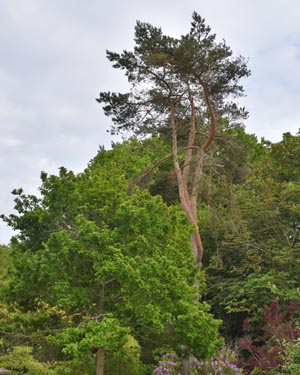
Pinus sylvestris
Scots Pine
One of only three native conifers to the UK the others being yew and juniper , and our only native pine. An evergreen conifer native to northern Europe. Growing to 35m, they can live for up to 700 years. The bark is a scaly orange-brown, which develops plates and fissures with age. Twigs are green-brown and hairless.The needle-like leaves are blue-green and slightly twisted, and grow in pairs on short side shoots.
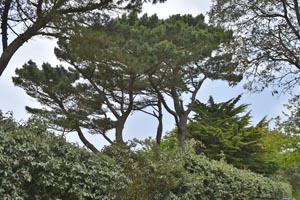
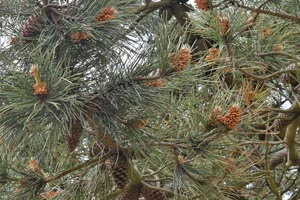
Pinus radiata
Monterey pine
, A.k.a. pinus insignis, insignis pine or radiata pine. A native of thc Central coast of California and Mexico (on Guadalupe Island and Cedros island). A fast growing conifer, extensively cultivated as a plantation timber in many temperate parts of the world (marketed in the timber trade when chemically treated with preservatives as Accoya). Growing to 30m in the wild, up to 60m in cultivation. Used widely as a shelter belt tree, often sacrificially, along coastal areas. Its cones are serotinous they remain closed until opened by the heat of a forest fire; the abundant seeds are then discharged to regenerate on the burned forest floor. .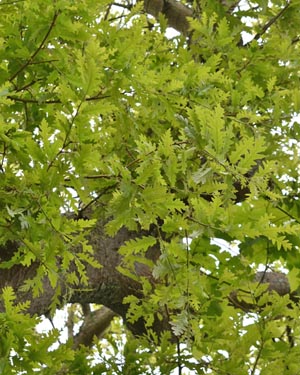
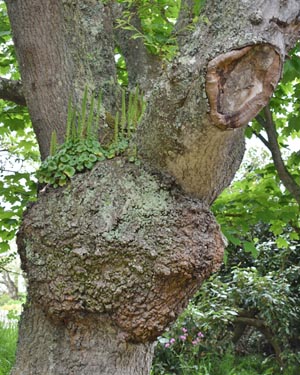
Quercus cerris
Turkey oak
I think this is a large turkey oak growing at the side of the Rue de la Seignurie on Sark. Probably planted as a quick growing specimen, but turkey oaks have naturalised across most of the UK, and certainly across Guernsey and the smaller islands.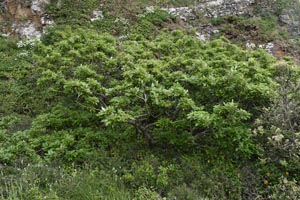
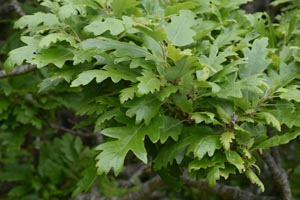
Quercus cerris
Turkey
I think this is a turkey oak, either planted or escaped to a wild area by the Window in the Rock, high on a cliff on the west side of Sark. With height stunted due to coastal winds it has instead grown outwards forming a dense, thick shrub-like tree.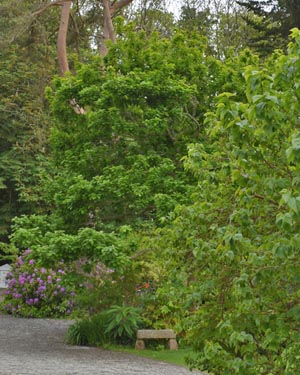
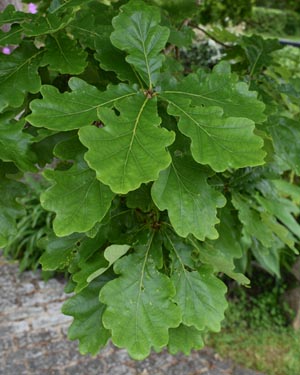
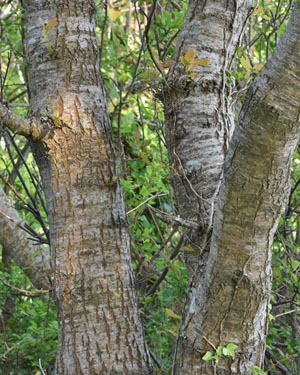
Quercus robur>
English oak
A.k.a. common oak or pedunculate oak (due to acorns being borne on peduncles a stalk bearing a flower or fruit ). A large, deciduous tree growing 20 to 40m. It forms a broad, spreading crown with sturdy branches beneath. Acorns are 2–2.5cm long, on long stalks and in cupules a small cup that holds and protects the fruit during its growth and maturation . As it ripens, the green acorn turns brown, loosens from the cupule and falls to the canopy below, sprouting the following spring. [Woodland Trust]
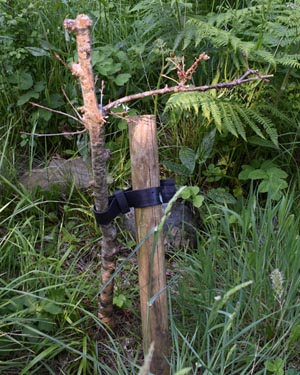

Quercus spp.
The Cassino oak
A couple of hundred yards up the road from Stocks Hotel is a plaque commemorating Operation Basalt, a raid on Sark by a British commando group while Sark was under German occupation. An oak sapling was planted on the 80th anniversary (2022), raised from an acorn from Cassino in Sicily. Sadly it has not survived, leaving the memorial plaque as something of a mystery to passers by, though there is a fine native oak just to the right of the plaque.
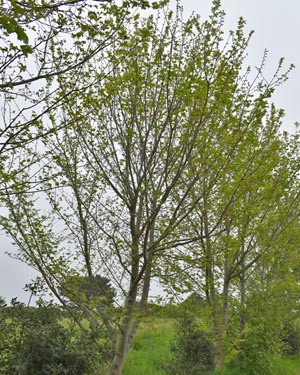
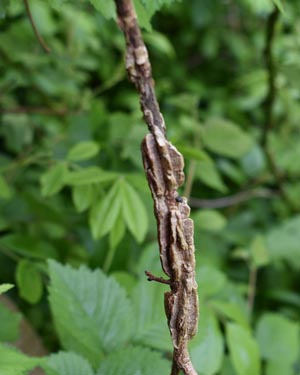
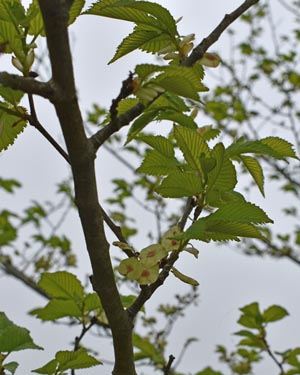
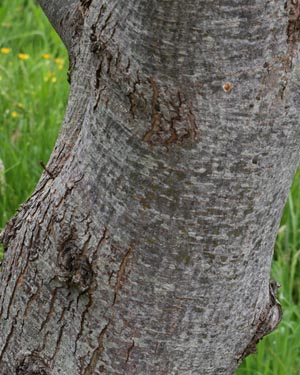
Ulmus (glabra?)
Wych elm ?
These are probably wych elms growing by the roadside on Sark. Trees can grow to a height of 30m. Flat-barked twigs are dark grey and covered in coarse hairs, and leaf buds are hairy, purple-black and squat in shape. In winter bud and twig are densely covered in orange hairs.