×
![woodturning]()

Trees Gallery - Herm
Herm
Herm is the smallest of the islands, and has the gentlest coastlines with long unspoilt beaches and bays. No cars and no crowds, a half hour ferry ride from Guernsey. The whole island is run by Herm estate: the estate manager, Lee Stewart, kindly helped me with a few identifications He told me that they have a lot of Australian and South African plants on the island.
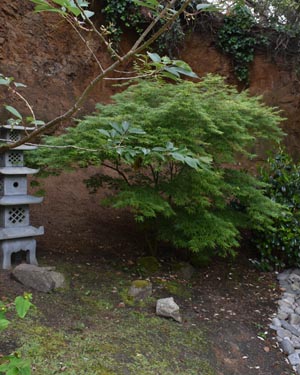
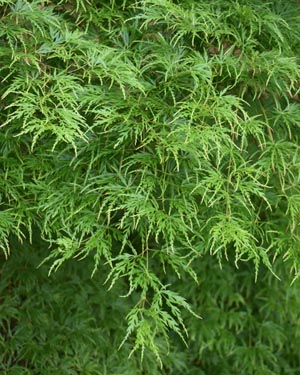
Acer palmatum dissectum
Japanese maple
A low-growing, mound-forming shrub to around 2m tall and 2.5m wide. Its deeply-cut leaves emerge green in the spring before turning shades of yellow, orange and red in the autumn. Purplish-red spring flowers are followed in autumn by bright red winged fruits ( samaras a winged achene, a type of fruit in which a flattened wing of fibrous, papery tissue develops from the ovary wall. )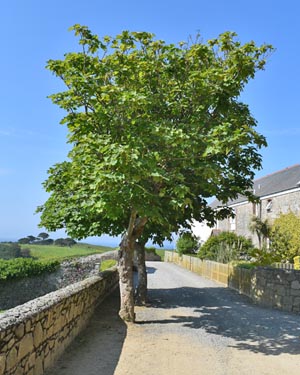

Acer pseudoplatanus
Sycamore
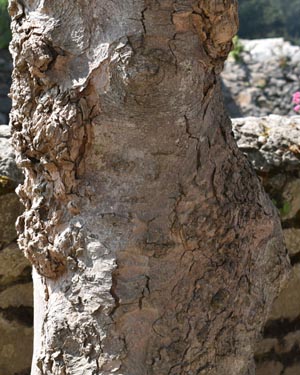
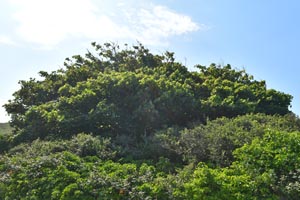
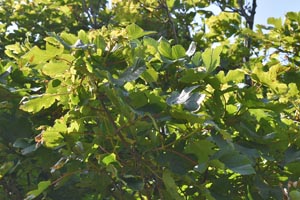
Sycamore is native to C, E and S Europe. It is thought to have been introduced to the UK by the Romans, though possibly later in the Tudor era. Earliest reports of the species naturalising in the UK date from the mid-1800s. The seed is extremely fertile, so sycamore has spread quickly across the UK and colonised many woodlands to the detriment of native species.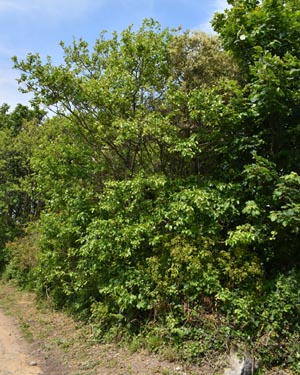

Alnus cordata
Italian alder
A native of Italy, Sicily and Corsica, a medium-sized tree growing to 25m, with a trunk up to 1m in diameter. Slender cylindrical male catkins are pendulous, reddish and up to 10cm long. Female catkins are ovoid, dark green to brown, hard, woody, and develop into pseudo-cones. The small winged seeds disperse by wind and through the winter. Growing along riversides it will often give rise to four to six stems, which fan out from vertical. In open meadows near rivers, marshy ground and flooding can cause trees to angle or tilt over, whereupon over a matter of seasons they grow natural bends to return the upper trunk to vertical. In groves of multiple trees they grow thinner and straighter. [Wikipedia]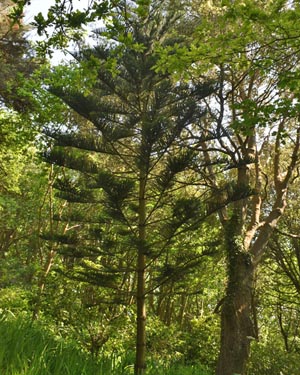

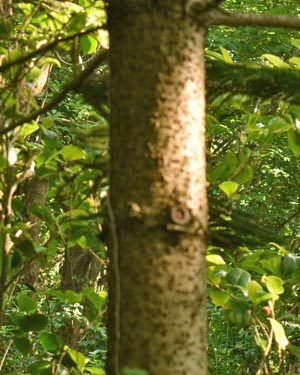
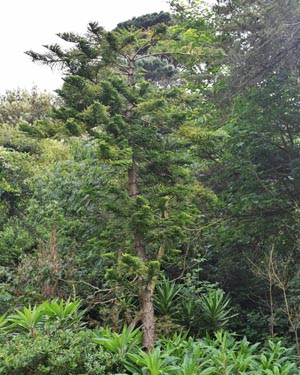
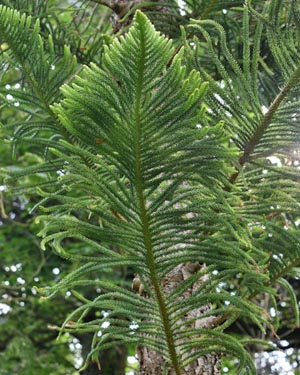
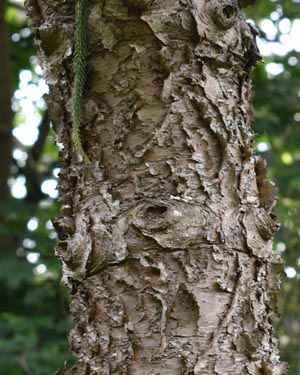
Araucaria heterophylla
Norfolk Island Pine
A native of Norfolk Island, an Australian external territory. The tree is slow growing and can reach a height 65m, with straight vertical trunk and symmetrical, almost horizontal branches. The plane of each floor of branches is a perfect pentagon. Cones disintegrate to release nut-like edible seeds. It is usually dioecious male and female flowers in different plants , although it can also be monoecious.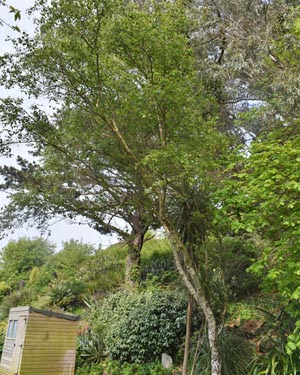
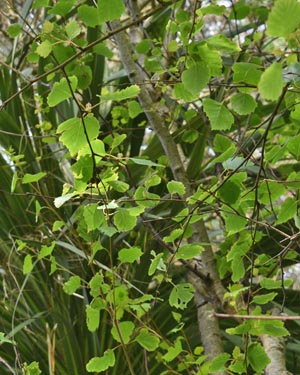
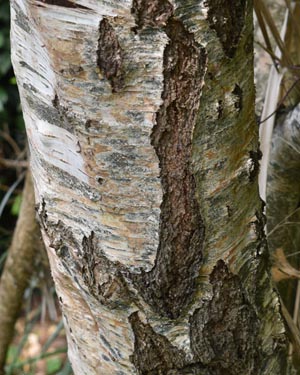
Betula pendula
Silver birch
A medium-sized deciduous tree, growing to 30m, forming a light canopy with elegant, drooping branches. The flowers are catkins and the light, winged seeds get widely scattered by the wind. The silver birch is a hardy tree, a pioneer species, and one of the first trees to appear on bare or fire-swept land. Its timber is used for forest products such as joinery timber, firewood, tanning, racecourse jumps, and brooms. Various parts of the tree are used in traditional medicine.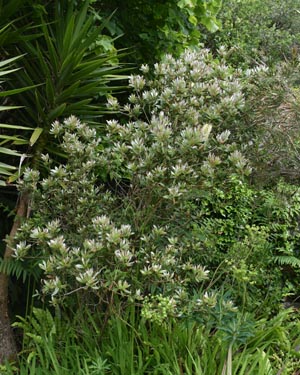
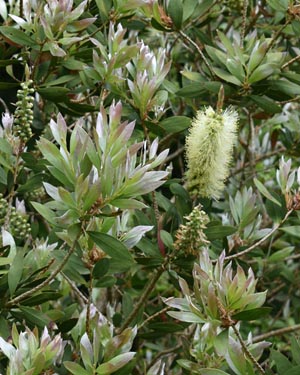
Callistemon pallidus
Lemon bottle brush
An erect or spreading evergreen shrub, 2-4m high, with numerous slender branches. The young shoots are silvery or red and covered in silky hairs, as well as narrowly-elliptic, grey-green or dark green, leaves up to 10cm long. Cream or pale yellow flowers, in semi-open "bottlebrush" spikes 10cm long, appear from late spring to midsummer, followed by woody fruit capsules which may persist for several years. [RHS]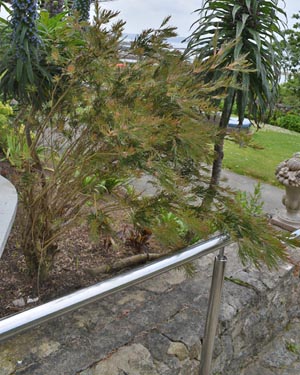
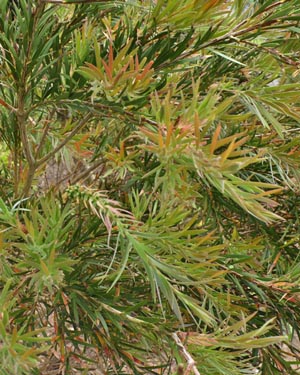
Callistemon rigidus
Bottle brush
Native to sandy areas of W Australia. A bushy, upright evergreen shrub with slightly arching branches. Flowers appear in late spring and early summer as dense spikes of bright deep red blooms, resembing a bottle brush.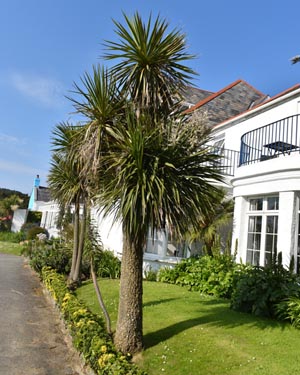
Cordyline australis
Cabbage tree
A widely branched monocot grass or grass like flowering plants tree endemic to New Zealand. It grows up to 20m with a stout trunk and sword-like leaves, which are clustered at the tips of the branches and can be up to 1m long. Maoris used it as a source of food, and it provided durable fibre for textiles, anchor ropes, fishing lines, baskets, waterproof rain capes and cloaks, and sandals. Before it flowers, it has a slender unbranched stem. After the first flowering, it divides to form a much-branched crown with tufts of leaves at the tips of the branches. Each branch may fork after producing a flowering stem.

Cotinus coggygria (RoyalPurple?)
Smoke bush
A cultivar of the species native to Europe and Asia. It is a multiple-branching deciduous shrub growing to 7m, spreading, irregular habit, only rarely forming a small tree. The leaves are 3–8 centimetres (1+1⁄4–3+1⁄4 inches) Flowers are numerous, produced in large inflorescences up to 30cm long; most of the flowers in each inflorescence abort, elongating into pinkish-purple feathery plumes which give it the common name.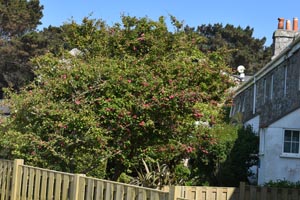

Crataegus laevigata (Paul's Scarlet?)
Red May tree
A.k.a. Hawthorn 'Paul's Scarlet', Double Crimson Hawthorn. A spectacular small tree capable of reaching 5m in 20 years. It produces masses of deep scarlet-pink, double flowers in May and attractive small red haws in the autumn. The deeply lobed foliage is dark-green with a slight gloss, turning yellow and bronze for autumn. [Ornamental Tree Nurseries].